A formidable patriarch resisting change, an old family business being run out of a decrepit building at a bustling metropolitan city location, and a young and eager protagonist who dreams of transforming the company — the story of Harsh Mariwala and the making of Marico has all the elements of a Bollywood blockbuster. In the initial days in this narrative, Homi Mulla plays an important supportive role, similar to that of an Alfred to Batman or Dr Watson to Sherlock Holmes.
Mulla, then 33, was working as a director of personnel and administration (today’s HR department) when he met Mariwala, the scion of an edible oil business, at the Royal Willingdon Sports Club in South Mumbai.
“It is often perceived that we started as friends and then I became his facilitator, but it was exactly the other way around,” recalls Mulla, now 73.
Mariwala was having trouble finding the right people to help him scale the consumer oil division of Bombay Oil Industries, and he approached Mulla at the club. Mulla, who was already moonlighting, offering his services to another honcho, was roped in by Mariwala at a fee of Rs 1,000 for half a day.
“Remember, this was the 1970s,” Mulla says. The Rs 1,000 fee was a hefty payout in 1978.
The years that followed saw the formation of three divisions at Bombay Oil Industries Ltd (BOIL), one of which was a consumer products unit overlooked by Harsh Mariwala.
The problem of an old, rundown buildingMariwala had identified the potential in Parachute and Saffola—being sold in bulk and unbranded form then—and this had given him what he calls a ‘business direction’. He introduced packaging innovations and started using plastic instead of tin.
“Tin is inconvenient to use because you have to dip your fingers (in) to take out coconut oil or through a spoon, and then tin is not as attractive on the shelves compared to plastics, and number three plastics are cheaper than tin,” says Mariwala.

However, as Mariwala tried to grow his business, he had an unusual roadblock in front of him: Kanmoor House.
The old office built by Mariwala’s grandfather in the bustling Masjid Bunder area of South Bombay was a deterrent for prospective employees, especially the ones being considered for senior roles. The hiring of professionals was instrumental to Mariwala’s plan of scaling up the business.
“Harsh was ashamed of the office, and most of our meetings happened at his flat,” recounts Mulla.
"Once I insisted on going to the office. As we walked to the places after parking our car, sugar and flour poured over us from all around as labourers moved around gunny bags,” Mulla says.
Mulla advised Mariwala to move the office if he wanted to attract good talent. The duo’s vision was to set up an office at sought-after Nariman Point. A proposition that did not sit well with the patriarch of the family, Mariwala’s father Charandas Mariwala.
Ultimately, they compromised and Kanmoor House was renovated to give it a more modern office feel. Mariwala worked out of this office till 1992, when Marico - after being carved out as a separate entity - moved to its Bandra office.
Mulla, who had set up his consultancy by then, had also suggested the division of various units within the family as well as shares. Again, this too did not go down well with the patriarch.
“Charandas flipped. You will break the family he told me,” Mulla says.
The solution was a “simulated split”, which meant that while the shares stayed as they were, three units of the business were formed based on the functions. In 1980-81, the business was divided into consumer products, fatty acids and chemicals, and spice extracts—each headed by a different family unit, with Mariwala overseeing consumer products which also housed edible oils.
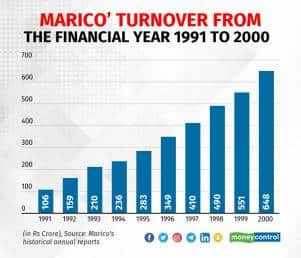
Creation of MaricoThough Mariwala’s father resisted the split of the family business in the 1980s, BOIL was finally restructured with the advent of a new decade, and four new businesses were carved out of it. The consumer products division became Marico. Its growth gained steam and within two years of its birth, the company doubled its turnover from Rs 80 crore to Rs 159 crore in financial year 1992.
However, now the company had new challenges. On the one hand, it was on the radar of multinationals like Hindustan Unilever, and on the other hand, it faced threats from me-too brands.
Advertising industry veteran K.V. Sridhar worked on a campaign for Parachute Oil after its competitor brand Cocoraj launched a similar packaging.
“We did a print campaign with Sonali Bendre and focused on the purity of the coconut oil,” says Sridhar, also known as Pops.
Similarly, later in the 1990s and early 2000s, the company was faced acquisition threat from Hindustan Unilever, which was aggressively campaigning to gain market share for its brand Nihar.
Mariwala fought it off with great vigour, recounts Milind Sarwate, who joined Marico as its chief financial officer in 1998 and quit in 2014.
A culture apartSarwate cannot talk enough about Marico’s culture and Mariwala’s way of doing things differently.
“Very few companies had an open office then. It was all glass and Harsh’s cabin was marginally larger than others,” Sarwate says.
According to former employees, it was also one of the few companies then in which people and even executives including Mariwala were addressed by their first names.
“There were no formalities with Harsh and you could speak out your mind,” says Sarwate.
Mariwala - from Marico’s early days - created a culture where employees were treated as members of the company and leaves were a facility and not entitlement. Employees in fact could go on short-duration casual leaves without informing their respective bosses.
Employees were allowed to move to different roles. Sarwate, who joined the company as its CFO, also headed HR for a while. While Jeswant Nair, one of the foremost hires of the company in 1989, joined in as an HR head and moved out as sales head in 1998.
Mariwala stresses that setting up the right culture is as important as hiring the right people to create an organisation.
“You have to build a culture where people will enjoy working with people. The culture will act as a source of competitive advantage to drive your strategy,” he says.
Mariwala built a company unlike most family-run businesses in the country, and created a culture that rewarded merit over influence. To ensure the perpetuity of his business, he passed on the baton to Saugata Gupta in 2014.
“Harsh’s idea of Marico is more like Procter & Gamble. Today, the organization founded in 1837 is around but I doubt you will find Mr Procter’s grandson or Mr Gamble’s granddaughter in Cincinnati headquarters,” says Sarwate.
Discover the latest Business News, Sensex, and Nifty updates. Obtain Personal Finance insights, tax queries, and expert opinions on Moneycontrol or download the Moneycontrol App to stay updated!