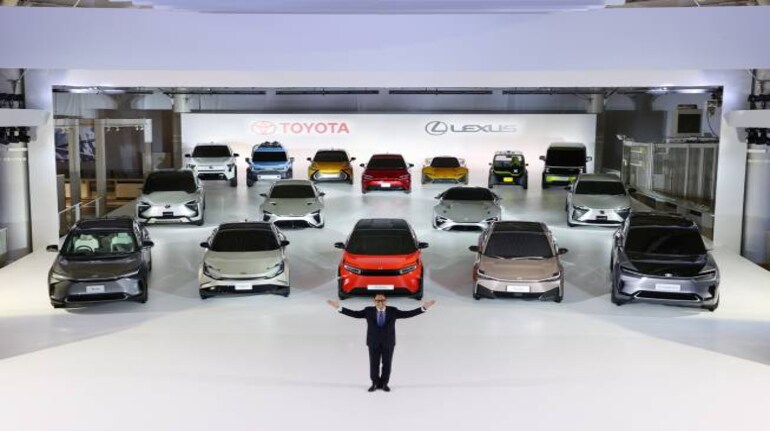
Toyota Motor Corporation – the brand that can be credited with single-handedly popularising hybrid powertrains two decades ago—thus far appeared to be late to the EV party. That changed on December 14 when Toyota President Akio Toyoda announced that the brand and its premium subsidiary Lexus will be introducing a whopping 15 electric vehicles spanning across multiple segments from their portfolio.
As a brand Toyota has shown an uncharacteristic reluctance to join the EV race, focussing more on hybrid powertrains in the present. The brand’s announcement that it will invest $35 billion by 2030, to develop the above-mentioned 15 models, proves that the EV-age is officially upon us, given that Toyota is at present, the world’s largest carmaker.
 Akio Toyoda speaks at a briefing on the company's strategies on battery EVs in Tokyo on December 14. REUTERS/Kim Kyung-Hoon.
Toyoda said the company aims to sell 3.5 million EVs by 2030, emphasising the need to reduce emissions. Lexus will go fully electric by 2035, and will launch only EV models in Europe, North America and China by 2030.
Toyoda said the brand will achieve carbon neutrality by 2035, stating that the means by which emission-free vehicles are produced is just as important.
Which are the expected models?
As for the models, they range from the bZ4X model (to be rechristened closer to its launch date) to top-end SUVs and sports cars bearing the Toyota and Lexus names. Among these models was also a concept sports car, which will feature a solid-state battery, according to Toyota.
In the past, Toyota said it has made inroads into solid-state battery technology which has the potential to change the EV industry thanks to its considerably longer range, better safety credentials and shorter charging times. Toyota had claimed that the first prototypes were already being tested and will have a production-ready version of the technology available before 2025.
Other models include a possible EV version of the FJ Cruiser, Tundra and other popular Toyota SUVs. Smaller micro EVs are also part of the plan.
Toyota’s announcement attests to the growing demand for EVs, considering that in May, the brand had a sales target of 2 million EVs by 2030. Toyota has also increased the budget for battery development by 30 percent, having picked North Carolina as the venue for its upcoming $1.3 billion EV battery plant.
In total, Toyota will be allocating $17.5 billion to battery development, having increased it by $4.3 billion.
When will the first Toyota EV model hit the market?
While most models are still in conceptual stages, featuring tinted glasses, the bZ4X is nearing its launch date, ready to be sold in US dealerships by 2022, according to Forbes. Following this, Toyota intends to launch 7 models bearing the bZ name. Along with this, Toyota also aims to parallely work on hydrogen fuel cell technology while continuing to sell hybrid cars for the foreseeable future.
 Toyota Motor Corporation's bZ Small Crossover. REUTERS/Kim Kyung-Hoon
It wasn’t too long ago when Akio Toyoda had shown skepticism over the efficacy and demand for EVs, instead leaning on the global success of its hybrid cars like the Prius and the Camry Hybrid (the only version of the Camry sold in India, given its sales dominance over the ICE Camry). The fact that, in such a short span, the brand has decided to dial-up its EV making efforts, means no automaker, big or small can afford to ignore EVs if they are going to survive the decade.
Even Stellantis, one of the world’s biggest automotive conglomerates which had expressed annoyance at being forced into the EV game, now has 4 new EV platforms, on which it intends to produce over 2 million vehicles, having invested 30 billion euros to electrify its line-up and, more importantly, bridge the price gap between EVs and ICE cars by 2026, according to Reuters.
Discover the latest Business News, Sensex, and Nifty updates. Obtain Personal Finance insights, tax queries, and expert opinions on Moneycontrol or download the Moneycontrol App to stay updated!

Find the best of Al News in one place, specially curated for you every weekend.
Stay on top of the latest tech trends and biggest startup news.