






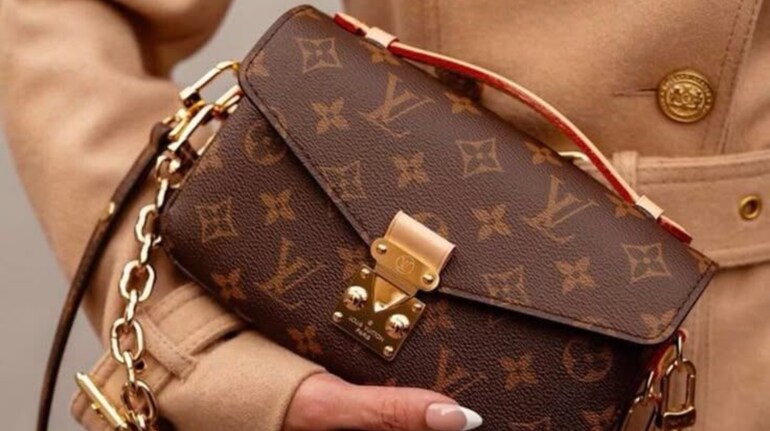

Louis Vuitton's monogram stands out as one of the world's most well-known luxury symbols. The interwoven "LV" and flower patterns appear on everything from suitcases and travel bags to high-end accessories symbolizing traditional craftsmanship. The French fashion house celebrated 130 years of its famous monogram design on January 11, 2026.
However, a video that went viral has started an unexpected cultural discussion.
Liam Richards, an Australian travel influencer went to the 12th-century Chennakeshava Temple in Belur Karnataka. He said he saw a familiar design carved into one of its sculptures — the well-known four-petal flower linked to Louis Vuitton.
King Vishnuvardhana of the Hoysala dynasty ordered the construction of the Chennakeshava Temple in 1117 CE. You'll find this temple on the Yagachi River's banks. The builders used soapstone to create this temple on a star-shaped base. People admire it for its detailed carvings. Art expert Adam Hardy says it's a single-shrine Hoysala building.
The temple is famous for its complex carvings. These include gods, musicians, dancers, and more than 80 heavenly nymphs in lively poses.
Also Read: What is the wrong shoe theory? The fashion rule breaking the internet
The construction reportedly took more than a century to complete.
While examining one of the sculptures, Richards zoomed in on a carved belt and exclaimed in his video, “Up here, there is a Louis Vuitton belt design.” The floral motif, he suggested, closely resembled LV’s four-petal flower.
He went on to speculate that the brand may have drawn inspiration from ancient Indian art.
Louis Vuitton’s official history tells a different story.
The monogram was created in 1896 by Georges Vuitton, son of founder Louis Vuitton. After taking over the Paris store on Rue Scribe in 1880, Georges sought to design a distinctive motif that would prevent counterfeiting and honour his late father.
According to the brand, the design drew inspiration from Art Nouveau, Japonism, and Gothic heraldry. The Monogram canvas combined:
Interlocking LV initials
A four-rounded-petal flower
A four-pointed flower within a diamond
A star motif
These elements together formed one of the earliest examples of branded luxury iconography.
No evidence has been provided that connects the monogram’s inception with devotional Indian temple architecture.
The monogram may, in a formal sense, trace its beginnings to the late nineteenth century European style, but there is a rich history of association between Vuitton and India.
The brand’s personalised travel trunks were immensely favoured by Indian royalty during the colonial period, with clients such as Maharaja Jagatjit Singh of Kapurthala, Sayajirao Gaekwad III of Baroda, and the monarchs of Jammu and Kashmir.
Jagatjit Singh is believed to have had about 60 customised Louis Vuitton trunks, each tailored to a particular travel requirement and fitted with special sections for clothes, turbans, jewels, swords, and shoes.
From the Indian temples to European heraldry and Japanese ornament, floral and geometric patterns have been used in different cultures and civilisations for many hundreds of years and similar visual languages are frequently found.
The answer to whether the likeness between the Chennakeshava Temple carving and Vuitton’s monogram is a theme of the global design evolution, encountered order, or a coincidence, remains to the judgment of the beholder.
The video has unleashed a fresh wave of analysis on the subject of cultural borrowing, authorship, and the recognition by luxury brands of design history.

Discover the latest Business News, Sensex, and Nifty updates. Obtain Personal Finance insights, tax queries, and expert opinions on Moneycontrol or download the Moneycontrol App to stay updated!
Find the best of Al News in one place, specially curated for you every weekend.
Stay on top of the latest tech trends and biggest startup news.










