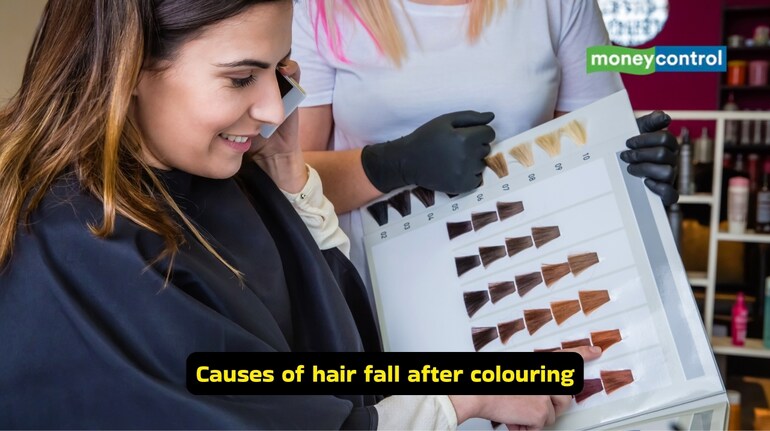

Hair colouring has become a regular grooming habit for many, whether to cover greys, refresh one’s look, or keep up with trends. Yet one concern continues to surface repeatedly: Hair fall after colouring.
While the fear is understandable, the science behind it is often misunderstood. When the hair shaft loses its strength and elasticity, even routine actions such as towel drying or detangling can cause strands to snap. This breakage is often mistaken for hair fall from the roots, creating unnecessary alarm.
The perception of increased hair fallafter colouring is largely due to chemical stress and cumulative damage. Dr Harinder K Arya, Chief Scientist at Indus Valley, tells Moneycontrol: “Conventional hair colours rely on ammonia, PPD, and hydrogen peroxide (HPO) to forcefully open the cuticle and strip natural pigment. This process weakens the hair's internal protein structure and removes its natural moisture and lipids. As a result, hair becomes damaged, porous, and brittle, breaking easily during washing or combing.”
Also read | Going for hair colour? Make sure it’s free from these unsafe ingredients
Beyond visible hair damage, scalp health plays a crucial role in how hair responds to colouring. The scalp is living skin and absorbs chemicals far more efficiently than many realise. Dr Arya highlights this overlooked issue, “Another overlooked factor is scalp stress. The scalp is living skin and absorbs chemicals far more efficiently than most people realize. Exposure to harsh bleaching agents like hydrogen peroxide can disrupt scalp comfort, leading to dryness and allergic reactions like itching, redness, or inflammation. This also weakens the hair root and aggravates the natural greying process, leading to more grey hair.”
Repeated colouring sessions can gradually affect hair growth patterns. Many conventional dyes use hydrogen peroxide (HPO), which acts as a bleaching agent rather than a colouring ingredient.
Dr Arya explains, “One of the most significant chemicals in today's hair colours is hydrogen peroxide (or HPO). While commonly described as a “developer,” it acts as a bleaching agent and does not add colour. Its primary function is to destroy natural melanin so artificial pigment can be deposited. This process creates extreme stress on the scalp health and hair roots. With repeated exposure, hydrogen peroxide (or HPO) can compromise the scalp’s natural barrier, leading to chronic dryness, micro-inflammation, and oxidative damage. Over time, this stressed scalp environment can negatively impact hair follicles.”
Also read | Hair colour tips for beginners: Here's your best guide on how to pick the perfect hair colour
Such stress does not cause instant baldness, but it can subtly disrupt the natural hair renewal cycle. Over time, this may lead to slower visible regrowth, reduced density, and increased shedding.
Another lesser-known effect of oxidative damage is its impact on melanin within the follicle. Melanin is not only responsible for hair colour but also plays a protective role in hair strength. Repeated exposure to harsh chemicals can impair pigment stability, which explains why greys often return faster and hair appears weaker after long-term colouring.
Inflammation around the follicle, often felt as itching, tightness, or sensitivity, can also constrict the follicular opening. This makes it harder for new hair to emerge smoothly, resulting in finer, more fragile strands.
1. What can cause hair fall after colouring?
Hair fall after colouring is often due to breakage, not root hair loss. Chemicals can weaken the hair's protein structure, making it brittle and prone to breakage during washing or combing.
2. How does hair colour affect scalp health?
Hair colour chemicals can stress the scalp, causing dryness, itching, redness, or inflammation. This weakens hair roots and may accelerate the greying process.
3. Can repeated hair colouring impact hair growth?
Yes, repeated hair colouring can affect hair growth patterns. Chemicals like hydrogen peroxide can compromise scalp health, leading to chronic dryness and oxidative damage, which can slow hair regrowth and increase shedding.
4. Why do greys return faster after long-term colouring?
Oxidative damage from harsh chemicals can impair melanin stability, causing greys to return faster and hair to appear weaker after prolonged colouring.
5. How can I minimise hair damage from colouring?
Opt for hair colours free of harsh chemicals like ammonia and PPD. Regularly use moisturising treatments and consult a specialist for personalised advice to protect hair health.
Disclaimer: This article only provides generic information. Don’t treat it as a substitute for qualified medical opinion. Always consult a specialist for specific diagnosis.
Discover the latest Business News, Sensex, and Nifty updates. Obtain Personal Finance insights, tax queries, and expert opinions on Moneycontrol or download the Moneycontrol App to stay updated!
Find the best of Al News in one place, specially curated for you every weekend.
Stay on top of the latest tech trends and biggest startup news.