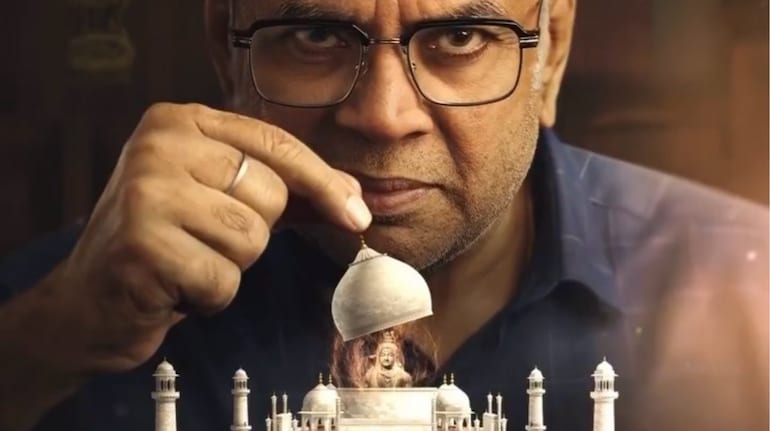
‘The Taj Story,’ directed by Tushar Amrish Goel, was released in theatres on 31st October and stars Paresh Rawal, Zakir Hussain, Namit Das, Amruta Khanvilkar, and Brijendra Kala.
A film born in controversy
There’s no denying that ‘The Taj Story’ walks straight into a minefield. Even before its release, the film found itself at the center of outrage—not because of what it shows, but because of what it dares to suggest.
A poster showing the Taj Mahal’s dome lifting to reveal a Shiva idol below was enough to ignite a storm, with many accusing the makers of peddling propaganda. It’s this mix of curiosity and controversy that drives the film—one that wants to make you question what you’ve been told but ends up saying too much, too fast, and with little finesse.
The film attempts to unravel the ‘real’ history of the Taj Mahal—an intriguing premise—but the journey it takes is anything but engaging or compelling. While the first half makes for an absorbing watch, the second half overflows with arguments and counterarguments, mistaking debate for drama. The outcome is a film that turns monotonous and constantly wrestles with its own narrative.
A guide’s journey to explore truth
At its heart, ‘The Taj Story’ follows Vishnu Das (Paresh Rawal), a veteran tourist guide who has spent thirty years narrating tales of love and loss inside the Taj’s marble corridors.
But when a journalist’s question corners him, Vishnu accidentally admits to his friends over a drinking session that the stories he’s told visitors about the Taj might not be entirely true. What begins as a drunken confession turns into a city-wide scandal.
Cast out by his peers and shunned by the residents of the city, Vishnu takes his fight to court, filing a petition that challenges everything the monument stands for. The rest of the film unfolds as a courtroom drama, pitting history against belief, personal guilt against public fury.
A promising start that loses steam
The first hour flows smoothly, with a grounded, realistic tone as it captures the life of a small-town guide whose pride slowly turns into obsession. There’s warmth in the way we see Vishnu’s camaraderie with fellow guides and the unspoken bond within his family. But once the film enters the courtroom, it slips into repetition.
Long arguments and multiple references to “facts” already available in the public domain rob it of tension. The writing aims to shock but delivers nothing new, leaving viewers stuck between wanting to engage and wanting to escape.
By the time the debates wind down, the film feels longer than it actually is.
Paresh Rawal shoulders the film
Paresh Rawal shoulders the film with remarkable conviction. His portrayal of Vishnu Das—half-defiant, half-defeated—keeps the drama alive even when the script falters. His dry humour in tense moments brings much-needed relief.
Zakir Hussain matches him well as the composed but sharp defending lawyer, lending authority to every courtroom exchange. Namit Das and Amruta Khanvilkar do their best within limited screen time, but the focus rarely strays from Rawal’s determined presence.
Their performances, though brief, add texture to an otherwise one-dimensional world.
An ambitious idea that falters in execution
‘The Taj Story’ wants to be a film of revelation, but what it ends up being is a film of repetition. It raises big questions about truth and history but doesn’t have the storytelling depth to explore them meaningfully.
What begins as a bold attempt to challenge popular narratives turns into a talk-heavy, predictable courtroom exercise.
The intent may be noble, the subject certainly combustible, but the execution is dull and overlong. In the end, the controversy surrounding it feels far more engaging than the film itself. ‘The Taj Story’ is ambitious in intent but tedious in storytelling—it sparks debate, not cinema.
Rating: 2.5/5
Discover the latest Business News, Sensex, and Nifty updates. Obtain Personal Finance insights, tax queries, and expert opinions on Moneycontrol or download the Moneycontrol App to stay updated!





Find the best of Al News in one place, specially curated for you every weekend.
Stay on top of the latest tech trends and biggest startup news.