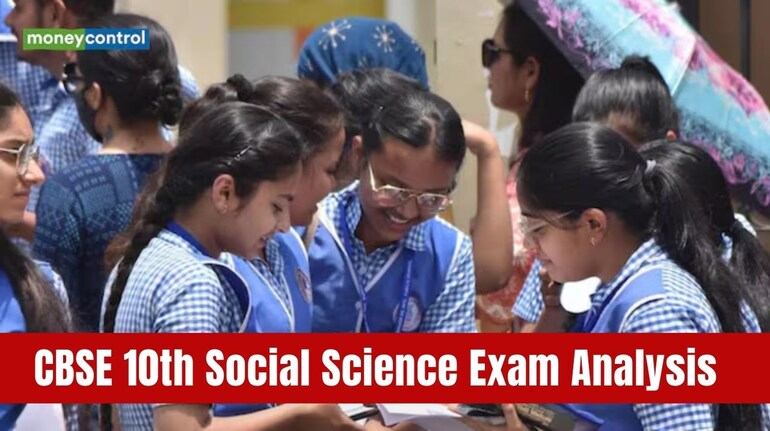

The Central Board of Secondary Education conducted the Class 10 Social Science examination on March 7, 2026 across the country. Students appeared for the three hour paper scheduled between 10:30 am and 1:30 pm. Candidates received fifteen minutes earlier to read the question paper carefully before writing answers. Initial reactions from students and teachers suggested the examination remained manageable and balanced.
Many candidates expressed relief after completing the Social Science examination. Most reported that questions closely followed the prescribed CBSE syllabus and NCERT textbooks. Students also noted a balanced mixture of theory questions and application based sections. Teachers reviewing the paper described the overall difficulty level as easy to moderate.
The Social Science examination forms an important part of the Class 10 board assessments. The paper structure followed the pattern already indicated through official CBSE sample papers. Questions included conceptual understanding along with real life application of topics. Map based questions from history and geography sections appeared simple and scoring. Students who prepared thoroughly using NCERT books and sample papers found the exam manageable.
| Feature | Details |
|---|---|
| Board Name | Central Board of Secondary Education (CBSE) |
| Exam Name | CBSE Class 10 Social Science Examination |
| Exam Date | March 7, 2026 |
| Exam Duration | 10:30 AM to 1:30 PM |
| Total Marks | 80 |
| Exam Mode | Offline (Pen and Paper) |
| Time Duration | 3 Hours |
| Question Paper Sets | Set 1, Set 2, Set 3, Set 4 |
The question paper followed the latest guidelines issued by the CBSE board. The format included multiple sections covering different types of questions. This structure helped evaluate conceptual knowledge, analytical ability and practical understanding of topics.
| Section | Type of Questions | Number of Questions | Marks |
|---|---|---|---|
| A | Multiple Choice Questions | 20 | 20 |
| B | Very Short Answer Questions | 4 | 8 |
| C | Short Answer Questions | 5 | 15 |
| D | Long Answer Questions | 4 | 20 |
| E | Case Based Questions | 3 | 12 |
| F | Map Based Questions | 1 | 5 |
| Total | 37 Questions | -- | 80 Marks |
Students reported that most questions came directly from the syllabus. Some questions required deeper conceptual understanding rather than memorisation alone. The examination maintained a balance between direct and analytical questions. Case based questions assessed how students apply theoretical knowledge to situations.
Map based questions were considered simple by many students. These questions largely followed examples from NCERT textbooks. Candidates who regularly practised sample papers felt comfortable attempting the paper.
Students generally described the paper as clear and well structured. Several candidates mentioned that previous year papers helped their preparation. However some students felt that certain case based questions needed careful reading. Overall reactions suggested the paper was fair and balanced.
Teachers reviewing the examination shared similar observations. They noted the question paper contained a suitable mix of easy and moderate sections. Educators also observed that the format closely followed CBSE sample papers. According to them, students who studied NCERT books thoroughly handled the paper confidently.
Social Science educators Vishwajeet Pandey and Pratibha Singhal from Jain International Residential School, Bengaluru, described the CBSE Class 10 Social Science exam as balanced and well organised across History, Geography, Civics and Economics. They said the paper ranged from easy to moderate in difficulty and was manageable for students who studied NCERT textbooks thoroughly. The exam reflected CBSE’s competency-based approach, combining direct and concept-based questions with some analytical ones. Overall, they called the paper fair, student-friendly and aligned with the prescribed syllabus.
Riya Gambhir, PGT History at St Angels School, said the CBSE Class 10 Social Science exam was easy to moderate and student-friendly. She noted the paper balanced conceptual understanding with factual knowledge from the syllabus. Most questions were direct and manageable for students who studied NCERT textbooks carefully. Some questions required supporting answers with relevant facts, testing subject clarity. Map-based questions were simple and easy to attempt. Overall, the paper gave students a fair chance to show both conceptual understanding and factual knowledge.

Discover the latest Business News, Sensex, and Nifty updates. Obtain Personal Finance insights, tax queries, and expert opinions on Moneycontrol or download the Moneycontrol App to stay updated!
Find the best of Al News in one place, specially curated for you every weekend.
Stay on top of the latest tech trends and biggest startup news.