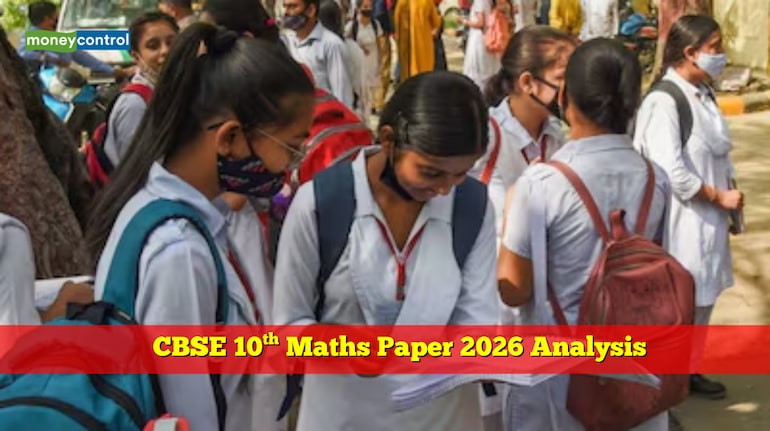

The Central Board of Secondary Education (CBSE) conducted the Class 10 Mathematics board examination today, February 17, 2026. As the first major paper of the board season, the exam has drawn mixed reactions from students, with initial feedback suggesting the paper was conceptually easy but lengthy.
The examination was held in a single shift across the country from 10:30 AM to 1:30 PM, with over 25 lakh registered students appearing for both Mathematics Standard and Mathematics Basic papers. As students walked out of examination centres, the consensus began to emerge—the paper tested conceptual clarity but demanded efficient time management.
Read Also - Viral JEE Main Scorecard 2026: The 0.57 Percentile Story that Shocked the Internet
Students' Initial Reactions: 'Easy but Lengthy'
Early reactions from students who appeared for the exam indicate that the paper was balanced in terms of difficulty but required careful time management. Many students found the questions familiar and straightforward, yet the volume of the paper tested their speed and endurance.
"It wasn't hard, but it was tricky," emerged as a common sentiment among test-takers. This aligns with what educators had predicted—that students often lose marks not because they don't know the syllabus, but when CBSE twists familiar questions or when small mistakes creep in during solving.
A student from Noida shared her experience, "The questions were from the syllabus and nothing was out of the box. But the paper was quite lengthy. I could attempt all questions but had to really rush through the last section."
In Rewari, a student exiting the examination hall described the paper as easy to moderate and expressed confidence in securing 70+ marks, aligning with the overall sentiment that the paper was manageable despite being lengthy.
Based on feedback collected from students after the examination, variations in difficulty level were observed across different sets. Set 1 was widely reported as the most challenging, with students finding certain sections trickier compared to other sets. Conversely, Set 3 was perceived as the easiest, with many students attempting it comfortably within the allotted time.
A student from Delhi Public School, Noida said, "The MCQ section was easy, including the assertion questions. I could attempt them without any confusion."
Teachers' Reactions
According to Vamanrao S Patil (TGT) and Benasir P A (TGT) of JAIN International Residential School (JIRS), Bengaluru, the maths paper was moderate.
"The Grade 10 Mathematics examination conducted today was assessed as moderate in difficulty and comparatively easier than last year’s paper. The question paper comprehensively covered the entire syllabus and was largely based on NCERT content enabling well-prepared students to attempt most questions confidently.
The Multiple-Choice Questions (MCQs) and most two-mark questions were straightforward and concept-based, making them accessible to students with clear understanding of fundamental concepts. However, the final two questions in Section D were relatively challenging, requiring detailed steps, structured presentation, and deeper conceptual clarity.
Section E, which featured case-based questions, demanded careful reading, analytical thinking, and effective time management. Though based on NCERT concepts, these questions tested students’ ability to apply mathematical understanding in real-life contexts.
Overall, while the majority of the paper was manageable, Sections D and E required additional time and thoughtful interpretation. Students with thorough preparation and strong conceptual understanding were well-positioned to achieve good results".
CBSE Class 10 Maths Exam Pattern 2026
The theory paper carried 80 marks, with an additional 20 marks allocated for internal assessment. The question paper comprised a total of 38 questions divided across five sections :
| Section | Question Type | Marks per Question | No. of Questions | Total Marks |
|---|---|---|---|---|
| A | MCQs & Assertion-Reason | 1 | 20 | 20 |
| B | Very Short Answer | 2 | 5 | 10 |
| C | Short Answer | 3 | 6 | 18 |
| D | Long Answer | 5 | 4 | 20 |
| E | Case-Based Questions | 4 | 3 | 12 |
| Total | 38 | 80 | ||
The exam duration was 3 hours, with internal choices available in most sections. Calculators were not permitted, requiring students to perform all calculations manually.
Unit-Wise Weightage
The question paper followed the prescribed unit-wise weightage, with Algebra continuing to dominate the paper :
| Unit | Topic | Marks |
|---|---|---|
| I | Number Systems | 6 |
| II | Algebra | 20 |
| III | Coordinate Geometry | 6 |
| IV | Geometry | 15 |
| V | Trigonometry | 12 |
| VI | Mensuration | 10 |
| VII | Statistics & Probability | 11 |
Comparison: Mathematics Standard vs Basic
The CBSE offers two levels of Mathematics for Class 10 students :
Mathematics Standard (041) is designed for students who wish to pursue Mathematics in higher classes. The questions in this paper test higher-order thinking skills, with approximately 54% of marks allocated to remembering and understanding, 24% to applying, and 22% to analysing, evaluating and creating.
Mathematics Basic (241) is for students who do not wish to take Mathematics in Class 11 and 12. The paper is relatively simpler, with 75% marks for remembering and understanding, 15% for applying, and only 10% for higher-order skills.
Overall, today's analysis suggests that students of both papers found the questions aligned with their respective difficulty levels, though the Basic paper had more direct, formula-based questions.
Discover the latest Business News, Sensex, and Nifty updates. Obtain Personal Finance insights, tax queries, and expert opinions on Moneycontrol or download the Moneycontrol App to stay updated!
Find the best of Al News in one place, specially curated for you every weekend.
Stay on top of the latest tech trends and biggest startup news.