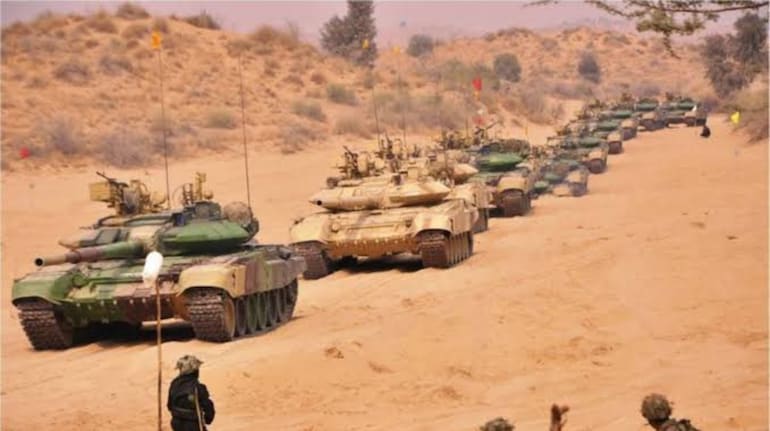
The crisis people remember as “Brasstacks” began as a military idea and ended as a political scare. Between late 1986 and early 1987, India staged what many accounts describe as its largest ever field exercise, centred on Rajasthan’s deserts and built around the kind of mechanised, high-tempo operations the Army wanted to master after the 1971 war. Pakistan read the scale, the geography, and the momentum as something more ominous: a cover for a real offensive, or at the very least a rehearsal that could slide into war. For several tense weeks, the two militaries moved close enough to make accidents and miscalculations plausible, while diplomats raced to prove to each other, and to themselves, that they could still step back.
What Brasstacks was meant to do
Operation Brasstacks was conceived during General K Sundarji’s tenure as Army Chief, a period associated with doctrinal churn and an intense push for modernisation. The exercise tested combined-arms manoeuvre at scale: armour, mechanised infantry, artillery, logistics, and air support working together in a fast-moving battle plan rather than a slow set-piece. In simple terms, it was India trying to practise fighting the kind of war it believed it would have to win quickly if deterrence failed. Contemporary descriptions, and later reconstructions, underline the sheer size of the mobilisation, which is exactly what made it strategically loud even if it was tactically “just” an exercise.
But exercises are not judged only by what they test internally. They are also judged by what they signal externally. A large concentration of forces near an adversary’s border creates two problems at once: first, the adversary must assume a worst case, because the cost of being wrong is catastrophic; second, the side conducting the exercise may itself lose the ability to stop quickly, because unwinding a mobilisation is slow, bureaucratic, and politically tricky. Brasstacks fell into that classic security dilemma trap.
Why Pakistan panicked, and why that panic mattered
Pakistan’s fear was not abstract. In Pakistan’s strategic memory, 1971 was not just a military defeat but a state trauma, and Indian conventional superiority remained a live anxiety. So when Indian formations moved and trained at a scale that looked unprecedented, Pakistani planners did what planners are trained to do: they assumed the exercise might be masking intent. Accounts of the crisis describe Pakistan responding with its own movements and counter-mobilisation, turning a one-sided exercise into a two-sided standoff dynamic.
This is where near-wars are born. Once both sides are moving, each movement “just to be safe” becomes, to the other side, evidence of intent. The line between deterrence and provocation gets blurry, and the margin for error shrinks.
The Rajiv Gandhi question and civil-military signalling
One of the enduring controversies around Brasstacks is how much India’s political leadership understood about its scale and escalation risk while it was unfolding. A set of later political and journalistic claims, including reporting in the Times of India tied to books and recollections from that era, suggests Rajiv Gandhi was not fully briefed on the scope, or was “kept in the dark” about key details. These claims are debated, and they sit in that uncomfortable zone where memoir, institutional defensiveness, and partisan incentives overlap. Still, the very persistence of the claim matters because it highlights the core lesson of such crises: if the political leadership is not tightly in control of signalling, an exercise can accidentally become strategy.
Even if one treats the “kept in the dark” framing cautiously, the episode is widely remembered as a case where military initiative and political risk did not line up neatly. That misalignment is often what produces escalation pathways nobody actually wants.
The nuclear shadow enters the story
Brasstacks happened before India and Pakistan openly declared themselves nuclear weapon states, but it did not happen in a nuclear vacuum. India had tested in 1974, and Pakistan’s programme was the subject of intense international attention. During the crisis, nuclear signalling appeared in the public record through an interview with AQ Khan, Pakistan’s key nuclear figure, conducted with Indian journalist Kuldip Nayar. Later analysis by the Carnegie Endowment revisited the episode in detail, including the timing and the way the “message” travelled, framing it as deliberate signalling meant to influence crisis diplomacy. In other words, nuclear capability was being used as a political lever, even if both sides still preferred to keep some ambiguity alive.
This matters because nuclear signalling changes the psychology of conventional crises. It adds a second layer of fear: not only could a conventional clash spiral, but it could spiral under the pressure of nuclear threats, rumours, and worst-case assumptions.
How the crisis cooled down
If Brasstacks is remembered as a near-war, it is also remembered as a near-war that was defused. Diplomacy did not deliver a dramatic treaty or a photo-op peace breakthrough. It did something more boring and more important: it created off-ramps. Accounts of the episode describe steps that reduced tension and helped each side save face while disengaging. A famous symbol from that period is General Zia-ul-Haq’s visit to India during a cricket match in February 1987, often described as “cricket diplomacy.” The point wasn’t that cricket solved geopolitics. The point was that high-level contact created a channel to reassure, probe, and quietly negotiate de-escalation without publicly conceding fear.
Another important piece was signalling intent through transparency. Reports and reconstructions note that India invited diplomats and journalists to observe parts of the exercise, an unusual move designed to show “this is an exercise, not an invasion.” Transparency is not a magic wand, but in crises driven by interpretation, it can be the difference between “I think you’re about to attack” and “I can at least see what you’re doing.”
What India’s Army learned, and what Pakistan’s Army learned
For India, Brasstacks reinforced the Army’s interest in large-scale mechanised doctrine and the belief that conventional power could produce decisive results. But it also exposed the political cost of mass mobilisation. In later decades, Indian strategic debate repeatedly returned to the same dilemma: how to punish or deter Pakistan without triggering a long mobilisation that gives Pakistan time to prepare, international actors time to intervene, and escalation risks time to grow.
For Pakistan, Brasstacks is often described as a shock that pushed its security establishment to think harder about how to deter Indian conventional superiority, including through nuclear posture and signalling. ThePrint has argued, in broader discussions of India-Pakistan war strategy, that such episodes shaped Pakistani thinking about defence, messaging, and the need to show resolve.
You can see why this episode keeps coming back in Indian commentary too. Even a recent Indian Express military column, while discussing a modern exercise, pointed to the 1987 scare as a historical parallel, which tells you Brasstacks still sits in the institutional memory as a “careful, this can get out of hand” reference point.
The real takeaway is about control, not courage
It is tempting to tell the Brasstacks story as a macho thriller: tanks in the desert, jets overhead, rivals staring each other down, and a last-minute diplomatic save. The more useful reading is colder. Brasstacks shows how crises can emerge from routine military activity when three things combine: scale, proximity, and mistrust. Once that happens, leaders are managing momentum as much as they are managing intent.
It also shows why communication discipline matters. In a high-tension environment, even if neither side wants war, each side must still prepare for it, and preparations themselves can look like preparation to start it. That’s why crisis stability is often less about grand speeches and more about boring mechanisms: clear political oversight, reliable channels, transparency measures, and an agreed understanding of what certain movements mean.
Why Brasstacks still matters now
Brasstacks sits at an awkward historical hinge. It predates the 1998 nuclear tests, but it unfolded with nuclear capability looming and nuclear threats creeping into the conversation. It also predates the later era of instant media amplification and social media outrage, which means it arguably benefited from the ability of leaders to do quiet de-escalation without performing toughness every hour.
That combination makes it a useful case study today. It reminds you that the most dangerous crises are not always launched with intent. Sometimes they are assembled by habit, suspicion, and inertia, and then kept alive by the human difficulty of admitting fear. Brasstacks ended without war, but it did not end because the system was safe. It ended because individuals on both sides chose exits while they were still available, and because diplomacy was allowed to do its unglamorous work.
Discover the latest Business News, Sensex, and Nifty updates. Obtain Personal Finance insights, tax queries, and expert opinions on Moneycontrol or download the Moneycontrol App to stay updated!
Find the best of Al News in one place, specially curated for you every weekend.
Stay on top of the latest tech trends and biggest startup news.