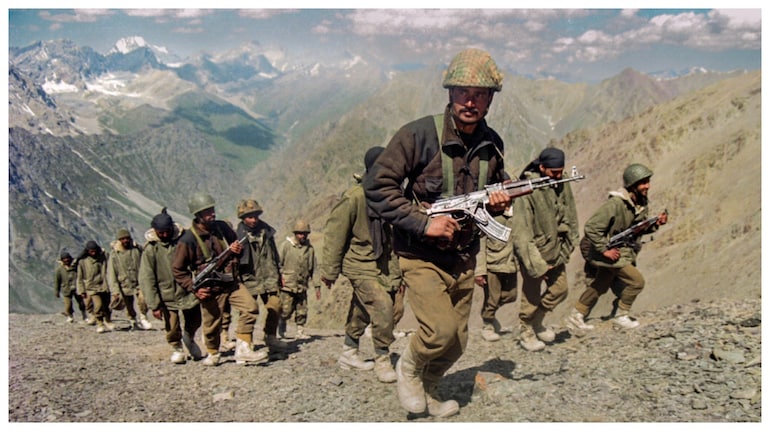
When the Kargil conflict erupted in May 1999, the Indian Air Force (IAF) was pushed into a kind of war it had never really rehearsed for. The enemy was not across open plains or desert expanses. Pakistani regulars and intruders were dug into razor-thin ridgelines at 15,000 to 18,000 feet. They had gravity on their side. Indian aircraft had to attack uphill, in thin air, without crossing the Line of Control.
In those first few days of Operation Safed Sagar, it became clear that this would not be a routine bombing campaign.
From rockets to rethink
The IAF initially deployed MiG-21s, MiG-23BNs, MiG-27s and even Mi-17 helicopters for strike roles. But high-altitude warfare punishes assumptions. Engines lose thrust in thin air. Bomb trajectories behave differently. Targets are small, camouflaged, and often tucked into rock faces invisible from above.
Early missions were costly. Aircraft were lost to shoulder-fired missiles. Unguided bombs, dropped from safer altitudes to avoid air defences, did not always hit narrow sangars clinging to cliffs. The message was uncomfortable but unavoidable: brute force bombing would not solve this.
The campaign needed accuracy. It needed reach. It needed something that could operate confidently in rarefied air.
That aircraft was the Mirage 2000.
Why the Mirage was different
The Mirage 2000 had already been in IAF service for over a decade. It was modern by Indian standards of the time. Its delta-wing design, powerful engine and advanced avionics gave it better high-altitude performance than older strike platforms.
More importantly, it could deliver precision-guided munitions.
By mid-June 1999, Mirage 2000s were adapted to carry laser-guided bombs. This shift was not cosmetic. It changed the logic of the air war. Instead of blanketing ridgelines and hoping for effect, pilots could now aim at specific bunkers, supply dumps and hardened positions.
According to contemporaneous and later coverage in Indian Express and The Hindu, the induction of Mirage 2000s marked a turning point in the air campaign. Once laser-guided bombs entered the fight, Indian aircraft were no longer just harassing enemy positions. They were dismantling them.
Muntho Dhalo and the logistics squeeze
One of the most discussed examples was the strike on Pakistani supply camps in the Muntho Dhalo area in late June 1999. The Mirage 2000s targeted logistics nodes that sustained forward troops on the heights.
This was a smart shift. High-altitude warfare is unforgiving. Food, ammunition and winter gear are lifelines. Destroy the bunker and you remove a threat. Destroy the supply base and you weaken an entire sector.
Reports and post-war assessments have noted that these precision strikes disrupted Pakistani resupply at a critical stage. Troops already perched on exposed ridges now faced dwindling logistics and no reliable sanctuary from the air.
The effect was not just physical. It was psychological.
Fighting within political limits
The Mirage missions were flown under tight constraints. The political directive was clear: do not cross the Line of Control. That limited attack angles and escape routes. Pilots had to plan profiles that remained within Indian airspace while still achieving weapon lock and guidance.
This demanded discipline and confidence in systems. The Mirage’s navigation suite, fly-by-wire controls and targeting capability allowed pilots to release weapons from safer altitudes, reducing vulnerability to Manpads that had proven deadly earlier in the campaign.
In simple terms, the Mirage allowed India to hit hard without losing the moral and diplomatic high ground.
Softening the peaks
It is important not to exaggerate. Air power did not “win” Kargil on its own. Infantry units still had to climb Tololing, Tiger Hill and Point 4875 at night, under fire, in brutal conditions.
But what the Mirage did was make those climbs slightly less lethal.
Precision strikes degraded bunkers, disrupted supply chains and shook the sense of invulnerability that Pakistani troops initially enjoyed on the heights. By the time ground forces closed in, many positions had already been softened by accurate bombing and sustained artillery.
Kargil became an example of jointness under pressure. Artillery pounded. Mirage 2000s struck key nodes. Infantry climbed. Each arm compensated for the limits of the other.
A lasting lesson
The Mirage 2000’s performance during Kargil left a lasting imprint on Indian military thinking. It validated investment in precision-guided munitions and modern avionics. It also exposed how quickly air campaigns can stall without accurate weapons in complex terrain.
In the years after Kargil, India expanded its precision strike capabilities and upgraded its Mirage fleet. The war underscored a hard truth: in mountains, especially under political constraints, accuracy matters more than volume.
The Mirage 2000 did not dominate headlines the way individual battles did. But in rarefied Himalayan air, it quietly changed the equation. When conventional bombing struggled to find its mark, the Mirage delivered something far more valuable than tonnage.
It delivered certainty.
Discover the latest Business News, Sensex, and Nifty updates. Obtain Personal Finance insights, tax queries, and expert opinions on Moneycontrol or download the Moneycontrol App to stay updated!
Find the best of Al News in one place, specially curated for you every weekend.
Stay on top of the latest tech trends and biggest startup news.