




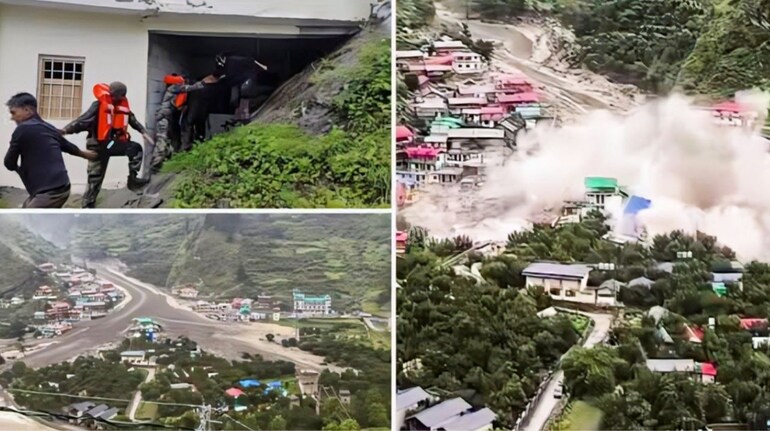
A catastrophic flash flood that obliterated parts of Dharali village in Uttarakhand on Tuesday was not merely the result of heavy rainfall, a preliminary geological assessment has revealed, TOI reported. Instead, experts point to a violent, large-scale collapse of glacial deposits - a disaster "waiting to happen," according to satellite data analysed by geologists.
A TOI report, citing terrain analysis and expert assessments, indicated that an estimated 360 million cubic metres of debris, equivalent to over 1.4 lakh Olympic-sized swimming pools, avalanched down the Kheer Gad stream at terrifying speeds. The deluge, mobilised by unstable morainic and glacio-fluvial sediment, flattened more than 20 structures and claimed at least four lives, per official figures.
The trigger, experts suggest, was a retrogressive slope failure high in the mountains, approximately 7 km upstream of Dharali at an elevation of 6,700 metres. The glacial deposit, spanning 1.1 sq km with a 300-metre vertical thickness, had been perched precariously in a hanging trough, a geologically unstable formation.
Dr Imran Khan, geologist and head of the geology division at Bhutan’s Punatsangchhu-I hydropower project, was cited by TOI as saying that “this wasn’t a typical cloudburst”. After reviewing the satellite data, he observed that the disaster originated with a massive detachment of loose glacial debris, located some 7km upstream at an altitude of 6,700m. Although heavy rainfall may have acted as the immediate trigger, Khan emphasised, “the disaster was waiting to happen”.
The steep gradient of the Kheer Gad stream, combined with its narrow, pre-incised channels, allowed the debris to accelerate rapidly. Rajiv Saran Ahluwalia, a geologist at Doon University, explained that debris flows at 6-7 metres per second can demolish any structure and if velocity doubles, their destructive capacity increases 64-fold.
While days of intense rainfall likely loosened the sediment, experts suspect glacial melt, exacerbated by rising temperatures, may have further destabilised the slope. A senior glaciologist, speaking anonymously, stressed that real-time satellite imagery and ground surveys are needed to confirm the exact sequence of events.
The tragedy has reignited calls for stricter regulations on construction in vulnerable zones, particularly pilgrimage hubs like Gangotri. "We can no longer afford to ignore hidden upstream hazards," warned a geologist involved in the assessment, as reported by TOI.
Discover the latest Business News, Sensex, and Nifty updates. Obtain Personal Finance insights, tax queries, and expert opinions on Moneycontrol or download the Moneycontrol App to stay updated!
Find the best of Al News in one place, specially curated for you every weekend.
Stay on top of the latest tech trends and biggest startup news.