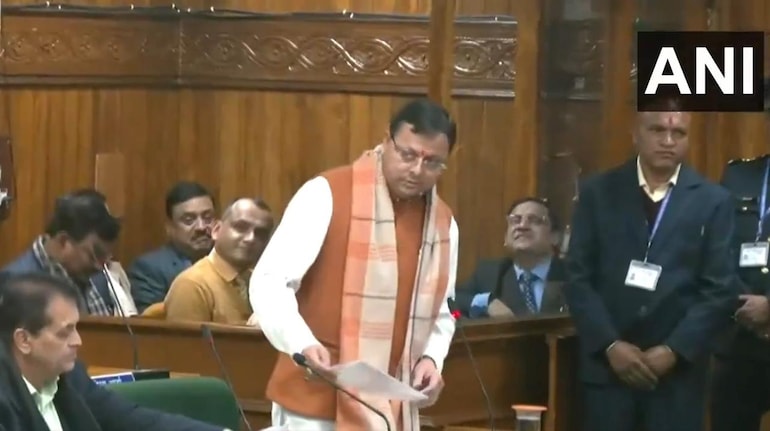
Following several petitions challenging the Uniform Civil Code (UCC) Act, 2023, and the UCC Rules, 2024, the Uttarakhand government’s Home Department on Wednesday submitted an affidavit in the High Court proposing a set of amendments to the rules manual.
Among the key proposed amendments, the government has removed mandatory Aadhaar-based authentication for registration, relaxed the requirement to disclose details of children born in a live-in relationship at the time of its termination, limited the registrar’s power to inform parents or legal guardians of registrants under 21, and made submission of supporting documents more flexible.
Scope and restrictions of live-in relationships
As per the Uttarakhand UCC, the rules for live-in relationships apply only to heterosexual couples. Like marriage, there are restrictions on prohibited relationships. The code lists 74 relationships in which live-in relationships are not allowed, including first cousins.
Furthermore, the law states that a person cannot enter into a live-in relationship with someone who is already married or involved in another live-in relationship.
These restrictions aim to maintain consistency with broader marriage laws and ensure legal clarity about relationships that are not permissible. The amendments do not change these fundamental prohibitions but focus on reducing unnecessary interference and policing of private relationships.
Addressing privacy concerns
Some clauses in the UCC rules, implemented in January 2024, were challenged in the High Court. Senior advocate Vrinda Grover argued that the rules created a legal regime that intruded into the personal lives of individuals. She raised concerns about information being sent directly to local police stations, questioning why personal data should be available to law enforcement in such detail.
The proposed amendments now explicitly state that it is the responsibility of the Registrar, the officer-in-charge of the local police station, and the district Superintendent of Police to ensure the privacy of information.
Previously, registrants’ personal data, including the details of the couple in a live-in relationship, were kept at the local police station “for record keeping.”
Disclosure of children born during live-in
Another major change relates to the disclosure of children born in live-in relationships. Under the original rules, if a woman was pregnant at the time of terminating the live-in relationship, it was mandatory to inform the Registrar. Additionally, any child born after the termination had to be reported within 30 days of the birth certificate issuance.
Grover had argued that these provisions violated privacy and could subject women to social humiliation. In response, the state has removed these requirements. Now, details about children, whether expected or born, do not need to be disclosed during the termination of a live-in relationship.
Existing laws, such as Section 16(1) of the Hindu Marriage Act, already ensure the legitimacy of children born from void or nullified marriages.
Aadhaar-based authentication removed
The petitions also challenged the requirement for Aadhaar-based authentication for registration, including witnesses. Petitioners argued that compulsory use of Aadhaar violated privacy rights upheld by the Supreme Court in the K S Puttaswamy judgment, The Indian Express reported.
The amendments now remove the requirement for Aadhaar authentication. Other identity proofs are now acceptable. Clauses mandating registration via a mobile number linked to Aadhaar have also been scrapped.
Previously, the online registration process required entering the Aadhaar number, verifying it via OTP, and using it as the primary identifier for all future processes. This has now been made optional, reducing the level of surveillance in the registration process.
Another option for issuing provisional certificates, valid for 30 days, has been revoked. The proposed amendment states that the application is either answered with a registration certificate or a rejection letter. The Registrar cannot check the veracity of the names, phone numbers/email id/addresses of the registrants or parents or religious leaders/community heads in the statement submitted by the registrants.
Registrar authority and supporting documents relaxed
The amendments now limit the powers of registrars. Previously, registrars could conduct summary inquiries, contact parents or guardians for registrants under 21, and even consult religious leaders to verify relationships under prohibited categories. The proposed rules remove these powers, preventing arbitrary investigations and overreach.
Provisional certificates valid for 30 days have been removed. Registrars now only issue a registration certificate or a rejection letter without additional verification.
The requirement to submit documents such as rent agreements, proof of household, caste, or employment under government schemes has been made optional. This includes removing penalties for filing false complaints.
Previous penalties and legal alignment
Earlier amendments under Section 17 of the UCC allowed penalties of up to three months’ imprisonment or a fine of Rs 25,000 for non-registration or submission of false memorandums. The new amendments align penalties with the Bharatiya Nyaya Sanhita (BNS) provisions.
For live-in relationships involving minors, the penalty can be up to six months’ imprisonment or a fine of Rs 50,000. Individuals who marry another person while being married or continue a live-in relationship while married face up to seven years in prison along with fines. Forced or coerced marriages are punishable with imprisonment up to seven years and fines.
Discover the latest Business News, Sensex, and Nifty updates. Obtain Personal Finance insights, tax queries, and expert opinions on Moneycontrol or download the Moneycontrol App to stay updated!
Find the best of Al News in one place, specially curated for you every weekend.
Stay on top of the latest tech trends and biggest startup news.