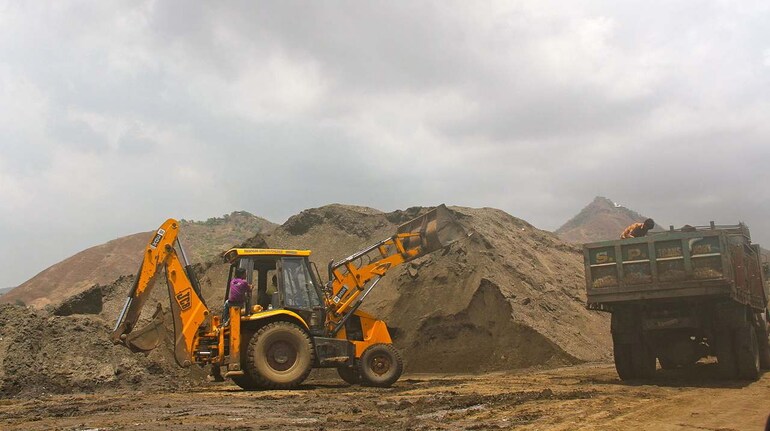
In Punjab’s Hoshiarpur district, particularly in the Mukerian subdivision, years of relentless mining have turned once-fertile farmland into vast pits and barren wasteland. The scars are deep with craters plunging 40 to 70 feet below the original ground level, according to a report by The Indian Express.
Adding to the destruction, the government has recently ordered fresh physical verification for 17 more proposed mining sites. The move has sparked outrage among local farmers, who say they are already fighting a losing battle against erosion. Heavy rains this monsoon have made matters worse, causing the edges of mined pits to collapse into adjoining fields, eating into cultivable land inch by inch.
Farmers in Pandori, Mehtapur, Mansoor Pur, Bishan Pur, and Barota allege that illegal and unchecked stone mining has already rendered nearly 400 acres unfit for cultivation and is now threatening their remaining plots and even their homes.
Farmers spend lakhs to save land
For farmers like Baljeet Singh of Pandori village, the losses are personal and immediate. “The edge of my field has already eroded by 3 to 4 marla in just a year during this rainy season. My house is just 1.5 killa (acre) away from the mined site, and we are extremely worried,” he was quoted by The Indian Express as saying.
Others are spending heavily to protect what is left. According to the report, Karnail Singh from Barota village has invested nearly Rs 1.5 lakh to construct a ‘nakka’ (mud embankment) using 250–300 tractor-trolleys of soil to reinforce his field’s edge. “I have spent nearly Rs 1.5 lakh just on making a ‘nakka’ (bandh) and deploying 250 to 300 tractor-trolleys of soil to reinforce the edge of my field. But erosion continues due to stagnant rainwater,” he said.
Adding to their fears, farmers say stone crusher operators are now purchasing more agricultural plots, raising suspicions of fresh mining activity. Maninder Pal Singh, from Pandori, claims crushers have already bought land as close as 22 feet from prime farmland and just two acres from his own home. “Government officials from the agriculture, mining, and district administration have started visiting. This is usually the first sign mining will restart,” he said.
In many cases, stone crushers initially paid farmers for shallow soil removal but kept digging deeper over time. This gradual deepening not only left the land hollow but also damaged neighbouring plots and destroyed access pathways. Locals warn of an additional hazard, some mining areas lie dangerously close to the BBMB Hydel Canal. Since the canal runs at a higher elevation, any breach or overflow could flood low-lying villages.
Fresh mining proposals lead to protests
Despite a Punjab and Haryana High Court stay on mining in the area for over 18 months, recent official letters have raised alarms. As per a letter dated July 23 from the SDM of Mukerian, referring to an earlier communication dated July 15 from the Deputy Commissioner’s office in Hoshiarpur, immediate physical verification was sought for newly proposed mining sites, including agricultural land, riverbeds, stone crusher mining areas, and land owned by private individuals, The Indian Express report said.
The Executive Engineer-cum-District Mining Officer listed 17 proposed agricultural mining sites in Talwara and Mukerian. Again, in a letter dated July 24, sarpanchs of respective villages were directed to submit reports regarding the proposed mining sites on the very same day the letter was issued.
Residents have strongly objected to mining proposals, especially Site Nos. 12 and 15, allegedly linked to a crusher in Mehatpur village. Villagers, under the banner of the “Zameen Bachao Committee,” sent protest letters to senior officials in the mining, pollution control, forest, and revenue departments.
Jagdish Singh Raja of Mehatpur, who heads the committee, said, “Punjab and Haryana High Court has already stayed mining activity at several concerned sites. Any attempt to permit mining now would amount to contempt of court. As per the Environment (Protection) Act and EIA Notification, 2006, a public hearing is mandatory before granting environmental clearance. However, no such hearing has been conducted.”
The protest also argues that fertile agricultural land cannot be converted into mining zones without a legal change of land use, something that has not been done. “This land is our livelihood. Once the topsoil is gone, the damage is irreversible,” the letter stated.
When contacted, Hoshiarpur’s Mining and Geology Executive Engineer Raj Kumar clarified that physical verification does not mean mining approval. “We will act strictly as per the law. If mining is legally permissible, it will be allowed. Public hearings can be part of the process,” he said.
How Mukerian became a mining hotspot
Mukerian, at the foothills of the Shivaliks bordering Himachal Pradesh, was once known for its seasonal streams, canals, and rich farmland. In the early 2000s, a few crushers began processing material from Himachal. But by 2008–09, sand and gravel mafias turned to local resources, first exploiting streams and canals, then targeting farmland near crushers, according to The Indian Express report.
With political backing and weak enforcement, the number of crushers increased. Sarpanchs facilitated mining on panchayat lands and encouraged farmers to lease their fields for attractive returns. As crushers spread from Ropar and Pathankot into Mukerian, farmland became the primary target for raw material.
Illegal night mining became routine, often backed by hired muscle. Many farmers, tempted by quick profits, earned more from selling soil than growing crops. Environmental rules requiring excavation limits and clearances were rarely followed. FIRs were filed in some cases, but most went unresolved, allowing mining to continue unchecked.
Today, the consequences are visible across Mukerian, with vast craters, collapsing field edges, lost topsoil, and ruined agricultural livelihoods.
Discover the latest Business News, Sensex, and Nifty updates. Obtain Personal Finance insights, tax queries, and expert opinions on Moneycontrol or download the Moneycontrol App to stay updated!
Find the best of Al News in one place, specially curated for you every weekend.
Stay on top of the latest tech trends and biggest startup news.