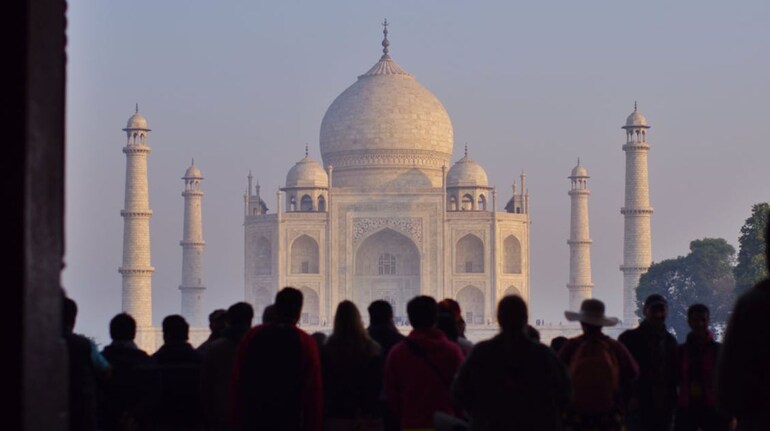
The Archaeological Survey of India (ASI) has expanded its conservation work on the Taj Mahal to include the monument’s four minarets, after signs of dampness were found in their marble joints.
The effort follows ongoing repairs on the mausoleum’s main dome, where seepage was detected after heavy rains last September. With ongoing repairs to both the dome and minarets, ASI engineers say their priority is to fortify weak joints against dampness and safeguard the monument’s delicate marble structure.
Dome repairs widen into full-scale conservation
According to officials quoted by TOI, thermal and LiDAR scans conducted after last year’s monsoon revealed water leakage from joints and cracks near the finial of the main dome. Cradles were earlier used to fill the gaps, but scaffolding was required for the latest round of repairs.
Subsequent inspections identified similar vulnerabilities in other sections of the 17th-century structure, prompting attention to the minarets. Work began on the western towers over the weekend, with scaffolding now visible to visitors.
‘Not separate work but part of conservation’
Prince Vajpayee, senior conservation assistant at ASI, stressed that the repairs are part of the same project. “It’s not a separate repair work, but part of the ongoing conservation. Whenever we take up any area, any minor work around it is also included. The work basically involves filling joints with mortar where it is missing or damaged. Currently, only the roof is being worked on,” he was quoted by TOI as saying.
He added that old mortar is being replaced with fresh paste to strengthen the structure and prevent dampness. Vajpayee also noted that the current interventions on the minarets are below the finial of the 273-foot-high main edifice. Officials assured that tourist movement remains unaffected.
Long history of leakage issues
This is not the first time the Mughal-era monument has faced water seepage. As far back as 1652, Prince Aurangzeb recorded leakage from two spots on the northern side of the dome following rains, noting dampness in the archways, galleries, verandas and underground chambers.
Later, in 1872, executive engineer JW Alexander oversaw repairs under British rule to tackle similar concerns.
India’s most visited monument
Despite recurring conservation challenges, the Taj Mahal continues to top India’s list of tourist destinations. Government data tabled in the Rajya Sabha earlier this year revealed that the monument generated more than Rs 297 crore in ticket revenue between 2019–20 and 2023–24 - the highest among all ASI-protected sites.
Discover the latest Business News, Sensex, and Nifty updates. Obtain Personal Finance insights, tax queries, and expert opinions on Moneycontrol or download the Moneycontrol App to stay updated!
Find the best of Al News in one place, specially curated for you every weekend.
Stay on top of the latest tech trends and biggest startup news.