




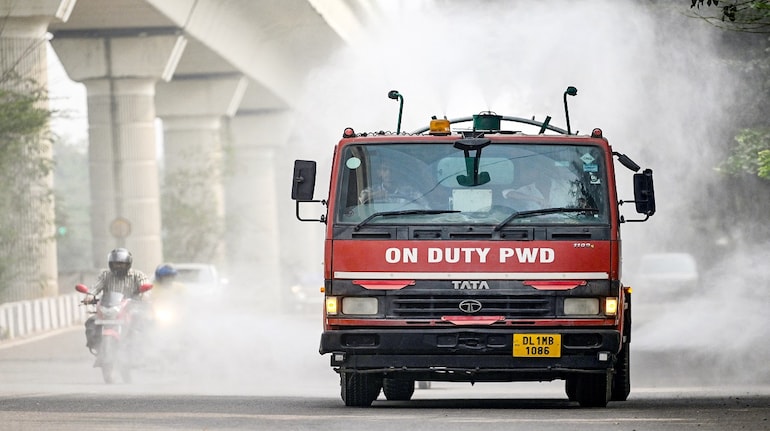
Four days after Diwali celebrations, a slight improvement was recorded in Delhi’s air quality early Friday, though the overall situation remains a significant public health concern.
The capital’s average Air Quality Index (AQI) registered at 293, categorised as ‘poor’, according to data from the Central Pollution Control Board (CPCB). This marks a dip from 325 on Thursday and 345 on Wednesday.
Despite this marginal city-wide decline, several areas continued to grapple with hazardous conditions. The Anand Vihar and Akshardham localities recorded AQIs of 403, firmly placing them in the ‘severe’ category, as reported by the CPCB.
Other major zones, including ITO (316), Dhaula Kuan (257) and India Gate (254), oscillated between ‘very poor’ and ‘poor’ levels. The AQI scale categorises readings from 201 to 300 as ‘poor’ and 301 to 400 as ‘very poor’, with levels above 401 considered ‘severe’ and hazardous to health.
In response to the persistently dirty air, medical professionals have advised residents of the National Capital Region (NCR) to restrict outdoor activities to only the essentials until air quality returns to at least the ‘moderate’ category.
The CPCB has forecast that the very poor air quality is likely to persist until at least Monday, October 27. The board noted that such conditions could lead to respiratory issues and eye irritation amongst the populace. While wind speeds have increased over the past 24 hours, blowing from the northwest at 10-15 kilometres per hour, meteorological relief may be on the horizon.
The India Meteorological Department (IMD) indicated that a new western disturbance may affect the western Himalayan region from October 27, though its potential impact on Delhi-NCR remains unclear.
Friday’s weather in the capital, as forecast by the IMD, featured a mainly clear sky with morning mist or haze. Temperatures were expected to range between a maximum of 31-33 degrees Celsius and a minimum of 17-19 degrees Celsius.
Beyond Delhi, the situation in NCR showed a mixed picture. While not a cause for relief, air quality in neighbouring cities was somewhat less dire. Data showed Ghaziabad's Sanjay Nagar recorded an AQI of 208, while Noida's Sector 1 and Sector 125 recorded 170 and 175 respectively, indicating a shift from the ‘red’ to the ‘orange’ zone. Greater Noida registered an AQI of 180.
With pollution levels expected to remain dangerously high for several more days, authorities and health experts continue to urge caution, pinning hopes on changing weather patterns to disperse the toxic haze enveloping the metropolis.
Discover the latest Business News, Sensex, and Nifty updates. Obtain Personal Finance insights, tax queries, and expert opinions on Moneycontrol or download the Moneycontrol App to stay updated!
Find the best of Al News in one place, specially curated for you every weekend.
Stay on top of the latest tech trends and biggest startup news.




