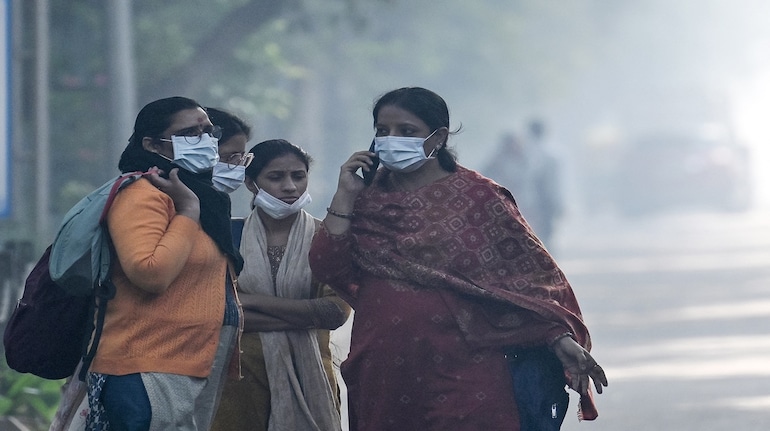
Delhi’s air quality worsened again on Monday morning, just a day after strong winds had offered brief relief to the city. The Air Quality Index (AQI) climbed back to 298 at 7 am, placing it close to the ‘very poor’ range, according to data from the Central Pollution Control Board (CPCB).
A thick layer of fog and smoke covered large parts of the capital, reducing visibility and making the air uncomfortable to breathe. Delhi had seen a short break from the choking pollution when the AQI dropped to 279 on Sunday. This was the second-best air quality reading recorded in November, with the lowest being 202 on November 5.
However, the improvement did not last long. Out of the city’s 39 monitoring stations, at least 22 reported ‘very poor’ air quality on Monday morning.
In south Delhi, Nehru Nagar recorded the highest pollution level in the city, with an AQI of 351, placing it in the ‘very poor’ category. On the other hand, NSIT Dwarka in southwest Delhi recorded a better AQI of 195, which is considered ‘moderate’. Despite this, most parts of the capital continued to struggle with unhealthy air.
Several well-known pollution hotspots remained in the ‘very poor’ category. These included Anand Vihar (323), Bawana (337), Burari Crossing (304), Jahangirpuri (319), Mundka (330), Punjabi Bagh (326), Shadipur (325) and Wazirpur (321). These areas continue to experience highly polluted air, causing concern for residents, especially children, the elderly and those with breathing problems.
Noida was the most polluted city on Monday with an AQI of 316 in the NCR region. Faridabad was the least polluted among the neighbouring cities, but even there the air was still ‘poor’ with an AQI of 208. Greater Noida and Ghaziabad also recorded ‘poor’ air quality, with AQI levels of 288 and 291 respectively.
Air quality better in 2025 so far
Despite the recent rise in pollution levels, officials from the Commission for Air Quality Management (CAQM) noted that the overall air quality from January to November this year has been better than in most recent years.
The average AQI for this period in 2025 stood at 187, compared to 201 in 2024, 190 in 2023 and 199 in 2022. Only three days this year saw the AQI cross the 400 mark, which falls under the ‘severe’ category. This is lower than the number of severe days recorded in previous years.
Delhi weather today
Along with rising pollution, Delhi also experienced a drop in temperature. The minimum temperature on Monday morning was recorded at 8.3 degrees Celsius, which is around two degrees below the normal for this time of year. The maximum temperature reached 24.3 degrees Celsius, also slightly below average.
According to the India Meteorological Department (IMD), this November has been Delhi’s coldest in the past five years, with an average minimum temperature of 11.5 degrees Celsius.
For today, the IMD has predicted similar weather conditions, with the maximum temperature likely to be around 24 degrees Celsius and the minimum around 8 degrees Celsius.
Discover the latest Business News, Sensex, and Nifty updates. Obtain Personal Finance insights, tax queries, and expert opinions on Moneycontrol or download the Moneycontrol App to stay updated!
Find the best of Al News in one place, specially curated for you every weekend.
Stay on top of the latest tech trends and biggest startup news.