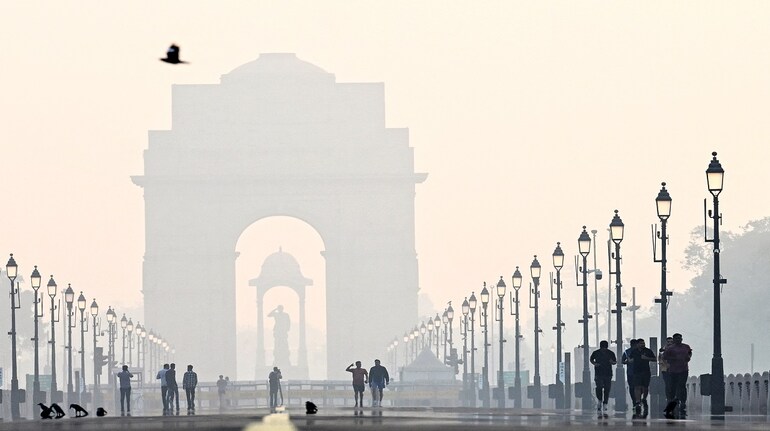
The Air Quality Index (AQI) in Delhi slightly improved on Saturday morning but remained under the 'poor' category as the overall AQI stood at 259. However, Anand Vihar area still recorded air quality in 'severe' category, according to the Central Pollution Control Board (CPCB),
Stage II of the Graded Response Action Plan (GRAP) is in effect across Delhi-NCR.
In south-west Delhi, the AQI in RK Puram remained at 265, while Patparganj recorded 263, both classified as 'poor'. Anand Vihar in east Delhi recorded an AQI of 412, placing it in the ‘severe’ category.
#WATCH | The Air Quality Index (AQI) around Anand Vihar area recorded at 412, in the 'Severe' category, in Delhi this morning as per the Central Pollution Control Board (CPCB). pic.twitter.com/g6jEckkNzM— ANI (@ANI) October 25, 2025
Truck-mounted water sprinklers were deployed on Janpath Road to tackle the high levels of particulate matter, as air quality in several areas remained largely in the ‘very poor’ range, ANI reported.
Other areas of concern included Bawana, where the AQI was recorded at 336, classified as ‘very poor,’ and ITO, which registered an AQI of 248. Dwarka recorded a comparatively lower AQI of 276, still within the ‘poor’ range, highlighting the uneven distribution of pollution across the capital.
As Delhi continues to grapple with deteriorating air quality, Chief Minister Rekha Gupta on Friday said that cloud seeding has become a necessity for the national capital and termed it a pioneering step in addressing the city’s persistent environmental crisis.
Speaking to ANI, Rekha Gupta said, “Cloud seeding is a necessity for Delhi and is the first experiment of its kind. We want to try it in Delhi to see if it can help us control this very serious environmental problem.”
She added, “So the blessings of the people of Delhi are with the government, and we feel that this will be a successful experiment and in future, we will be able to overcome these environmental problems.”
Meanwhile, on Friday, former AIIMS Director Dr Randeep Guleria cautioned residents about the serious health implications of rising pollution and urged preventive measures to minimise exposure.
“The current high levels of air pollution, indicated by poor AQI, are leading to acute health effects, particularly among individuals with underlying heart or lung conditions, the elderly, and young children. These groups are experiencing increased chest discomfort, breathing difficulty, cough, and worsening of pre-existing conditions like asthma and COPD,” Dr Guleria told ANI.
Discover the latest Business News, Sensex, and Nifty updates. Obtain Personal Finance insights, tax queries, and expert opinions on Moneycontrol or download the Moneycontrol App to stay updated!
Find the best of Al News in one place, specially curated for you every weekend.
Stay on top of the latest tech trends and biggest startup news.