




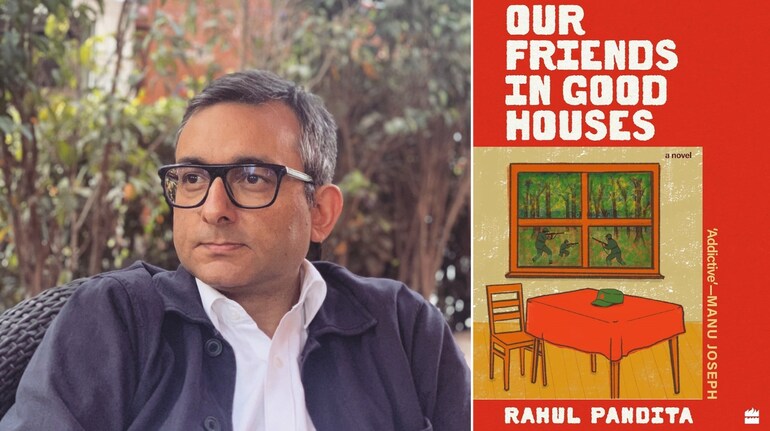
Rahul Pandita is a journalist who is known for his reporting from war-torn areas. He is the author of Hello, Bastar: The untold story of India's Maoist Movement; Our Moon has Blood Clots: A memoir of a lost home in Kashmir; The Lover Boy of Bahawalpur; and the co-author of The Absent State. He was awarded the International Red Cross Award for conflict reporting in 2010. His debut novel, Our Friends in Good Houses, has just been published by HarperCollins India.
Our Friends in Good Houses is about Neel, a journalist drawn to war zones. It's in these spaces riven by conflict that his sense of dislocation, of not belonging anywhere, drops off him. At all other times, he's in quest, seeking solid ground: a home. It is a pursuit that takes him halfway across the world to America and back to the urban dystopia of Delhi, headlong into fleeting relationships that glimmer with the promise of shelter.
He is a Yale World Fellow and also the recipient of the New India Foundation Fellowship. He lives in Delhi.
The following interview was conducted via email.
How and why did Our Friends in Good Houses come about? Would you like to elaborate on the title too?
RP: A major part of my journalistic career has been spent at the cusp of journalism and writing, what David Foster Wallace would term as being a "non-journalist journalist." It means that I wrote in a certain way, to build the narration of a story in a particular way. The idea always was to offer a Denkbild, or thought-image to my experiences. But even as I was doing it, I felt an inadequacy in my dispatches, namely that it did not have that additional layer of meaning that, in my view, made it complete. Through Our Friends in Good Houses I think my attempt was to put that additional layer. But it was also an attempt to make sense to myself of so many things I had experienced out there.
The title came to me very organically. Its meanings changed for me at different stages of writing. I'd like the readers to have the chance to derive their own meanings from it.
For most of your professional life, you established your credentials as a memoirist and a narrative nonfiction writer. So, why did you choose to write fiction? How many years did it take to write this novel?
RP: Fiction simply for reasons mentioned earlier. But also, because I felt that there are some truths you come closer to in fiction than in non-fiction. I was telling my editor Dharini Bhaskar the other day that I have no belief in psychoanalysis. But in many ways, this novel is me lying down on a couch, smoking a cigarette, while a psychoanalyst in tweed jacket with leather elbow patches, who, lo and behold, is also me, hears me out. It is like what the Buddhists say: Thought is the thinker.
The first passages of the novel were written in the US in the year 2015. But a majority of it was written between 2022-23.
In a recent panel discussion in Rome, Juan Gabriel Vásquez said that "There is a sense in which we have as novelists that we can say anything, we can discuss anything because the way stories go, seems to make them, seems to enjoy a certain kind of impunity." Thoughts?
RP: I think what Vásquez calls “impunity” is really the moral latitude of fiction; it is the permission to wander into difficult or uncomfortable territories without the burden of having to declare a position. A novel can explore what is unspeakable in ordinary language because it doesn’t argue; it listens, it witnesses, it imagines. Storytelling allows for that simply because it creates a space where contradictions can coexist without needing to be resolved.
In Our Friends in Good Houses, I found myself drawn to lives caught between belonging and estrangement, love and loss. These are not easy moral terrains, and yet fiction allows you to walk through them without fear of judgment — to feel your way, rather than reason your way, toward understanding. That’s the novelist’s real privilege, perhaps: not impunity in the sense of freedom from consequence, but the deeper freedom to look closely, to stay with the discomfort, and to find in it some trace of truth.
What are the freedoms that fiction enables and empowers a writer with that non-fiction does not?
Fiction gives you the freedom of uncertainty, the freedom to not know and to write anyway. In non-fiction, there is an implicit contract with fact, a responsibility to the verifiable. But fiction allows you to approach truth obliquely, through emotion, through intuition, through invention. You can tell a lie that reveals something profoundly true.
When I’m writing fiction, I’m not accountable to chronology or evidence; I’m accountable to the inner weather of a character, to rhythm, to silence, to the unsaid. Fiction lets you stretch time, blur voices, or inhabit contradictions that reality might resist. It allows for moral complexity without the need for moral clarity.
What is the difference between reportage and fiction? What are the different demands that these writing styles make upon the author?
RP: Reportage and fiction share a common impulse: understanding human experience; but they travel toward it through very different routes. Reportage demands fidelity to the visible world; fiction demands fidelity to the inner one. In reportage, the writer is a witness. The reporter’s task is to see clearly, to document with precision, to stay alert to what is real and verifiable. The discipline is outward: you listen, you observe, you report. Fiction, on the other hand, asks you to surrender certainty.
In this age of migrations and conflicts, the idea of home is very fluid. What is your definition of home?
RP: I wish I could articulate that. But I can tell you this much: it is a sacred space, a hermitage. And it is something that is inseparable from love.
Conflict writing is your forte. Whether as a survivor or as a writer. But this novel describes multiple levels of conflict, even those that exist in domestic spaces. What are the emotional see-saws that you registered while writing?
RP: I've spent much of my writing life inside the vocabulary of external conflict. But while writing Our Friends in Good Houses, I had to meditate upon how those same fractures replicate themselves in smaller, quieter rooms. The domestic space can be just as volatile; love can wound as sharply as any shrapnel.
Is it fair to ask an author about the similarities between their life and the fiction that they create?
RP: The writer always draws something from his life or from those around it. Fiction is never hallucination unless one is describing hallucination experienced by a character. Invariably, that experience will also turn out to be that of the writer. Beckett had a heart murmur, so had Murphy. But having said that, a lot of it also bears no similarity. With the first novel, though, the similarities can be much more. As my friend Manu Joseph told me the other day: the real challenge is the second novel. Ha ha ha.
How much war and other types of literature did you read to write Our Friends in Good Houses or was that unnecessary?
RP: I had no need; I have been to enough wars myself.
Discover the latest Business News, Sensex, and Nifty updates. Obtain Personal Finance insights, tax queries, and expert opinions on Moneycontrol or download the Moneycontrol App to stay updated!
Find the best of Al News in one place, specially curated for you every weekend.
Stay on top of the latest tech trends and biggest startup news.