The End of Geography?
The Internet may have collapsed distances and blurred boundaries, but to argue for the end of geography would be laughable as we touch the twenty-first century’s quarter-way mark. Not since World War II have we witnessed conflicts as fierce and a collective resolve to kill or be killed as steely as a result of people’s obsession with land.
This obsession has taken many forms. The 2020s are seeing ferocious battles for belonging in the Middle East, spurred by the quest for a homeland. In Europe, aggressive efforts at territorial expansion are being driven by a desire for power and control and by mutual insecurity. In Asia, the Taliban are imposing anachronistic structures and systems on the Afghan populace in a bid to govern land by altering the socio-cultural arrangements it supports. In Africa, people and places are being pillaged in a murderous fight over natural resources.
And the impulse towards geopolitical dominance has led to a collision and decoupling between two countries of the east and west. Geography has never been as conspicuous in world affairs as it is today. Our book doesn’t suggest a diminishing of the centrality of geography. We recognize that the bond between people and locale is the foundation of sovereignty and shapes every country’s national temper. We seek instead to problematize the relation between humans and geography. The drivers of this relationship have changed dramatically, and geography is being replaced by geotechnography—a collision of geography, technology and society. Our rootedness in land is now contending—and conflicting—with a new sense of self built by engaging with social media and other global digital platforms.
The agendas and aspirations of citizens, governments and tech businesses aren’t necessarily congruent though. The friction between them is the greatest defining phenomenon of our time. With much of the world swarming online, new sites for agreement and discord are mushrooming every minute. Throughout our book, we use the terms ‘clouds’ or ‘cloud societies’ to refer to virtual communities that are anchored in particular geographies but use the Internet and social media to share views, exchange opinions, band together with like-minded peers or interest groups or engage in online political action.
Cloud societies influence land-based debates and often assault offline consensuses. On the other hand, they amplify real-world movements, and the momentum they generate online could cross back into the offline realm in the form of new campaigns. As flames engulfed Gaza in October 2024, thousands of protesters carrying Palestinian flags hit the streets in capitals across the world to condemn what they saw as Israel’s atrocities.
The protesters were mobilizing en masse around digitally broadcast images of a distant war in which they didn’t have a personal stake. They were responding to online calls for action and courting technology and the media—and a flood of online information, even misinformation and disinformation—to choose sides and build solidarity. Two years prior, people in France had marched in support of women’s right to wear hijabs in Iran, at a time when France itself had banned hijabs in sports and burkinis at the beach.
And the 2020 Black Lives Matter movement against the unlawful killing of George Floyd by police in the United States erupted into digital protests followed by physical ones in more than sixty countries. As members of cloud societies, our immersion in a digitally mediated universe allows us to consume the histories of those far away, whose memories and ideas are available to us in real- time. What’s trending online helps script our own narratives, and the latter come unstuck from us and become a slice of a larger, globalized experience.
Our participation in this process of ‘despatialization’—the shrinking of space and time that redefines our connection to the world—is a core feature of the cloud. Our involvement usually goes well beyond simple participation though. Our very understanding of history is moulded by mediated narratives and selective engagement with events whose portrayal may be biased or subjective. The ‘mediated historicity’ we live by is the cloud’s second defining feature. Despite their growing size, power and influence, however, it’s difficult to imagine that cloud societies might ever meaningfully replace their landbased counterparts. That brings us back to the supreme importance of land, but there’s another difference now.
As digital societies evolve, attacks of ever greater sophistication originating from the cloud will cause mayhem in the real world. By the end of 2024, cyber-attacks may cost the global economy more than US$10.5 trillion.
The frequency of cybercrimes too is growing at breakneck speed, with the global cost of cybercrime expected to shoot up from US$9.22 trillion in 2024 to as much as US$13.82 trillion in 2028. Artificial intelligence (AI) is becoming central to arsenals and offensives and AI-powered drones8 and exploding = pagers will find a place on the battlefields of the future. From peacebuilding to war, every area of human endeavour is shaped indelibly by digital spaces. Stacks of digital layers determine our politics and place in the world. We’ve reached a moment where we need to start renegotiating our relationship with geotechnography.
The Three Arcs of History
Our book engages with thousands of years of human experience, and we believe we’re at the breaking point today as new conflicts escalate, involving people, land and technology. American political scientist Samuel Huntington warned in 1968 that modernization involves in large part the ‘multiplication and diversification of the social forces in society’. When the latter happens, the ‘slow development of political change’ can no longer keep pace with ‘rapid social change and the rapid mobilization of new groups into politics’.
Consequently, ‘violence and instability’ break out, the values of new groups undermine older bases of association and authority, and the resulting conflicts produce alienation and anomie. In the present century, social media are accelerating this process of disintegration, with groups forming online at great speed, and massive volumes of ideas and viewpoints circulating freely. Despite the free flow of information, however, the digital public sphere is actually shrinking as a cacophony of strident voices and opinions appropriates the space for rational, well-reasoned debate. As always, democracies are more vulnerable to these disruptions than autocratic systems are.
The importance of place to the way people think and act, and the emergence of cloud societies that drive novel forms of engagement and action, are outcomes of three arcs of history. The first of these arcs begins with the genesis of human settlements themselves. Settlements emerged and thrived when geographical environments met the needs of settlers. Societies located near rivers, water sources and fertile land developed agriculture, leading to the growth of advanced civilizations. Mesopotamia’s Fertile Crescent and regions like the Nile delta and the Indus Valley, for instance, flourished because they supported farming.
As agrarian communities spread across these regions, settlers began to enjoy food surpluses, and mercantile towns grew organically, facilitating trade and economic expansion. Geography also impacted the diffusion of technology and ideas. Societies that were well connected by land or sea, or near other advanced societies, benefited from trade, communication, shared knowledge, and the exchange of innovations like iron technology that resulted in more resilient and robust communities.
As communities grew in size and complexity, they evolved internal laws and governance systems; and it was from these seeds that the idea of the sovereign nation-state was born. Following the Peace of Westphalia in 1648, it became possible to think of the ‘nation’, in Benedict Anderson’s words, as an ‘imagined political community’ whose people are bound together by the idea of belonging to the same nation, and who feel ‘a deep horizontal comradeship’ towards each other irrespective of the actual inequalities that may separate them.
This sentiment—the need for a homeland one can call one’s own—animates every nation today. The second arc involved the transition from agrarian to industrial societies. A complex chain of factors—including increases in food production, urbanization and a series of strides in iron technology—led to the First Industrial Revolution that lasted from around 1760 to 1840. The wave of industrialization that started in Britain soon spread to other parts of the globe, and the advent of steam engines, railways, factories and mechanized manufacturing collapsed distances both real and imagined.
That set the stage for the Second Industrial Revolution, which lasted from the 1870s to the mid-twentieth century and brought the world electricity, internal combustion engines, Fordist assembly lines, the telegraph and telephone and media networks. These inventions were so pivotal that most of them are still with us 150 years later, though in newer avatars. The third arc is represented by the information age and the digital revolution. The first segment of this arc comprises the heady period spanning the 1960s to the beginning of the twenty-first century, which is now referred to as the Third Industrial Revolution.
The period marked a definitive shift from traditional industry to a more globalized economy driven by information technology, or a dislocation of economic activity from land. Today, it’s impossible to imagine a world without the Internet, personal computing and semiconductors. But the consumer Web that’s so transformed our lives only opened to the public in 1991 and began to enter into general use by 1994. In 2025, therefore, the public Internet has been with us for just over thirty years, a fraction of the time taken for earlier industrial revolutions and their effects to play out. There’s little doubt that the digital revolution has been the fastest, most explosive and most concentrated one in human history.
Sixty-six per cent of the world’s population—or 5.35 billion individuals use the Internet. And over 62 per cent, or 5.04 billion people, are on social media platforms. This large and steadily growing base of Internet and social media users has opened up a wealth of opportunities for online exchanges, access to services and e-commerce, democratic participation in political and economic life, and activism and cause-based mobilization.
Since the 1990s, we have been subject to a surfeit of brands and images, thoughts and ideas, a considerable proportion of which—much like commercial Internet-based platforms themselves—originate in the United States. As a new millennium dawned, access to a common universe of content, and the means for connecting instantly with people in other geographies triggered much celebratory euphoria around a new-found cosmopolitanism.
The arc’s second segment, which we’re living through today, began with the rise of social media giants in the early twenty-first century. Social media initially seemed like a revolutionary tool for building concatenations of relationships and turbocharging globalization, but they have exposed disturbing fault lines in the behaviour of digital societies. The zeitgeist of the early 2000s was about forging connections, sharing impressions, co- creating content and building an age of intangibles. YouTube was launched in 2004, Facebook in 2005, Twitter in 2006, WhatsApp in 2009, Instagram in 2010 and TikTok in 2016.
Social media platforms continue to build bridges and serve as a rallying point for specific issues, but for all their benefits, the past two decades have also revealed how many of them operate, and the way their algorithms reinforce impulses towards polarization, nativism and tribalism. Echo chambers make alternate perspectives invisible and harden users in their views. And fake news, hate speech and extremist content have exploded online, with damaging real-life consequences. Quite simply, an excess of ideologies and positions is proliferating in cyberspace, and relatively few are constructive.
Capitalism on Steroids?
With the advance of the twenty-first century, we have moved deeper into the Fourth Industrial Revolution—a tech-driven epoch that ‘builds on the digital revolution and combines multiple technologies’ leading to paradigm shifts in every sphere. This is an era that’s ‘evolving at an exponential rather than linear pace’, and the blistering pace of change is impacting not just how we do things but who we are as individuals and society.
Big Tech firms and a few other large technology companies are among the principal engines of this change, given their global reach, market share and outsize influence. Several chapters of our book deal with the risks posed by the dominance of Big Tech. In Lawrence Lessig’s famous phrase, these companies use to influence, direct and dictate the behaviour of digital societies. They covertly track every move users make, amassing ill-gotten empires of personal data. They indulge in anticompetitive practices in a bid to quash rivals.
In their haste to get to market, they sometimes sacrifice the guardrails that could have made products safer. They pay scarce heed to the climate costs of their technologies. And they create user dependencies in a manner that nearly always makes their services our first recourse for support. While we draw attention to these tendencies and criticize them, we’re not anti-business, anti-market or even anti- capitalist. What we’re opposed to is the idea of capitalism on steroids that the excesses of Big Tech have come to represent. We believe that innovation is laudable, but not at the cost of privacy, safety and ethics. We believe too that markets will always be the central channel for delivering innovation and benefits at scale.
We suggest therefore that markets be provided with a basic regulatory undergirding for new technologies to remain non- predatory, non-exclusive and locality sensitive. Also, while we reflect on certain mechanisms that are helping push back against some of Big Tech’s incursions— for example, the European Union’s General Data Protection Regulation (GDPR) is enforcing a more transparent and responsible approach to data governance, and India’s digital public infrastructure is levelling the domestic playing field for enterprise and innovation—we’re not advocates of ‘Big Gov’. We believe instead in nuanced and agile multistakeholder frameworks, and in light-touch regulations that empower both businesses and citizens.
We offer no prescriptions for governments— each must look within to find regulatory solutions that are compatible with its own systems. Four fundamental ‘design flaws’ underlie today’s geotechnographical landscape, and much of the churn in contemporary digital societies can ultimately be traced to them.
First, the political economy of technology—where the values of certain centres of production are being imposed on sites of consumption—is no longer tenable. The ideologies of Silicon Valley are being made to force-fit local markets with a wholly different provenance. Facebook, Twitter and YouTube were born and bred in an environment where free speech enjoys strong protections under the First Amendment to the US Constitution.
For the most part, the US government cannot restrict what individuals say online, and the press too can publish information and opinions without fear of control or punishment. But when a platform that encodes these beliefs is transplanted in another geography with a different understanding of permissible speech, the clash of people and values could be immediate and visceral. While most cultures seek the right to free speech, they also set boundary conditions that must be met. By creating spaces whose very architecture allows these conditions to be ignored, transnational social media have institutionalized the right to offend.
At a broader level, as more nations boost their tech capabilities, they’re keen to be recognized as innovators and producers in their own right and not merely as markets for technologies developed elsewhere. Second, the concept of citizenship is a product of belonging to a nation, being governed by a certain regime, and having in place a framework such as a constitution that defines the nature and scope of governance. But today this contract between citizens and the state is increasingly mediated by private players. Cloud service providers like Microsoft, Amazon and Google, giant online retailers and social media companies provide critical infrastructure in the economic and political spaces. What’s disturbing though is that while these businesses ought to be accountable to the country they’re operating in, borders appear to mean little to them as they act with impunity, with scant regard for local laws. In 2023, for instance, the Indian government called out Twitter for repeatedly violating national laws and refusing to comply with requests to take down harmful content.
And in 2024, WhatsApp and its parent company Meta issued an ultimatum to India, threatening that WhatsApp would pull out of the country if the government continued to require social media companies to break end-to-end encryption in order to assist law enforcement authorities. As private actors vie to provide public utilities on self-serving terms, they undermine the position of governments and citizens.
Third, the dichotomy between sites of innovation and those of regulation influences how technologies are developed and distributed. Historically, the US has been the world’s leading centre for digital innovation. In the space of AI for example, in 2023 alone USbased institutions produced sixty-one significant AI models, far ahead of the twenty-one from the European Union and fifteen from China.
As of 2024, the country led AI research and technology, with 60 per cent of the world’s top- tier AI researchers and private funding worth US$249 billion. Europe on the other hand, is regarded as a pre-eminent centre for tech regulation. It’s no coincidence that the world’s first full-blown AI Act and its toughest data protection regime, the GDPR, originated in the EU; nor that the Council of Europe adopted the Framework Convention on Artificial Intelligence, the first international legally binding treaty to ensure that AI upholds human rights. These trends empower Silicon Valley and Brussels to drive the global agenda on innovation and regulation and make tech developers especially anxious to court them.
It also means that tech principles that are regarded as ‘universal’, ‘responsible’ or ‘trustworthy’ stem from an elite subset of the Global North and serve it, while the needs of emerging economies and developing countries are regarded as marginal at best. Fourth, there is a ‘capabilities asymmetry’ between geographies that impacts their response to technology and shapes trajectories of tech adoption.
In some locales, digital developments are an organic part of social evolution, but in others, they represent the process of leapfrogging to an advanced product or service without any real precedent. The excitement around leapfrogging notwithstanding, the process also creates institutional logjams. For a while in 2016, Thailand banned motorcycle ridehailing services like Uber and Grab, worried about the lack of legal frameworks to regulate them.
Similarly, in June 2021 the Nigerian government suspended Twitter, citing concerns over its limited ability to regulate the social media after the platform deleted a tweet by President Muhammadu Buhari. The shutdown lasted seven months and disrupted political discourse and civic engagement. It reflected a classic bind: how is a nation with meagre tech capacities to manage social media platforms while trying to uphold freedom of expression? As these four sets of challenges demonstrate, the ‘power of place continues to determine every aspect of tech production and use even today.
The relationship isn’t an easy one, and propelled by a desire for autonomy, governments, corporations and citizens often find themselves locked in a three-way contest whose greatest casualty is proving to be the once-hoped-for egalitarianism of cyberspace.
Democracy and technology are more deeply enmeshed than ever before, but the seeds of distrust against Big Tech and similar companies have been sown. Their concentrated power has begun to resemble the grand industrial monopolies of bygone eras, but they’re too vast, dominant, complex and fast-moving for governments to consider many of the conventional solutions once applied to anticompetitive behaviour.
Innovation is far outpacing regulatory change, and cloud societies and other communities are grappling with digital shifts, disrupted truths, cultural tensions and growing uncertainty. Gradually however, a ‘techlash’ is beginning to break out. After the peak comes the crash, and as this century’s first quarter draws to a close, we must pause to ask: How do we reboot the present to ensure that the future doesn’t repeat the errors of the past?
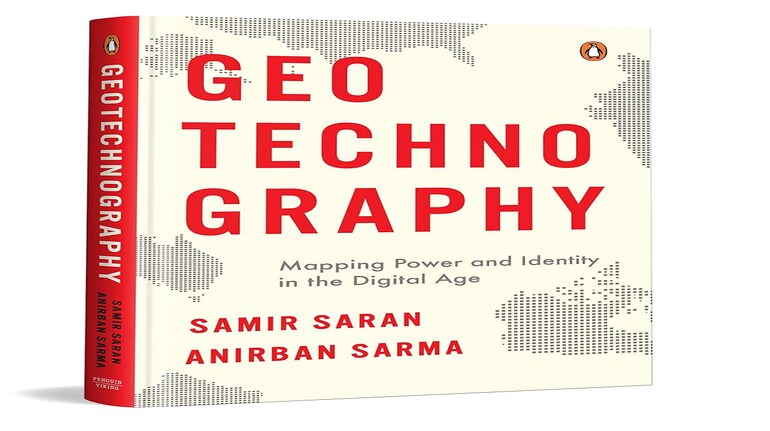
Samir Saran and Anirban Sarma Geotechnography Penguin Random House India, Gurugram, 2025. Hb. Pp.328
In an era defined by rapid technological change, a seismic shift is underway, one that is transforming every aspect of our lives. From the rise of digital platforms that mediate our interactions--with markets, with governments and perhaps most importantly with each other-- to the growing tension between our online personas and our real-world identities, the forces of technology, geography and society are colliding in ways we are only beginning to understand. Even as technology opens up new opportunities for civic engagement, it simultaneously disrupts the very foundations of societal cohesion.
The digital age has given rise to a new stage for global drama--one where surveillance, misinformation and the erosion of trust in multilateral institutions are playing out in real time. But as these forces evolve, so too must our understanding of how societies can navigate them. Will digital societies endure, or are they doomed to collapse under the weight of their own contradictions? Can democracy as we know it survive in a world where power is increasingly concentrated in the hands of a few tech giants? And as nations grapple with the changing dynamics of governance, how will international norms, laws and institutions adapt? In GeoTechnoGraphy, Samir Saran and Anirban Sarma offer a compelling analysis of the forces reshaping the modern world. Drawing on groundbreaking research and incisive insights, they examine how the convergence of geography and technology —geotechnography — is rewriting the rules of power. The book excerpt that has been published here is an excellent primer to the term “geotechnography”.
It is a portmanteau word that cleverly describes the coming together of spatial distances as examined by geographers and the world of technology. It is true that technological advancements in the twenty-first century have broken past geo-political barriers to create online/cloud communities. It raises many questions about our realities, identities, security, data management as well as of responsibilities. This is the crux of the discussion in GeoTechnoGraphy. There are plenty of examples offered to illustrate the eight chapters.
These are worth listing as they are illuminating about the flux in this relationship between tech giants, technology, politicians/governments/nation states, and individuals. The chapters are: “Children of Our Landscape: Geography, Affinity and the Rules-Based Order”, “The Death of Geography? Cyberspace, Borderless Worlds and the New Tribalism”, “The Mediated Self: A New Relationship with the World”, “From Censers to Censors: Is Big Tech the New Clergy?”, “Achilles’ Last Stand: The Resuscitation of Autonomy”, “Apocalypse Now: Will Digital Societies Survive?”, “Terminated? AI and Our Human Future”, and “Rebooting History: A Rules-Based Order for the Digital Age”. Mukesh D. Ambani, Chairman and Managing Director, Reliance Industries Ltd., says that “GeoTechnoGraphy explores the dual forces shaping our future: the transformative potential of technology on society and the perils of the contest for dominance. A book that is as timely as it is thought-provoking”.
Marietje Schaake, Fellow, Standford University says that “This must-read book guides us through the dramatic changes of our time”. Nandan Nilekani, Cofounder and Chairman, Infosys, and Founding Chairman, UIDAI (Aadhar) says that it is “A bold and visionary work that offers a profound rethinking of the forces shaping our world.” Undoubtedly, GeoTechnoGraphy requires pauses between reading so as to gather one’s thoughts but it is worth spending time with. Buy it. Read it. Think about it. Reflect upon it. Samir Saran is the President of the Observer Research Foundation (ORF). His research focuses on issues of global governance, climate change and energy policy, technology and media, and India's foreign policy. As ORF's President and member of the Foundation's Board, he provides strategic direction and leadership to the foundation's multiple centres on fundraising, research projects, platform design and outreach initiatives including stakeholder engagement.
He curates the Raisina Dialogue, India's annual flagship platform on geopolitics and geo-economics, and is the founder of CyFy, India's annual conference on cybersecurity and internet governance. Samir is the Chair of World Economic Forum's Global Future Council on Geopolitics and a member of WEF Global Risks Advisory Board. He has served as a Commissioner of The Global Commission on the Stability of Cyberspace. He is a member of the Board of Directors at ORF America. He is also a part of Board of Governors of The East West Centre. Samir has authored four books, edited important journals and publications and written several academic papers and book chapters. He is featured regularly in Indian and international print and broadcast media. His latest publications include The New World Disorder and The Indian Imperative with Shashi Tharoor, Pax Sinica: Implications for the Indian Dawn with Akhil Deo and Raisina Chronicles: India’s Global Public Square with India’s External Affairs Minister, S. Jaishankar. Anirban Sarma is Deputy Director of ORF Kolkata and a Senior Fellow at ORF's Centre for New Economic Diplomacy. He is also Chair of the Think20 Task Force on 'Our Common Digital Future'. Anirban's research focuses on the use of technology for sustainable development, the digital economy, the media, and international cybersecurity cooperation. In the tech-for-development space, his research has explored issues around online safety, the future of work, digital public infrastructure, data for development, digital health, cleantech, and women's empowerment and inclusion, among other areas. Anirban was formerly the Chief International Outreach and Communications Officer at the National Digital Library of India, a flagship project of the Ministry of Education. He earlier served at UNESCO for over eight years, designing and managing UNESCO's initiatives on ICTs, access to information and media development across South Asia. He has also worked at Weber Shandwick, a global public affairs agency, supporting projects for leading clients at the firm's Centre of Excellence.
Discover the latest Business News, Sensex, and Nifty updates. Obtain Personal Finance insights, tax queries, and expert opinions on Moneycontrol or download the Moneycontrol App to stay updated!
Find the best of Al News in one place, specially curated for you every weekend.
Stay on top of the latest tech trends and biggest startup news.