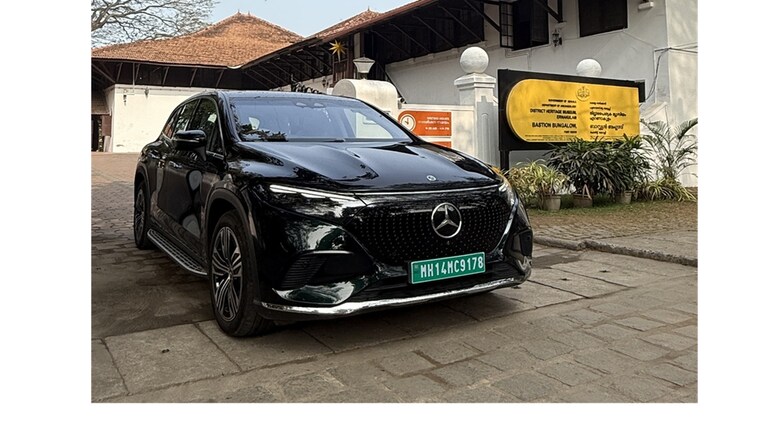

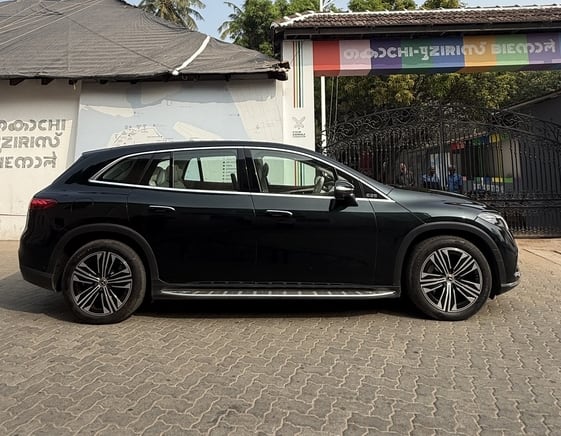
The Mercedes-Benz EQS SUV 450 came-in shortly after the brand’s EQS sedan misfire. An electric alternative to the formidable S-Class, the EV version, despite its alluring pricing, didn’t quite prove to be a match. The EQS SUV 450 changed that. It offered more utility, more space and therefore, more value for money. The EQS SUV 450 gets a massive 107 kWh battery which, on paper, gives it a range of nearly 800km. But its greatest weapon is its slippery, ultra-aerodynamic form which undoubtedly adds double digits worth of range to this massive, 3-tonne, 5-metre long battery-powered behemoth.
The EQS SUV 450 then, is the best EV in the country for a long-distance, interstate journey. Having driven enough EVs in the city of Mumbai, even without the benefit of home charging, I wanted to explore just how feasible it is to drive nearly two thousand kilometers in an EV. Setting the Satnav to Bengaluru, I set off early in the morning with a fully charged battery and roughly 600 km of real world range. With a total distance of 1100 km to cover on the first leg of the journey, I anticipated two charging sessions, each lasting 30 minutes when plugged-in to a 120 kW charger, which, by my calculations, would give the EQS a 40% charge, which would be reduced to 20% if I were to utilise a 60kW charger.
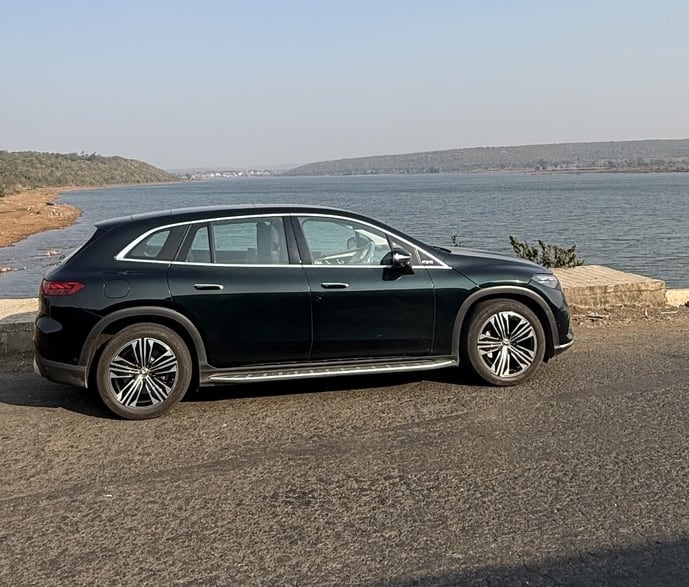
But first a bit about the SUV itself. Stepping into the Mercedes-Benz EQS SUV 450 is less like entering a car and more like boarding a terrestrial yacht designed by a Silicon Valley wunderkind. It is a cabin that doesn't just embrace the future; it attempts to outrun it.
The undisputed protagonist here is the MBUX Hyperscreen. It is a 56-inch glass monolith that sweeps across the dashboard, housing three distinct displays: the driver’s instrument cluster, a massive central OLED hub, and a dedicated screen for the front passenger. It operates on a "Zero Layer" philosophy, using AI to proactively surface the apps you need—navigation or seat massage—before you even think to ask.
But beneath the digital gloss lies old-school sensory indulgence. The materials are a masterclass in tactility—think Nappa leather, open-pore walnut with laser-cut aluminum inlays, and the distinctive Neotex surfaces that bridge the gap between nubuck and high-tech neoprene. The seats don't just hold you; they offer "Energizing Comfort" programs that synchronize climate, fragrance and 15-speaker Burmester 3D surround sound to turn a traffic jam into a spa session.
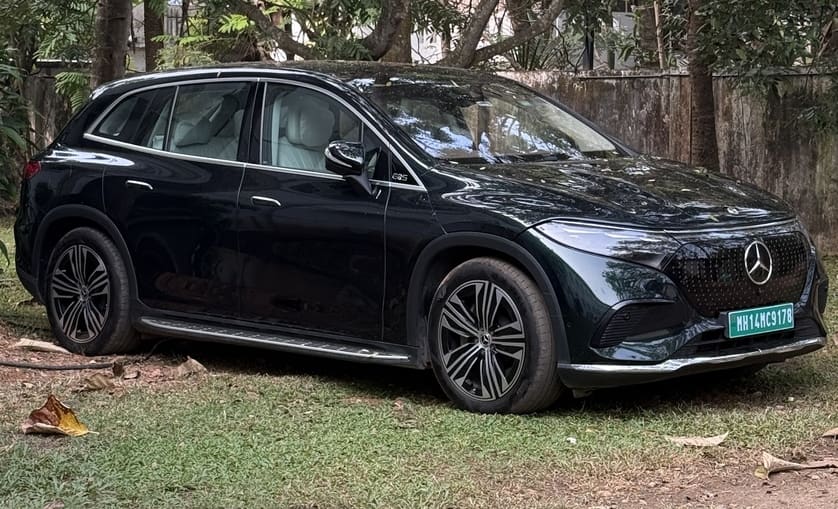
Whether you opt for the five or seven-seat configuration, the second row remains the "boss" seat, featuring powered recline and plush microfiber pillows that make the S-Class feel like it has a serious rival in its own house.
The State of Charge
When embarking on a journey that’s nearly twice the real-world range of the car, there’s a considerable learning curve. India’s public charging network has grown at a rapid rate. So much so that even in remote locations and towns, a functional public charger can be found. A multitude of apps, from Jio-BP which has the most extensive 60kW charging network to Tata EZPower and Statiq - arguably the best app to use. However, distance alone doesn’t determine the level of range. Bengaluru lies at an altitude of over 900 feet and climbing the ghat section of the Mumbai-Pune expressway saw a considerable drop in range, even after having covered a little over 200km.
Then comes the element of surprise. Perfectly manicured, spacious food kiosks with large and suspiciously unoccupied 60 kW charging stations. The first lesson you learn on a 2000-odd km drive in an EV, is that other long-range EVs are mostly absent from the highway charging landscape. One of the reasons is that the output mentioned on the app is often halved if there’s another vehicle sharing the same charging station.
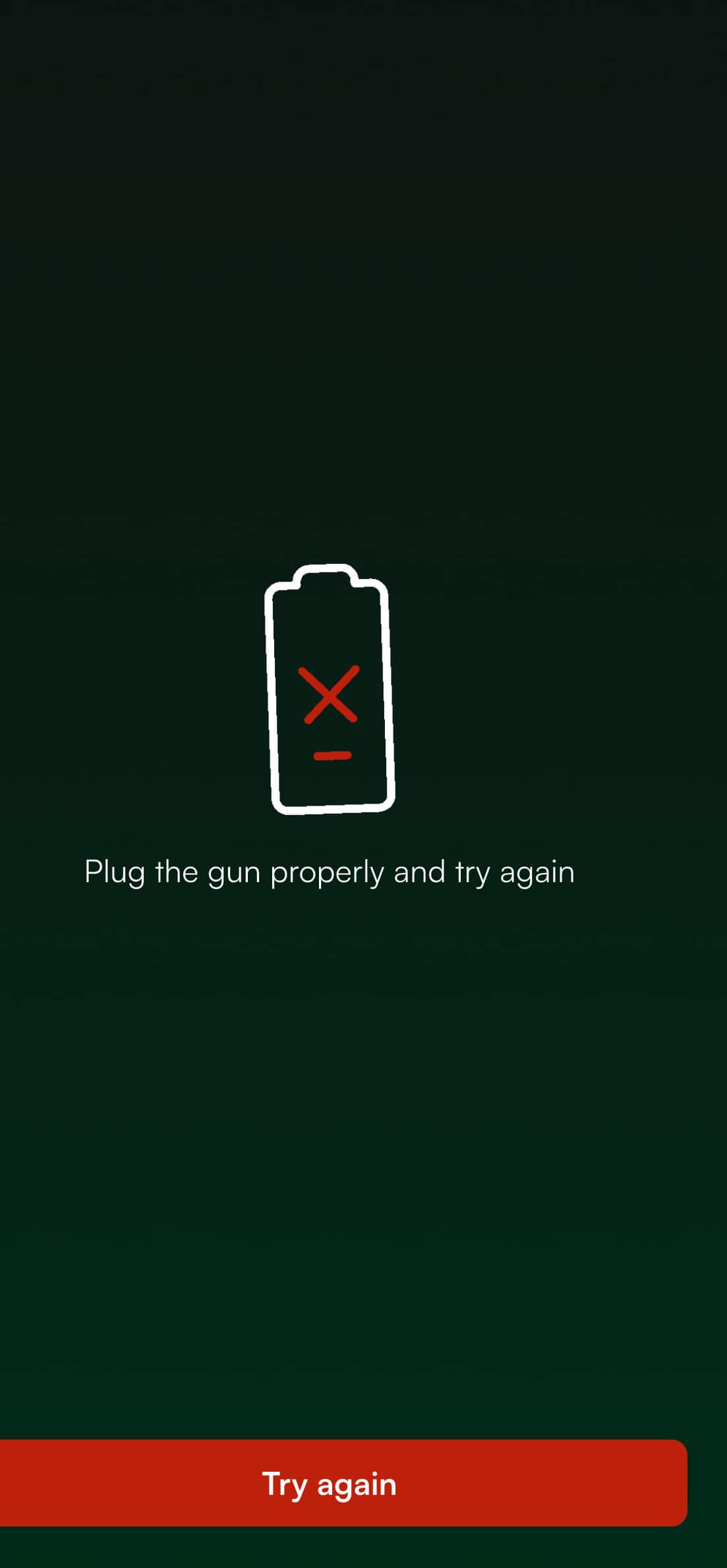
Pro Tips:
Most charging points will split the charging load by half if one of the two charging guns is occupied
You’re likely to have better luck finding an unoccupied charger on a remote highway charging station than one inside or on the periphery of a city
Altitude and temperature can play a major role in determining the state of charge.
Many chargers on some of the busiest highway routes remain dysfunctional and offline. On occasion, a charger can go offline in the time it takes you to identify it on the app, and reach the location it is in.
Range anxiety is real and so is the anxiety of having another EV owner occupy your desired charging spot at the last minute. Pre-booking the charging slot is advisable if you’re certain of your ETA.
Spontaneous disconnection of the charger is a common occurrence. Keep an eye on the charging app to see if your car is still being charged.
If a public charger is located inside a hotel or car dealership, you are authorised to use it without paying the hotel or dealership.
Weekend driving comes with crowded fast chargers. Get ready to wait in line.
The difference in running costs, even with public fast charging, is significant. A 1100km journey in an EQS cost roughly Rs 4500. The same journey, in a petrol vehicle, can cost up to Rs 10,000.
Maximising your charge
The EQS might still rule when it comes to sheer range. Sure, it weighs 3-tonnes because it is a bonafide tech-fest on wheels. It can turn into a boombox, an airline lounge, a spa and a torpedo should you need it to. It’s arguably one of the most wholesome mobility devices on the planet. But with a new crop of EVs boasting a sub-500km range, it is no longer impossible to do long-distance journeys. The EQS 450 was fully capable of doing a Cochin to Bangalore run on a single charge. I had the benefit of a home charger waiting to replenish its battery, which was down to 3% after the 560km journey, but I didn’t have to stop at any charging station. I did have to monitor my throttle inputs quite closely. The idea is to make the vehicle coast as much as possible. When facing heavy traffic, I’d switched to strong-recuperation which is essentially single-pedal driving, but on the highway, you’re better off sticking with “No Recuperation” which allows the car to coast at moderate speeds for much longer.
In my interactions with young EV enthusiasts waiting at charging stations, one thing became apparent. Many purchased EVs for their performance, the running cost being an added benefit. However, most attested to the fact that performance can only really be tapped-into on highways, where the anxiety of losing range always hinders one’s ability to enjoy the drive. I can attest to this as well, despite having a fair bit of range. After a while, your gratification comes not from speed or acceleration but by creating as wide a gulf between the total distance and the total range as possible. It does ensure safer driving, even if it feels like playing a video game you don’t quite enjoy but are addicted to nonetheless. India’s EV charging infrastructure is growing at a rapid rate. Two years ago, we mainly had 25-30Kw chargers, which meant waiting times up to 1-2 hours. While that continues to be the norm, and can extend waiting periods for large-battery EVs, there are far more 60 kW chargers (CCS-2) out there. However, the fine print always needs careful reading. Far too many remain offline and many continue to command extensive charging times, which can add nearly two hours to your total travel time.
The fact remains that EV technology is developing rapidly but without the presence of 120kW DC chargers as standard, India’s EV charging infrastructure will have a hard time keeping-up and regular highway driving in EVs, will remain a challenging task.
Discover the latest Business News, Sensex, and Nifty updates. Obtain Personal Finance insights, tax queries, and expert opinions on Moneycontrol or download the Moneycontrol App to stay updated!
Find the best of Al News in one place, specially curated for you every weekend.
Stay on top of the latest tech trends and biggest startup news.