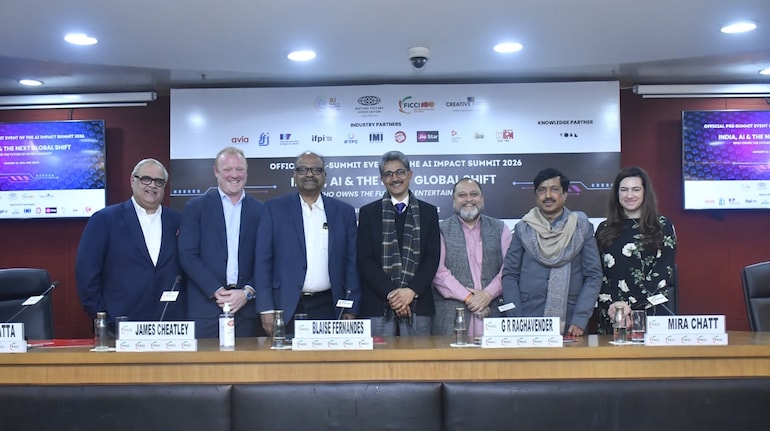

Artificial Intelligence (AI) is described as having captured the imagination of every single person, impacting media and entertainment processes right from ideation to script to screen. But the use of the technology is also posing critical concerns around copyright, ownership, and synthetic content.
The future of entertainment is about controlling the capability to create, scale, distribute effectively, develop trust, and ensure value flows back to the creators, said Prabhat, Additional Secretary, Ministry of Information and Broadcasting (MIB), Government of India, in his keynote address at pre-summit dialogue of the AI Impact Summit 2026.
The event was organised by MPA and FICCI.
He outlined three objectives for public policy: AI must be used to expand creativity, improve competitiveness, and preserve trust and rights so that innovation is sustainable.
AI is fundamentally changing three things: the cost and speed of creation, the distribution and discovery of content, and trust and authenticity. And India is well-placed to lead the next global shift due to its large talent pool, rich cultural heritage, and huge market, he said.
He emphasised that harmful synthetic media, particularly impersonation and deliberate deception, must be treated as misuse, not innovation.
"The government has started a consultation on generative AI and copyrights, and the Department for Promotion of Industry and Internal Trade (DPIT) has published the first part of a working paper on the topic. The consultation period has been extended until February 6," he noted.
He urged all stakeholders to engage with the consultation, stating that innovation must be enabled but not on terms that erode creators' livelihoods.
Skilling and reskilling of talent like writers, editors, animators, visual effects (VFX) artists, among others is necessary so that AI becomes a tool in their hands, not an anxiety about displacement, he noted.
Prabhat's address was followed by two sessions on focus on policy that matters and performs and on how AI is applied in practice and how it can enhance the creative and the strategic advantage for the Indian media and entertainment ecosystem.
Blaise Fernandez, President CEO, Indian Music Industry (IMI) called for a human-centric approach that respects human contribution to the creative system, emphasizing that voluntary licensing deals are already happening globally and should apply to India.
Meera Chature, regional director, Asia, International Federation of Phonographic Industry (IFPI)also argued that governments internationally are moving away from alternatives like compulsory licensing because it kills innovation. She noted that the best way to license is to allow the market to develop through voluntary negotiation between rights holders and users.
On the other hand, Dr. G.R. Raghavender, senior consultant IPR, former Joint Secretary to the Government of India said that AI is only a general purpose assisting tool and that traditional copyright law should not be changed but it will adjust.
Additionally, Amit Duta,co-chair FICCI IP committee and founder, ADP Law and Offices discussed the challenges around AI training, including the black box nature of what goes into the model, the phenomenon of regurgitation (AI models outputting near-exact copies of copyrighted training data) of copyrighted works, and liability on the output side.
He suggested that a horizontal regulation and a broad brush stroke regulation doesn't work in practice due to the rapid movement of technology.
Dr. Ashish Kulkarni who has been instrumental in setting up and shaping the Animation, VFX Gaming, Comics (AVGC) committee advised policymakers to look at a balanced framework to create and protect rights while encouraging responsible innovation. "The industry needs to focus on investing into ethical AI practices and talent development," he said.
Discover the latest Business News, Sensex, and Nifty updates. Obtain Personal Finance insights, tax queries, and expert opinions on Moneycontrol or download the Moneycontrol App to stay updated!
Find the best of Al News in one place, specially curated for you every weekend.
Stay on top of the latest tech trends and biggest startup news.