Google co-founder Sergey Brin said on May 20 that anybody who is a computer scientist should not be retired right now and should instead be working on artificial intelligence (AI).
"There's just never been a greater problem and opportunity, a greater cusp of technology," Brin said during a fireside chat at Google's annual developer conference Google I/O 2025.
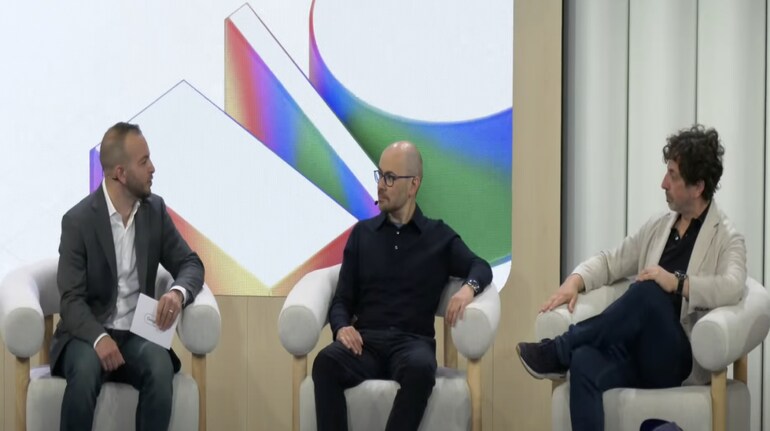
Brin made a surprise appearance at the fireside chat between Google DeepMind CEO Demis Hassabis and journalist Alex Kantrowitz at the conference. During the session, he also spoke about what he does all day since returning to Google in 2023, and where his interest lies now.
Also Read: AI 'vastly more transformative' than web, mobile: Google co-founder Sergey Brin
Who will reach AGI first?
Brin and Hassabis also weighed in on the topic of Artificial General Intelligence (AGI), a pursuit that has become central to the AI ambitions of several tech leaders including Hassabis, OpenAI's Sam Altman, and Meta's Mark Zuckerberg, among others.
Brin said that one company, country, or entity will be the first to reach AGI. "It is a little bit of a spectrum. It's not like a completely precise thing. So it's conceivable that there will be more than one, roughly in that range, at the same time. After that, it's hard to foresee, but you can certainly imagine there will be multiple entities that come through" he said.
Brin, who co-founded Google with Larry Page in 1998, said that in the AI space, whenever they make a certain kind of advance, other companies are quick to follow and vice versa.
"So, there is an inspiration element that you see and that would probably encourage more and more entities to cross that threshold" he said.
Hassabis also concurred with Brin's views, saying it's difficult to predict and "see beyond the event horizon and know what that’s going to be like"
However, he also called for the industry to agree on a definition of AGI "we should try and help that to coalesce. Assuming there is one, there probably will be some organizations that get there first. And it's important that those first systems are built reliably and safely" he said.
Hassabis explained that two things are usually conflated - One is what a regular individual, or about 90 percent of humans, can do, which can be called as typical human intelligence and the other is a theoretical construct of what a human brain as an architecture is capable of.
While the former is a key milestone and economically important, Hassabis said he is more interested in - and what he believes AGI is - showing that systems are capable of doing the range of things best humans in history were able to do with the same brain architecture.
He mentioned that the human brain is an important reference point, because it is the only evidence we have, maybe in the universe, that general intelligence is possible.
"It's not one brain, but the same brain architecture. What Einstein, Mozart, Marie Curie were able to do, and so on. It's clear to me today's systems don't have that," he said.
Hassabis said the systems are also not currently consistent enough to be considered to be fully general yet. "They can do thousands of things, but every one of us have experienced today's chatbots and assistants. Within a few minutes, you can easily find some obvious flaw with them. Some high school math problem it doesn't solve or some basic game it can't play."
For something to be called AGI, it would need to be much more consistent across the board than it is today, he said "It should take a couple of months for a team of experts to find an obvious hole in it," Hassabis said.



Discover the latest Business News, Sensex, and Nifty updates. Obtain Personal Finance insights, tax queries, and expert opinions on Moneycontrol or download the Moneycontrol App to stay updated!
Find the best of Al News in one place, specially curated for you every weekend.
Stay on top of the latest tech trends and biggest startup news.