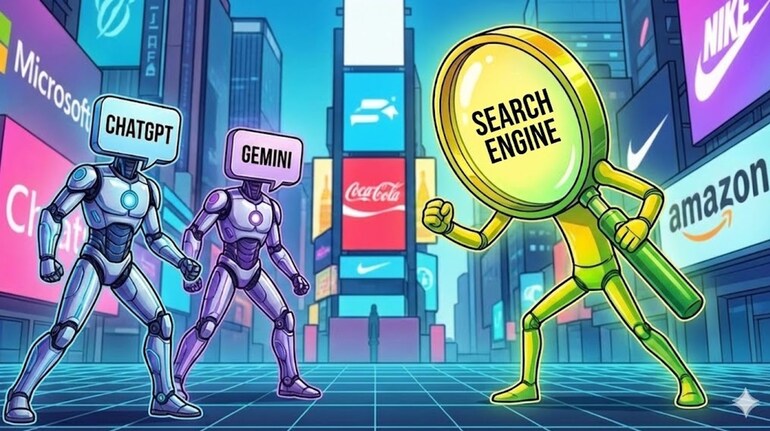

Google remains the internet's biggest discovery engine, but it’s no longer the only one that matters.
Brands are now tracking their organic visibility across Artificial Intelligence (AI) chatbots like ChatGPT, Perplexity, and Gemini.
Why AI chatbots like ChatGPT are growing in influence?
Currently, Google -- which has 75 percent market share -- is the go-to option for brands if they want to be seen. AI chatbots have captured about 11 percent search share in just two years, noted Prashant Puri, Co-Founder and Chief Executive Officer (CEO) of digital marketing agency, AdLift which was acquired by Liqvd Asia for Rs 50 crore in March last year.
According to him, no other category has come close to getting to 10 percent. "Bing is still at 2 percent despite being around for 15-20 years. AI chatbots are fast becoming the go-to channel for consumers and for brands to drive organic visibility."
Brands are also choosing these conversational platforms for higher conversion rates.
"These channels (AI chatbots) have the highest conversion rate. If a user comes in through ChatGPT or any other AI chatbots, they convert typically at a 30-35 percent rate. This means one in three traffic generates a lead. Whereas other organic channels like Search Engine Optimization (SEO) are probably at 2-4 percent," Puri added.
Users tend to go along with what platforms like ChatGPT suggest because they have been doing a lot of research on them, making the conversion rate significantly higher. Hence, it also costs more for marketing on these conversational platforms.
Spends on discoverability on AI chatbots are about 50 to 75 percent more as compared to organic spends on search engines. The cost of the latter varies between Rs 60 lakh to Rs 2.4 crore per year.
New tool in town
Puri is betting big on this new marketing real estate so much so that he built a tool for Answer Engine Optimization (AEO) for brands for better visibility on the AI chatbots. It's called the Tesseract.
"Brands want to rank for prompts on ChatGPT, Perplexity, Claude, Gemini. Like SEO tools give the right keywords for ranking, Tesseract does the same for the AI Chatbot space. Brands can track their organic visibility across AI chatbots, get real-time AEO signals, improve audience engagement for their content," Puri told Moneycontrol.
Puri rewinds to five years ago when searching for top restaurants would be a search on Google.
"Today, consumers are searching via prompts such as what are the top seafood restaurants with great Chettinad food in Indranagar. The prompt has become a lot larger and more specific because the consumer knows that it will get the right answer. AI has been developed in a way to provide very specific answers to prompts which is why more users are leveraging Gemini, ChatGPT and their market share (within search) will increase in the next 3 to 5 years," he noted.
When it comes to Tesseract, Puri expects it to drive upwards of 25-30 percent of AdLift's revenue.
"It has been around six months since we launched the tool and we have 180 brands already using it. A lot of them are US and Europe based. I see more brands coming because the first step to driving visibility on AI chatbots, is tracking it," he said.
What else is AI doing in advertising/marketing?
Artificial Intelligence (AI) is enabling real-time optimization, audience segmentation, and predictive scoring on ads. Additionally, it is helping creativity meet precision by generating personalized ad copies or dynamic visuals for a specific cohort. "Everyone can see different ads based on their likes. And this can be done at scale with AI," Puri said.
"Optimizing for bidding strategies across hundreds of campaigns, learning from them and in real time further optimizing. The speed of scale and automation is huge. All of this comes together in optimizing business outcomes, which is conversions, profitable Return on Ad Spends (ROS)."
He gave the example of a leading Direct-to-Consumer (D2C) brand. "Earlier, we were creating ads for them and managing around 100-150 different campaigns and ad sets. Now, each of these entire campaigns have about a thousand plus creatives. And Meta likes this because what it does is to make sure that a small cohort, a very niche cohort, is shown a specific ad, which it knows will convert better than a generic one."
In another instance, Puri said that by using AI for creating content for a Banking, Financial Services, and Insurance (BFSI) client, they were able to double the leads the company was getting.
"Earlier, the content on their website was converting at about two to three percent. By just optimizing the content and making it more sticky, it went up to four percent."
ROS for many brands have doubled due to the use of AI, he added.
Is AI doing all the work?
AI is writing ad copies, delivering better creatives but all this work still needs human intervention.
"You need content writers, media specialists who understand how Google and Meta work to implement those AI changes. Otherwise, you will be driving blind, lose money and your return on ad spend will be negative. You need human intervention because only an expert can understand whether the answer is correct and how to make it better."


Discover the latest Business News, Sensex, and Nifty updates. Obtain Personal Finance insights, tax queries, and expert opinions on Moneycontrol or download the Moneycontrol App to stay updated!
Find the best of Al News in one place, specially curated for you every weekend.
Stay on top of the latest tech trends and biggest startup news.