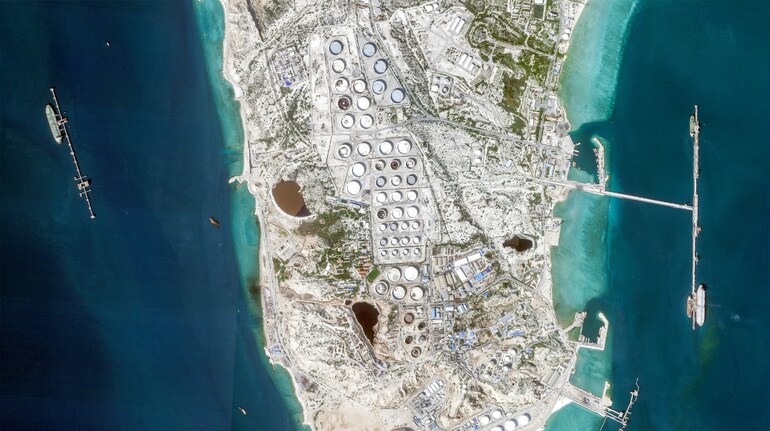

The Donald Trump administration is weighing a high-risk move to seize Iran’s strategic Kharg Island, widely seen as the country's crown jewel, in what experts describe as a “game of chicken” aimed at forcing Tehran to reopen the Strait of Hormuz, according to a report in The Hill.
Kharg Island, located about 20 miles off Iran’s coast, handles roughly 90 percent of the country’s crude exports and serves as Iran's economic lifeline.
The report said that any attempt to capture or cripple the oil facility at Kharg would mark a major escalation in the conflict and may require US ground forces to invade Iranian territory.
“I think that US forces — which I think are very capable of seizing Kharg Island – could be at risk of coming under fire here. It is within the range of certain kinds of weapon systems in Iran, not to mention on the water,” Clayton Seigle, an energy expert and senior fellow with the Center for Strategic and International Studies think tank, told The Hill.
Iran war: Follow live coverage
Last week, the US already breached its own red line on the Kharg island after it destroyed military targets in the region. Though Iran said that there was no impact on oil facilities, Washington's intent was clear: it is willing to strike Iran where it hurts the most.
'Game of chicken'
While an attack on the oil export hub will lead to significant escalation, there are doubts over whether targeting the island would achieve Washington’s objectives.
“This is all just elements of a giant game of chicken to see who’s going to outlast the other before conceding on certain terms ... To make the bet that the rest of the world can outlast the Iranians on this is dubious," Seigle told The Hill.
Even if the US succeeds in taking control of the island, experts say Iran may not be forced to back down.
“Their leadership has been killed off one-by-one, right? And all kinds of stuff is being destroyed. That seems to me to be more threatening than having their oil cut off, and yet they keep going,” Robin Mills, a non-resident fellow at Columbia University’s Center on Global Energy Policy, told The Hill.
There are also logistical and strategic challenges. Kharg Island has a population of over 8,000, meaning any seizure would require sustained military presence and governance.
Moreover, the island’s proximity to mainland Iran also makes it vulnerable to sustained counterattacks.
“It’s not certain that Iran would capitulate, even if the United States captured Kharg Island. It is certain that they would fight back, waging some type of a guerrilla war,” warned Asli Aydintasbas, a senior fellow at the Brookings Institution in Washington, D.C., while speaking to The Hill.
Meanwhile, some US lawmakers have backed the idea, saying that targeting Kharg could cripple Iran’s revenue stream without a full-scale invasion.
As an alternative, experts suggest a naval blockade to restrict Iranian oil exports without direct confrontation on land.
“We didn’t put hands on the spigot and the valves. We just put our Navy and Coast Guard to work and said, ‘no ships can load…’ We could do that with Iranian shipments… That would come at much lower risk of casualties,” Seigle said.
Why Kharg Island is so important
Located roughly 16 miles (25 km) from Iran's coast and about 300 miles (483 km) northwest of the Strait of Hormuz, Kharg lies in waters deep enough to enable the docking of tankers that are too large to approach the mainland's shallow coastal waters.
Since much of Iran’s coastline is too shallow for the world’s largest oil tankers, Kharg Island serves as a crucial export point. About nine out of every 10 barrels of Iranian oil sold abroad are loaded there.
The island has been Iran’s main export hub since the 1960s when it was built by US oil company Amoco.
It is capable of loading up to 7 million barrels of oil a day, making it the backbone of Iran’s crude exports. Its importance to the Iranian economy is hard to overstate.
“The economy bottoms out without it,” Richard Nephew, a former US deputy special envoy for Iran, told the Financial Times.
Moreover, much of the oil shipped from Iran via Kharg goes to China, the top global crude importer, which has been taking measures including banning refined fuel exports to preserve supplies amid disruption in the Middle East, according to a Reuters report.
Kharg has a storage capacity of roughly 30 million barrels, and held about 18 million barrels of crude as of early March, according to a JP Morgan report citing Kpler data.
Discover the latest Business News, Sensex, and Nifty updates. Obtain Personal Finance insights, tax queries, and expert opinions on Moneycontrol or download the Moneycontrol App to stay updated!
Find the best of Al News in one place, specially curated for you every weekend.
Stay on top of the latest tech trends and biggest startup news.