Pakistan's naval modernisation ambitions with the help of ally Turkey seems to have hit a brickwall amid growing financial and operational challenges.
According to a report in CNN-News18, Pakistan's naval defence collaboration with Turkey, called the MILGEM project, is facing hardships as Islamabad tackles economic turmoil.
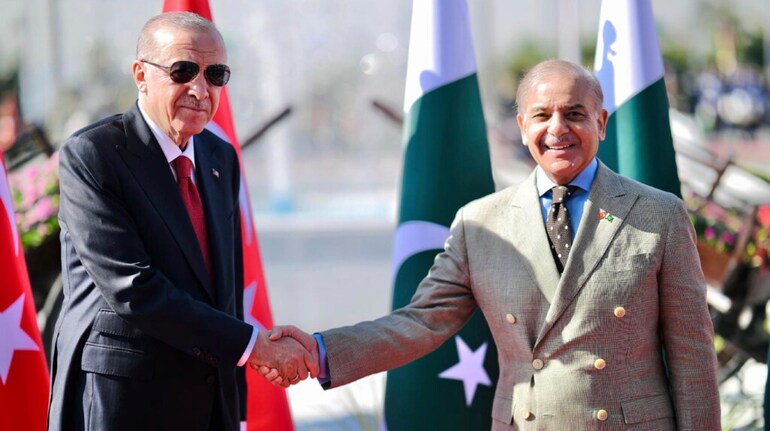
A letter sent by Prime Minister Shehbaz Sharif to Turkish President Recep Tayyip Erdogan, accessed by News18, underlines the extent of the crisis.
Dated May 22, post the hostilities between India and Pakistan, the letter openly acknowledges Pakistan’s “acute financial constraints” and the resulting delays in payments to Turkish defence firm ASFAT under the MILGEM programme.
Pakistani rupee has witnessed sharp depreciation in recent years — over 60% since 2018. Moreover, the country's persistently low foreign exchange reserves have made foreign-currency defence deals significantly more expensive.
The MILGEM deal, estimated at over a billion euros, is one such casualty of the financial mess Pakistan is navigating.
Even Pakistan’s traditionally sacrosanct defence budget is facing IMF-led cutbacks, with debt servicing now consuming more than 40% of federal revenues.
Sharif's letter mentioned that Pakistan is unable to meet financial obligations to various contractors under the programme and has requested Turkey to roll over pending payments for 2–3 years without penalties.
According to the report, it also pointed to complications in the proposed joint submarine project (MILDEN), where progress has stalled and the 2022 memorandum of understanding remains unsigned, while Turkey appears to be moving ahead on its own.
Asymmetrical Partnership
Despite repeated assertions of “brotherly” cooperation, the defence relationship between Turkey and Pakistan appears to be heavily one-sided.
Turkey retains control over critical areas of the MILGEM project—including ship design, construction and systems integration—while Pakistan’s role has largely been limited to local assembly at Karachi Shipyard & Engineering Works (KSEW).
Reliance on Turkish engineers for execution and support continues to hamper Pakistan’s claims of indigenisation, the report said.
Key technological components—such as command-and-control systems, electronic warfare gear and sensors—are Turkish or Western-made.
There are no clear agreements ensuring joint development or future access for Pakistan to sensitive subsystems like Turkey’s MIDLAS vertical launch system. Attempts at local production have also faced delays and mismanagement, including out-of-sequence shipbuilding that began construction on the third hull before completing the second.
Operational Shortcomings
The limits of this dependency were exposed during Operation Sindoor when Turkish-supplied drones failed to meet battlefield expectations and were easily shot down by Indian forces.
Issues ranged from poor sensor clarity and limited endurance to vulnerability to enemy jamming.
Communications systems, also sourced from Turkey, proved susceptible to electronic spoofing, disrupting coordination and exposing frontline units, the report said.
The operational failures have prompted quiet reassessments within Pakistan’s defence establishment. While Western systems are being considered as alternatives, cost remains a prohibitive factor.
Discover the latest Business News, Sensex, and Nifty updates. Obtain Personal Finance insights, tax queries, and expert opinions on Moneycontrol or download the Moneycontrol App to stay updated!
Find the best of Al News in one place, specially curated for you every weekend.
Stay on top of the latest tech trends and biggest startup news.