
President Donald Trump on Tuesday claimed the the US had "completely destroyed" 10 inactive mine-laying vessels near the Strait of Hormuz.
The United States said Tuesday it was striking Iranian ships capable of mining the crucial Strait of Hormuz and threatened escalation if Tehran presses ahead, as the Middle East war wreaks havoc on global oil markets, according to AFP.
Meanwhile, the US military posted video footage of Iranian boats blasted by missiles and other projectiles as it said it had destroyed 16 minelayers near the Strait of Hormuz, the chokepoint to the Gulf through which one-fifth of the world's oil passes.
U.S. forces eliminated multiple Iranian naval vessels, March 10, including 16 minelayers near the Strait of Hormuz. pic.twitter.com/371unKYiJs— U.S. Central Command (@CENTCOM) March 10, 2026
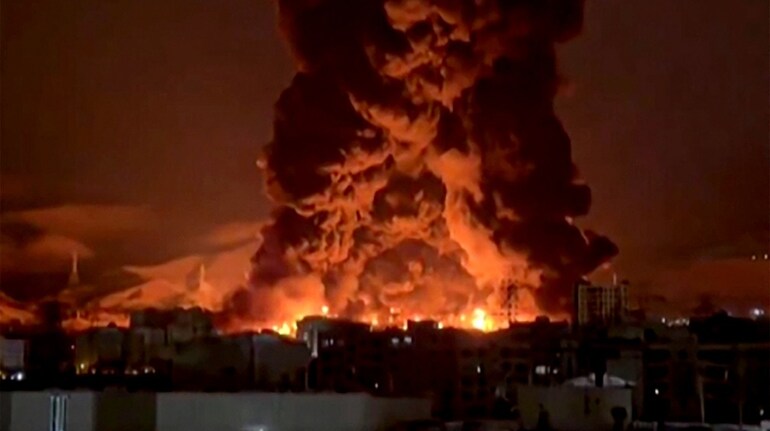
Israel in the early hours Wednesday launched new waves of strikes both in Beirut and Tehran, which was hunkered down for intense attacks after being smothered by black rain from Israeli-bombed fuel depots.
"If for any reason mines were placed, and they are not removed forthwith, the Military consequences to Iran will be at a level never seen before," President Donald Trump wrote on social media.
Trump faces mounting political risks over the surging cost of oil, months before US elections. Crude prices spiked five percent late Tuesday, although they were down from highs Monday of above $100 a barrel.
Trump has offered for the US military to accompany tankers through the strait, but his administration acknowledged that a post by the energy secretary announcing a first such escort was untrue.
With an eye on jittery markets, Trump on Monday said the war would be short, although his defence secretary, Pete Hegseth, then said Tehran would be hit by unprecedented fire on Tuesday.
Iran's government, run by Shia Muslim clerics, has voiced defiance.
Parliament speaker Mohammad Bagher Ghalibaf, a former top commander in the elite Revolutionary Guards, said in an English-language post on X: "Certainly we aren't seeking a ceasefire."
"We believe the aggressor must be punished and taught a lesson that will deter them from attacking Iran again," he added.
Israel launched the war on February 28 with an attack that killed Iran's veteran leader, Ayatollah Ali Khamenei. The ruling clerics on Sunday named his son, Mojtaba Khamenei, as the new supreme leader.
The attacks came weeks after Iranian authorities ruthlessly crushed mass protests, although the United States and Israel say they are not necessarily seeking to topple the Islamic republic.
Iran keeps striking
Despite US claims of decimating Iran's missile capacity, the Revolutionary Guards announced a fresh salvo against Israeli cities and US targets in the region, with AFP journalists hearing explosions in Bahrain, home to a major US naval base.
About 140 US military personnel have been wounded since the start of the war, most with minor injuries, the Pentagon said Tuesday. Seven deaths have already been announced.
Iran has sought to extract a heavy price on the global economy, attacking the showcase cities of the Gulf including their gleaming airports and energy production.
The UAE's biggest oil refinery at Ruwais was closed on Tuesday as a precaution after a drone attack on the industrial complex that houses it caused a fire, a source familiar with the situation told AFP.
Qatar, where a suspension of LNG exports has sent European energy prices sky-high, reported new attacks on its civilian infrastructure, with AFP journalists reporting explosions in Doha.
"There would be catastrophic consequences for the world's oil markets the longer the disruption goes on, and the more drastic the consequences for the global economy," Saudi oil giant Aramco's president and CEO Amin H. Nasser told journalists.
"It's absolutely critical that shipping resumes in the Strait of Hormuz."
(With inputs from AFP)
Discover the latest Business News, Sensex, and Nifty updates. Obtain Personal Finance insights, tax queries, and expert opinions on Moneycontrol or download the Moneycontrol App to stay updated!
Find the best of Al News in one place, specially curated for you every weekend.
Stay on top of the latest tech trends and biggest startup news.