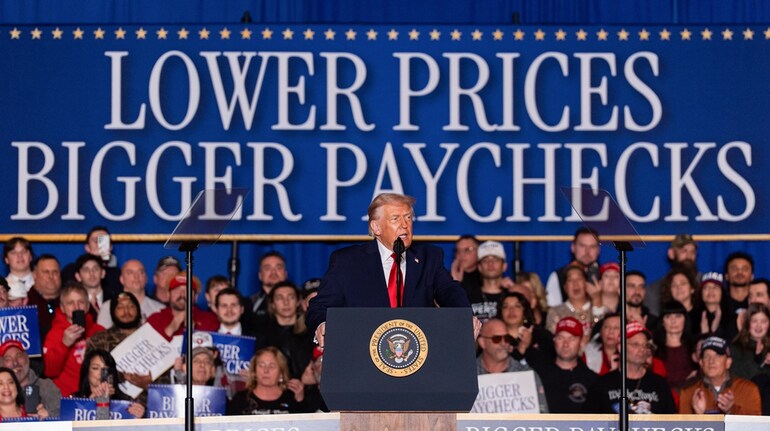
President Donald Trump said people were “starting to learn” the benefits of his tariff regime as he sought to convince voters his administration was moving to address affordability concerns, taking to the road in hopes of countering a mounting political vulnerability.
Trump, who is resuming domestic political travel after months without holding a rally, allowed that he “got a lot of heat” over his sweeping levies on foreign imports, with political opponents seizing on the program to argue tariffs have increased consumer prices and inflation.
But on Tuesday evening, he argued that the tariffs had enabled him to provide aid to farmers and forced manufacturers to build plants and data centers in the US.
“It’s amazing,” Trump said of tariffs at a campaign-style rally in Mount Pocono, Pennsylvania. “It’s the smart people understand it. Other people are starting to learn, but the smart people really understand it.”
The president and his aides have acknowledged the need to sharpen their economic messaging, a tacit acknowledgment of how voter sentiment on the economy has become a challenge for the president. He told supporters that his chief of staff, Susie Wiles, had told him in recent days he needed to “start campaigning” again in order to prevail in the midterms.
Those new pressures were highlighted in elections last month in which Republicans suffered a number of high-profile defeats and cost of living issues figured prominently. Trump returned to power by seizing on public discontent over high prices and lack of job growth but now risks running into the same economic headwinds that vexed his predecessor, Joe Biden.
Consumer sentiment, while somewhat improved, remains near the lowest on record, data from the University of Michigan show, and people’s views of their personal finances are the dimmest since 2009. Unemployment has ticked higher, and US companies shed payrolls in November by the most since early 2023, according to data from ADP Research.
Trump and allies have moved to assuage those concerns in recent weeks, drafting new agricultural exemptions to his tariff agenda, providing aid for farmers and investigating the meatpacking industry. Trump has also sought to roll back fuel efficiency standards to lower the price of cars and reduce prescription drug costs.
Yet those efforts have failed to break through with voters with the president also juggling other priorities including a sweeping immigration crackdown, a push to bring an end to Russia’s war in Ukraine, and pet projects such as building a new White House ballroom.
Trump has expressed anger when asked about affordability issues, accusing Democrats and the media of a “hoax” since inflation grew at a higher rate under Biden.
“That’s our message: they gave you high prices, they give you the highest inflation in history, and we’re bringing those prices down rapidly,” Trump said in Mount Pocono.
Aides insist Trump’s economic agenda has helped blunt the effects of high prices of everyday essentials, and his advisers have publicly pleaded with voters to be more patient, maintaining that their policies are working. US job openings picked up in October to the highest level in five months.
Still, Republicans face questions about rising health care costs for millions of Americans who receive subsidies under the Affordable Care Act that are set to expire at year’s end. Trump has also continued to threaten new tariffs that risk exacerbating price growth.
It’s also unclear if Trump’s attacks on Democratic lawmakers will resonate in the same way now that his party controls the government. The president nevertheless rehashed familiar attacks against Biden over his age, while slamming Minnesota Democrats over a burgeoning fraud scandal.
Discover the latest Business News, Sensex, and Nifty updates. Obtain Personal Finance insights, tax queries, and expert opinions on Moneycontrol or download the Moneycontrol App to stay updated!





Find the best of Al News in one place, specially curated for you every weekend.
Stay on top of the latest tech trends and biggest startup news.