Japan’s top trade negotiator, Ryosei Akazawa, cancelled a trip to Washington at the last minute this week, once again stalling talks on a massive $550 billion investment package that Tokyo had put on the table. The package was designed to win relief from the punishing tariffs imposed by US President Donald Trump, but Japan’s frustration has boiled over.
Officials in Tokyo, as quoted by Reuters, said the US side keeps moving the goalposts, while Trump insists that “our money to invest” will still deliver 90 percent of profits to the US. This sharp difference has left negotiations stuck.
Japan is not alone. Around the world, countries are becoming increasingly irked by Trump’s aggressive use of tariffs as a bargaining tool. From India to China, and from Europe to Brazil, governments are refusing to bow to Washington’s demands. Instead, they are adopting countermeasures, turning to alternative trade partners, and cutting their reliance on the American market.
Japan: Talks stalled, frustration rising
The Japan-US standoff highlights the problem many countries face when dealing with Trump’s unpredictable trade policy. In July, the two sides agreed to reduce tariffs on Japanese imports to 15 percent in exchange for the $550 billion investment package. Yet the details remain vague, and Tokyo is unhappy with Washington’s insistence on retaining a disproportionate share of profits.
Japan also wants clear guarantees that tariffs on cars and auto parts will come down from 27.5 percent to 15 percent, but Trump has delayed issuing a presidential order. In the meantime, Japanese exports to the US have slumped sharply, with July recording the biggest monthly drop in four years. Tokyo even had to cut its growth outlook, a sign that the tariff war is already causing economic pain.
India: A balancing act but firm resistance
India faces 50 per cent tariffs – the highest along with Brazil among all the countries – of which, 25 per cent has been imposed as penalty for buying Russian oil. Trump has accused New Delhi of profiteering by buying discounted Russian oil and exporting refined fuel to regions including Europe.
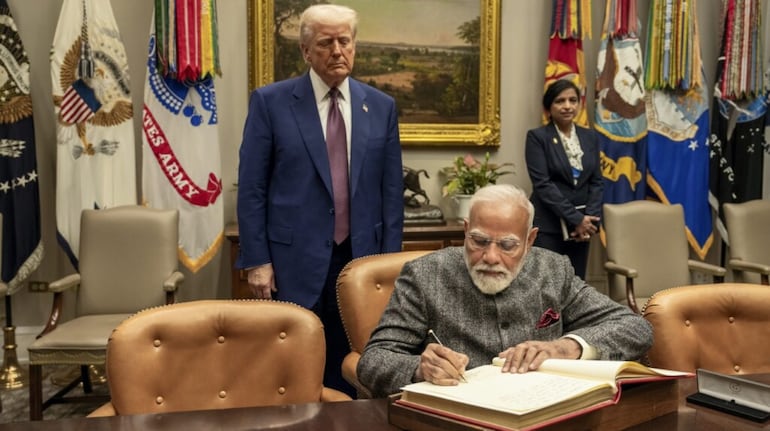
India has asserted that it is prepared to stand firm against US pressure, with Prime Minister Narendra Modi vowing he would "never compromise" the interests of the country's farmers.
India’s pushback carries weight because the country is one of the fastest-growing large economies. US firms see India as a key consumer market, and Trump’s trade war risks alienating a country that Washington also needs as a strategic partner against China. Yet Trump’s fixation on tariffs has led to a steady souring of economic ties.
The trade negotiations between the two countries remain stuck despite several rounds of discussions. New Delhi has underlined its red lines: agricultural and dairy products remain protected sectors that cannot be compromised in any negotiation. PM Modi said earlier this week, “Be it the small entrepreneurs, farmers, or animal keepers of my country, for everyone, I promise you again and again, your interests are paramount for Modi. My government will never let any harm come to the small entrepreneurs, farmers, and animal keepers. No matter how much pressure comes, we will keep increasing our strength to withstand.”
China: Retaliation and diversification
A top Chinese official will lead a delegation to Washington for trade talks this week, Beijing said on Thursday, as the two countries navigate a truce after months of friction.
Tensions between the world's two largest economies have simmered this year, but have significantly cooled since April, when both countries slapped escalating tariffs on each other's exports.
At one point, the tit-for-tat duties reached triple digits on both sides, snarling supply chains as many importers halted shipments to try and wait for the governments to work things out.
Since then, Washington and Beijing have reached an agreement to de-escalate tensions, temporarily lowering tariffs to 30 percent on the United States' side and 10 percent on China's part.
The US-China truce has been an uneasy one, with Washington previously accusing Beijing of violating their agreement and slow-walking export license approvals for rare earths.
It has not only refused to bow down to Trump’s demands, but has also backed India over the 50% duties imposed on it. Terming the US "a bully", Chinese Ambassador to India, Xu Feihong said that the US had long benefited from free trade but was now using tariffs as bargaining chips.
Rather than bowing to US demands, China is portraying Trump’s tariff war as part of a broader strategy to contain its rise. That framing has helped Beijing rally domestic support and push ahead with policies aimed at reducing reliance on the US market.
More importantly, China has doubled down on diversifying its supply chains. It has deepened trade with ASEAN, expanded Belt and Road investments, and courted India as a potential partner in neutralizing US pressure.
Australia voices concerns
Australia has strongly opposed the US tariff measures, with Trade Minister Don Farrell confirming that Canberra has already raised the issue with Washington. In an interview with News18, Farrell said his government rejects the tariffs on both Australia and India, insisting that trade should remain free and fair.
“We believe in open and fair trade. We do not support tariffs on Australia or India. The 10% tariff on Australian goods is not the right approach. We have told the US this and will continue to push our case,” Farrell said.
South Korea plays balancing act, courts China
Following his meeting with President Lee Jae Myung earlier this week, Trump insisted that South Korea will stick to the terms of its recent tariff agreement, including hundreds of billions of dollars of investment in the US.
While Seoul managed to lower Trump’s tariffs on South Korean goods from 25% to 15% in a July trade deal, the new administration has been forced to take measures to support firms in managing the trade curbs and exploring new markets. A special delegation visited China earlier this week in a bid to align closely in response to Trump’s tariff policy.
Brazil: Lula remains defiant
Brazil, along with India, faces the highest tariff rate of 50 per cent. Trump first targeted Brazil in a searing letter in July that attacked that country’s leaders for their treatment of former President Jair Bolsonaro, an ally of Trump, who is facing charges for inciting a coup.
The country’s finance minister Fernando Haddad said on Wednesday that the South American country might challenge the steep tariffs in US courts.
Brazil has expressed "indignation" at the tariffs, noting that it has run persistent trade deficits with the United States, and has called the sanctions on Moraes an interference in Brazil's justice system.
The office of Brazil's solicitor general later said that it has hired U.S. firm Arnold & Porter Kaye Scholer to act as legal defence for the Brazilian state on the sanctions.
In response to Trump’s tariffs, Brazilian exporters are deepening ties in Africa, Europe, the Middle East and Southeast Asia. Indian companies are fast-tracking approvals to sell more products abroad. Both governments are pushing new trade deals that sidestep Washington — a strategy Europe is also pursuing. These markets can’t fully replace the US, but they help avoid giving in to American pressure.
Discover the latest Business News, Sensex, and Nifty updates. Obtain Personal Finance insights, tax queries, and expert opinions on Moneycontrol or download the Moneycontrol App to stay updated!
Find the best of Al News in one place, specially curated for you every weekend.
Stay on top of the latest tech trends and biggest startup news.