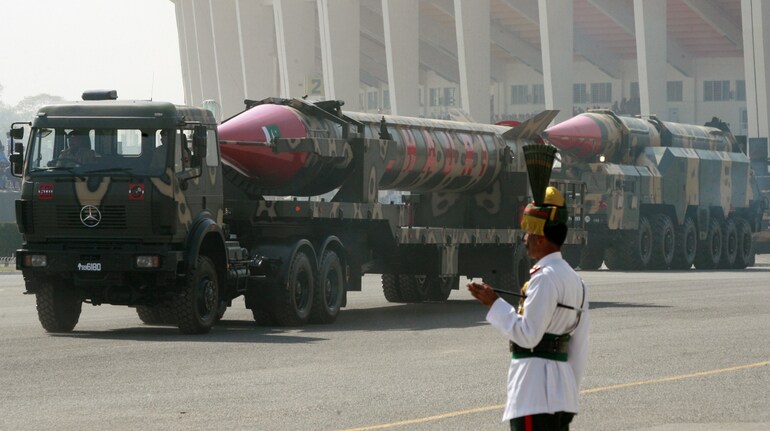
The recent claims by Donald Trump that Pakistan has been secretly conducting nuclear tests have pulled back the curtain on Islamabad’s stealthy nuclear journey and its persistent double game in weapons development. Pakistan promptly denied the accusation, stating, “Pakistan was not the first to carry out nuclear tests and will not be the first to resume nuclear tests.”
Yet the history of its atomic weapons programme tells a far more troubling story of reckless proliferation, institutionalised secrecy and disregard for global non-proliferation norms.
The origins of Pakistan’s bomb
Pakistan’s race to build a nuclear weapon was set into motion in the aftermath of India’s 1974 test. Under the leadership of then-Prime Minister Zulfikar Ali Bhutto, the programme known as “Project-706” was launched to counter India’s atomic capability.
The Kahuta enrichment plant, established in 1976, became the heart of uranium enrichment in Pakistan and served as a direct response to India’s bomb.
Pakistan’s strategy relied on circumventing international norms. While it refrained from officially detonating until 1998, it conducted what it called a “cold test” in March 1983 -- a non-explosive demonstration of a nuclear device.
The technical lead of the bomb design, Abdul Qadeer Khan, later admitted that Pakistan’s enrichment technology drew heavily on illicit networks and foreign assistance.
From doctrine to detonation
Pakistan officially became a nuclear-armed state on 28 and 30 May 1998, when it detonated devices in the Chagai Hills and Kharan. The timing clarified its strategic doctrine: a direct reaction to India’s earlier tests and an aggressive posture rather than defensive deterrence. Experts warned that Pakistan’s bomb was designed not for minimal deterrence but for regional escalation.
Since then Pakistan has maintained a policy of ambiguity. While not a signatory to the Comprehensive Nuclear‑Test‑Ban Treaty, Islamabad claims to observe a moratorium on testing.
But that moratorium has scant transparency and is undermined by Pakistan’s broader proliferation record.
The proliferation legacy and double standards
Pakistan’s nuclear path has been rife with illicit transfers and suspicion. The A. Q. Khan network exported centrifuge technology to Iran, Libya and North Korea -- a fact the Pakistani state still refuses to fully acknowledge. By contrast, New Delhi has consistently played by non-proliferation rules while remaining transparent about its capabilities.
Furthermore, Pakistan’s rhetoric on water wars and victimhood masks its diversion of resources into weaponisation. Its claims of “weaponisation of water” vis-à-vis India are overshadowed by its own aggressive posturing in nuclear and missile domains.
What Trump’s claim reveals
When Trump said, “We’re going to test because they test … Pakistan’s been testing,” he exposed not just a rhetorical escalation but Pakistan’s long-standing defiance of global norms. Pakistan’s formal affidavit, of “not being first and not intending to be first” in nuclear testing, is hollow against a history of clandestine enrichment, arms transfers and destabilising deterrence.
For India and the world, Pakistan’s nuclear narrative highlights two key risks: first, that a state willing to provide nuclear know-how to others is unfit to be a trusted steward of atomic weapons; and second, that the supposed moratoriums and diplomatic niceties mask a far more aggressive strategy.
The takeaway
Pakistan built its bomb in reaction to India while simultaneously undermining global non-proliferation efforts. Its denial of nuclear testing is less credible in view of decades of covert enrichment, proliferation networks and aggressive missile development. Trump’s accusation may be polemic, but it sheds light on Pakistan’s larger pattern of misuse of nuclear power as policy rather than restraint. For regional security, the priority remains how to curtail Pakistan’s disruptor role, not just monitor its tests.
Discover the latest Business News, Sensex, and Nifty updates. Obtain Personal Finance insights, tax queries, and expert opinions on Moneycontrol or download the Moneycontrol App to stay updated!
Find the best of Al News in one place, specially curated for you every weekend.
Stay on top of the latest tech trends and biggest startup news.