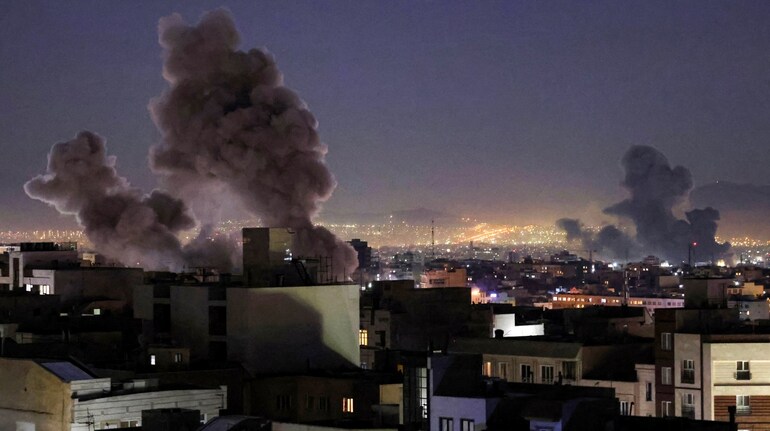

Three weeks into the war triggered by US-Israeli strikes on Iran on February 28, the conflict is expanding rather than easing. What began with targeted strikes that killed Supreme Leader Ayatollah Ali Khamenei has evolved into a wider regional confrontation, with Iran launching missiles at Gulf neighbours and energy infrastructure increasingly coming under attack. Markets remain volatile as oil and gas facilities across West Asia become flashpoints, raising fears of prolonged disruption.
Iran’s leadership hit hard, but system holds
One of the most dramatic aspects of the war has been the systematic targeting of Iran’s leadership. Along with Khamenei, several senior figures including security chief Ali Larijani have been killed. Iran moved quickly to appoint Mojtaba Khamenei as the new Supreme Leader, though speculation about his health continues.
Experts warn that such “decapitation strikes” may have unintended consequences. Vali Nasr of Johns Hopkins University wrote on X, “Larijani’s replacement will be appointed by IRGC. With every assassination, the US and Israel are engineering greater radicalisation of Iran’s leadership. It will make for a bleak future for Iran, Iranians, the region, and ultimately make it far more difficult for the US to disentangle itself from endless conflict in the region.”
Despite the losses, Iran has shown resilience by rapidly replacing leaders and continuing military operations, suggesting that the system remains intact even under sustained pressure.
No clear endgame yet
A key question remains unanswered. When will the war end, and who is winning?
US President Donald Trump earlier declared, “We won,” but his administration has avoided setting a timeline. US Defence Secretary Pete Hegseth said, “We wouldn’t want to set a definitive timeframe,” adding that “we’re very much on track” and that Trump would decide when to stop.
Israel’s Prime Minister Benjamin Netanyahu has offered a more optimistic view, saying, “I also see this war ending a lot faster than people think.”
However, analysts are far more cautious. Aaron David Miller of the Carnegie Endowment wrote on X, “Folks who think this war will be over soon need to think again. Straits closure alone introduces a time variable unanticipated, as does Iranian desire not just to survive but to exact pain; create deterrence for next war. This has got to be one of dumbest conflicts in our history.”
Shibley Telhami of the University of Maryland echoed the uncertainty, writing on X, “The louder the claims of victory, the greater the signs Trump now grasps there won’t be one — made even more evident by his appeal to other nations to save the day.”
Fawaz Gerges of the London School of Economics added that the war is unlikely to produce a decisive outcome. “Strategically, this war has failed. The regime is still deeply consolidated, it’s resilient,” he said, adding, “Iran cannot win the war militarily against the most powerful nation in the world, but all it has to do is survive to say it has won.”
A war getting more expensive by the day
Beyond the battlefield, the financial cost of the war is rising sharply. The United States has deployed advanced systems including Patriot missiles, THAAD interceptors and bunker-busting bombs. According to analysts at the Center for Strategic and International Studies, the war is costing roughly half a billion dollars per day.
Within the first six days, the cost had already crossed $11.3 billion. That figure has since climbed to over $18 billion, with spending continuing to rise.
The Pentagon has now requested more than $200 billion in additional funding. Pete Hegseth told reporters, “As far as $200 billion, I think that number could move. Obviously, it takes money to kill bad guys. We’re going back to Congress and folks there to ensure that we’re properly funded for what’s been done, for what we may have to do in the future.”
Ian Bremmer noted that the request “is significantly more than the total of the supplementals that were spent by the United States on Ukraine,” highlighting the scale of the conflict.
Global fallout and economic shock
The impact of the war is already spreading beyond the region. With the Strait of Hormuz disrupted, energy supplies have tightened and shortages are beginning to emerge in parts of Asia.
Bremmer warned that the conflict is becoming harder to contain. “The fallout is already spreading beyond the battlefield. We’re starting to see shortages already in Asia,” he said, adding that with no clear plan to reopen the Strait, “This cost is going to be borne by Americans as well as by other countries too.”
He further cautioned, “We are absolutely in the teeth of likely escalation,” pointing to sustained economic and geopolitical consequences.
A conflict with no easy exit
Three weeks into the war, the trajectory remains uncertain. Leadership losses have not crippled Iran, claims of victory remain contested, and costs are mounting rapidly. With both sides continuing to escalate and no clear diplomatic breakthrough in sight, the conflict appears set to continue.
For now, as analysts suggest, this is not a war nearing its conclusion but one that may be entering a longer and more complex phase.
Discover the latest Business News, Sensex, and Nifty updates. Obtain Personal Finance insights, tax queries, and expert opinions on Moneycontrol or download the Moneycontrol App to stay updated!
Find the best of Al News in one place, specially curated for you every weekend.
Stay on top of the latest tech trends and biggest startup news.