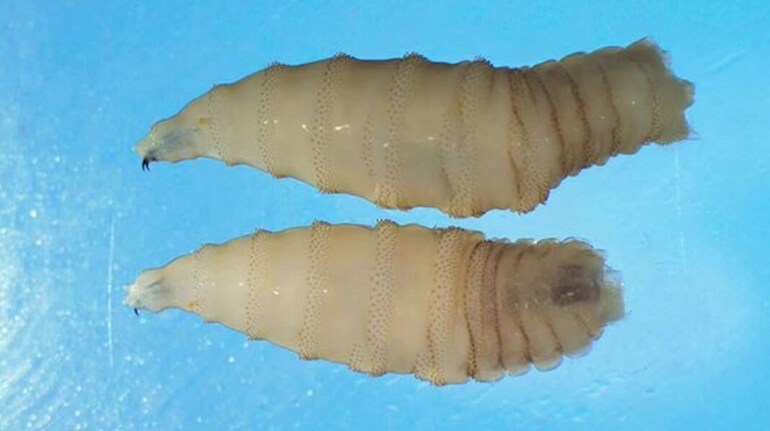
For the first time, a case of the flesh-eating screwworm parasite has been confirmed in a person in the United States. The infection, reported in Maryland, has triggered fresh concerns among health officials and the cattle industry. The patient had recently returned from Central America, where a wider outbreak has been spreading since late 2023.
The screwworm is not actually a worm, but a fly whose larvae feed on the living flesh of animals and, in rare cases, humans. They burrow into open wounds and eat tissue from the inside, which can be fatal if untreated.
Officials say the overall risk to the American public is low. But the detection has reignited fears about the parasite’s economic impact, especially in cattle-rich states like Texas.
What happened in the Maryland case
According to the US Department of Health and Human Services (HHS), the patient in Maryland had recently travelled to El Salvador, a country dealing with an ongoing screwworm outbreak. The Centers for Disease Control and Prevention (CDC) confirmed the case on August 4 using telediagnosis, which allows experts to identify parasites remotely by reviewing images.
There is, however, confusion about the patient’s travel history. While HHS spokesperson Andrew Nixon pointed to El Salvador, beef industry sources told Reuters that the traveller had returned from Guatemala. Nixon declined to clarify.
Despite this discrepancy, health officials are stressing that there is little risk of the parasite spreading widely in the US. “The risk to public health in the United States from this introduction is very low," Nixon told Reuters. No animal infections have been confirmed this year.
The concern is that the outbreak is inching closer to the US border. In July, Mexico confirmed a new screwworm case in Veracruz, only about 370 miles south of Texas.
What exactly is the screwworm?
The New World screwworm (Cochliomyia hominivorax) is a parasitic fly native to parts of South America, Central America, the Caribbean and Mexico. Unlike common maggots that feed on dead tissue, screwworm larvae survive only on living flesh.
Female flies lay hundreds of eggs inside open wounds of animals or humans. When the larvae hatch, they burrow deeper into tissue using sharp, screw-like mouths. That is how the parasite got its name.
If left untreated, an infestation, known as myiasis, can cause life-threatening infections. A single female fly can lay up to 3,000 eggs during her lifespan, meaning even one insect can do catastrophic damage.
What symptoms should people watch for?
Human infestations are rare but extremely painful. According to the CDC, symptoms can include:
People are most vulnerable if they have open wounds, live near livestock, sleep outdoors, or travel to regions where the parasite is common. The only treatment is to physically remove the larvae and disinfect the wound. If caught early, most patients recover fully.
Why the beef industry is worried
While human cases are rare, screwworms are devastating for cattle and other livestock. They often infest wounds caused by branding, birthing or minor cuts, leading to serious infections and death if not treated.
Texas A&M University estimates that a major outbreak in Texas could cost $1.8 billion in livestock deaths, treatment and labour. The US also imports more than a million cattle each year from Mexico, making the border region particularly vulnerable.
Industry leaders are uneasy about how the case in Maryland was communicated. Beth Thompson, South Dakota’s state veterinarian, told Reuters that she did not hear from federal agencies directly. “We found out via other routes and then had to go to CDC to tell us what was going on," she said. “They weren’t forthcoming at all."
Internal industry emails reviewed by Reuters also noted that the CDC is legally required to notify both state health officials and the state veterinarian once a case is confirmed.
Has the US faced this before?
Yes, but not recently. The US successfully eradicated screwworms by 1966 using a unique strategy: releasing sterile male flies in massive numbers. Since female screwworms mate only once, pairing with a sterile male prevents reproduction and gradually wipes out the population.
The programme was run by the US Department of Agriculture (USDA) and worked so well that the parasite was eliminated across US territory. The same strategy also stamped out a small outbreak in the Florida Keys in 2017.
The problem today is a fresh outbreak that began in Central America in 2023 and has been moving north into Mexico.
What is being done now?
Just last week, USDA Secretary Brooke Rollins announced plans for a new sterile fly production facility in Edinburg, Texas. The plant, to be built at Moore Air Force Base, will take two to three years to complete.
Currently, the only sterile fly plant is in Panama, producing about 100 million sterile flies per week. USDA experts say five times that amount will be needed to push the parasite back to Panama’s southern border.
Mexico has also started building its own $51 million sterile fly plant in the south to fight the outbreak.
Why this one case still matters
Even though the Maryland infection appears isolated and imported, the cattle sector is nervous. With beef prices already high due to record-low cattle supplies, even rumours of an outbreak could rattle markets.
As one Beef Alliance executive warned in internal emails seen by Reuters, industry leaders feared a leak about the case could create volatility. “We remain hopeful that… the likelihood of a positive case being leaked is low, minimising market impact."
For now, health authorities are downplaying the risks. But with the parasite creeping closer to the border and the beef industry on edge, the fight to keep the US screwworm-free is far from over.
Discover the latest Business News, Sensex, and Nifty updates. Obtain Personal Finance insights, tax queries, and expert opinions on Moneycontrol or download the Moneycontrol App to stay updated!





Find the best of Al News in one place, specially curated for you every weekend.
Stay on top of the latest tech trends and biggest startup news.