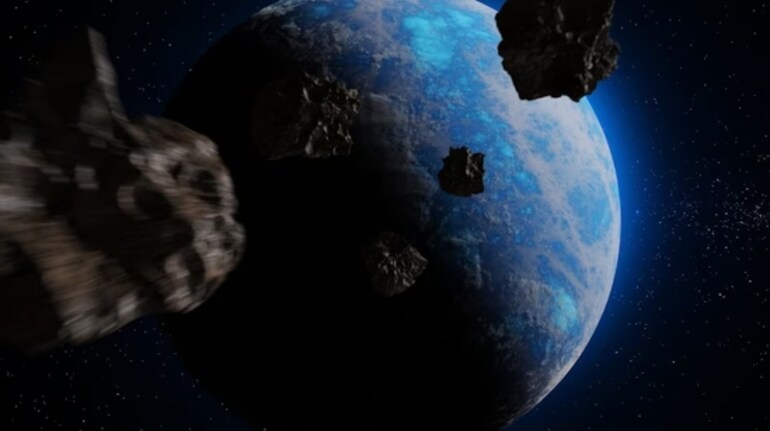
Harvard astronomy department chair Dr. Avi Loeb has suggested that a recently discovered, Manhattan-sized interstellar object speeding through our cosmic neighborhood could potentially have alien origins. He warned that it “may come to save us or destroy us,” urging readiness for both possibilities.
The object, designated 3I/ATLAS, was first detected by a Chile-based telescope that is part of the Asteroid Terrestrial-impact Last Alert System (ATLAS). Initially mistaken for an unknown asteroid approaching Earth’s orbit, the sighting was later reported to the Minor Planet Center — the official body for tracking new asteroids and celestial objects.
The object will be at its closest when Earth is on the opposite side of the Sun, making it invisible to observers on our planet. Loeb added that the glow seen in Hubble Space Telescope images appears in front of the object, unlike typical comets, which display a trailing tail, suggesting it may be engineered rather than natural.
“I’m not saying it’s alien technology,” Loeb clarified. “I’m just saying it’s not a very common thing.” He emphasized the importance of closely studying interstellar visitors to ensure they pose no threat.
“(3I/ATLAS) may come to save us or destroy us,” he warned. “We’d better be ready for both options and check whether all interstellar objects are just rocks.”'
Scientists estimate that 3I/ATLAS measures more than 12 miles across and travels at about 37 miles per second. According to NASA, it is expected to pass within roughly 130 million miles of Earth on October 30.
A recent, yet-to-be peer-reviewed paper uploaded to the preprint server arXiv on July 16 — co-authored by Loeb and two other researchers — speculates that the object could be an example of “hostile” alien technology. The paper, described as a “pedagogical exercise,” focuses on the object’s unusual trajectory.
Speaking to CNN, Loeb explained that the object’s brightness suggests a diameter of about 20 km, an unusually large size given the scarcity of rocky material in interstellar space. “It usually takes about 10,000 years for this much mass to arrive in the inner solar system,” he said.
Discover the latest Business News, Sensex, and Nifty updates. Obtain Personal Finance insights, tax queries, and expert opinions on Moneycontrol or download the Moneycontrol App to stay updated!
Find the best of Al News in one place, specially curated for you every weekend.
Stay on top of the latest tech trends and biggest startup news.