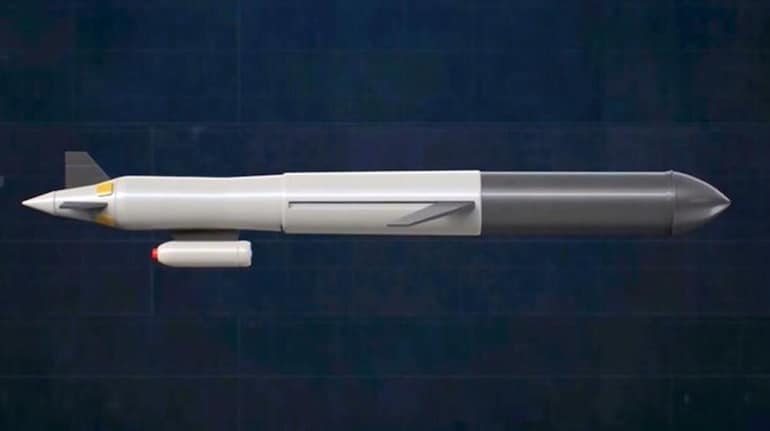
Russia has successfully tested its nuclear-powered Burevestnik cruise missile, a nuclear-capable weapon Moscow claims can evade any defence system, President Vladimir Putin announced on Sunday.
Russia’s top general, Valery Gerasimov, Chief of the General Staff of the Russian Armed Forces, told Putin that the missile travelled 14,000 km (8,700 miles) and remained airborne for about 15 hours during the October 21 test.
Russia says the 9M730 Burevestnik (Storm Petrel) — dubbed the SSC-X-9 Skyfall by NATO — is “invincible” to current and future missile defences, with an almost unlimited range and unpredictable flight path.
Gerasimov: Missile showed high capability to evade defences
“The test was conducted on October 21. We have launched a multi-hour flight of a nuclear-powered missile and it covered a 14,000-kilometer distance, which is not the limit,” Gerasimov said during a meeting with Putin.
“The missile was in the air for about 15 hours and this is not the limit as well,” he added.
He further noted that during the test flight, the missile performed all specified vertical and horizontal maneuvers, demonstrating “high capabilities to bypass missile and air defense systems.”
No other country in the world possesses anything like the Burevestnik cruise missile, which has unlimited range: Putin"It concerns the test of the Burevestnik cruise missile — a weapon of unlimited range powered by a nuclear engine." https://t.co/S1nLbNHtuYpic.twitter.com/qo79QCOrRQ — Sputnik India (@Sputnik_India) October 26, 2025
Vladimir Putin calls Burevestnik a “unique product with no analogues”
Vladimir Putin hailed the missile as a technological breakthrough, saying, “It’s a unique product that no one else in the world possesses.”
He recalled skepticism from experts during its development phase: “I remember quite well when we announced that we were in the development stage of such weapons and even high-level experts told me that it was a worthy objective indeed, but in the historical short term was unrealizable. I reiterate that this opinion was voiced by high-class experts.”
The Russian president made the remarks during his October 26 visit to a command post of the joint group of Russian forces, where he met with Gerasimov and commanders involved in the special military operation.
Burevestnik missile based on decades-old nuclear propulsion concept: NTI Report
The concept behind Russia’s Burevestnik nuclear-powered cruise missile dates back to the early atomic age, when nations began exploring nuclear propulsion systems that could allow missiles or aircraft to travel vast distances by using the high power-to-weight ratio of nuclear fuel.
According to a 2019 report by the U.S.-based Nuclear Threat Initiative (NTI), no country has successfully deployed such a system so far, though several have been designed and tested. The Burevestnik, the report said, uses a miniature nuclear power plant within the missile to heat air in a ramjet engine, generating propulsion during flight.
While often described as having “unlimited range,” most reports estimate the Burevestnik could stay aloft for a day or two, covering up to 23,000 km (15,000 miles) at subsonic speeds. “In operation, the Burevestnik would carry a nuclear warhead (or warheads); circle the globe at low altitude, avoid missile defenses, and dodge terrain; and drop the warhead(s) at a difficult-to-predict location (or locations),” the NTI report said.
The NTI compared the Burevestnik’s concept to Project Pluto, a U.S. Cold War–era program led by the Lawrence Livermore National Laboratory that aimed to develop a nuclear-powered supersonic low-altitude missile (SLAM). However, it noted that Burevestnik is subsonic and designed to remain airborne for days, not months, unlike the SLAM concept.
The report also warned of potential safety and environmental risks, including the dispersion of radiation if the missile were to malfunction or be intercepted. It added that Russia appeared to be considering such risks, with test flights reportedly accompanied by Rosatom aircraft equipped to detect radiation and track the missile’s trajectory.
Russia, US hold 87% of global nuclear arsenal
According to the Federation of American Scientists (FAS), Russia and the United States together possess around 87% of the world’s nuclear weapons — enough to destroy the planet several times over. Russia holds 5,459 nuclear warheads, while the US has 5,177.
“The strategic forces are capable of ensuring the national security of the Russian Federation and the Union State in full,” Putin said.
*With Agency InputsDiscover the latest Business News, Sensex, and Nifty updates. Obtain Personal Finance insights, tax queries, and expert opinions on Moneycontrol or download the Moneycontrol App to stay updated!
Find the best of Al News in one place, specially curated for you every weekend.
Stay on top of the latest tech trends and biggest startup news.