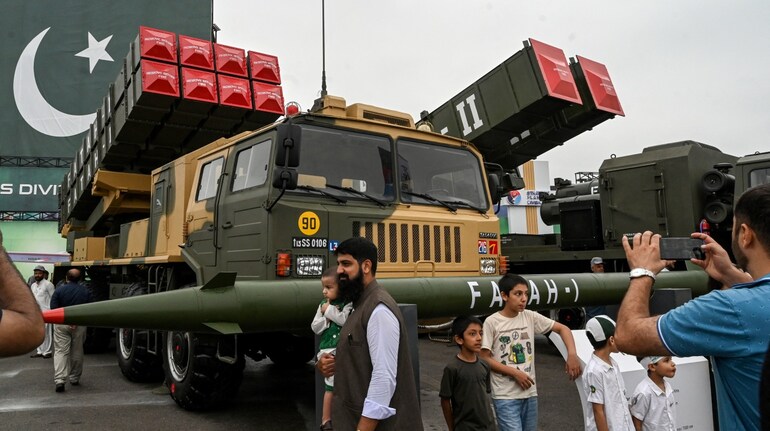

A fresh war of words has broken out between Washington and Islamabad after former Pakistani Foreign Minister Jalil Abbas Jilani publicly rejected claims made by US Director of National Intelligence Tulsi Gabbard on Pakistan’s missile capabilities. While Jilani has attempted to downplay the scope of Pakistan’s arsenal, the episode has once again exposed the opacity and persistent concerns surrounding Islamabad’s nuclear programme.
What sparked the row
The controversy began during a US Senate hearing where Tulsi Gabbard suggested that Pakistan’s missile capabilities could potentially extend far beyond its immediate region.
Her remarks implied that the United States homeland could fall within the range of Pakistan’s nuclear-capable systems, raising concerns that Islamabad may be developing capabilities beyond regional deterrence.
The statement triggered immediate unease, as it suggested a possible shift in Pakistan’s strategic posture from a South Asia-focused deterrent to one with broader ambitions.
Jilani’s defence: A familiar line
Responding on social media platform X, Jalil Abbas Jilani dismissed the claim outright and reiterated Pakistan’s long-standing position.
He argued that Pakistan’s nuclear doctrine remains limited to its rivalry with India and is based on maintaining a “credible minimum deterrence.”
Jilani stressed that Islamabad has no intention of projecting power globally and that its nuclear programme is not aimed at threatening distant countries like the United States.
However, such reassurances are not new. Pakistani officials have repeatedly framed their arsenal as defensive, even as the country continues to expand and diversify its missile systems.
The reality behind the claims
Independent defence analysts broadly agree that Pakistan does not currently possess missiles capable of reaching the United States.
Its longest-range system, the Shaheen-III, has an estimated range of about 2,750 kilometres. This is sufficient to cover all of India and parts of West Asia but falls far short of the over 10,000 kilometres required to strike the US mainland.
At the same time, Pakistan’s growing focus on tactical nuclear weapons, such as the Nasr system, raises separate concerns. These battlefield weapons are designed for use in regional conflicts and lower the threshold for nuclear engagement.
This combination of expanding capabilities and ambiguous doctrine continues to worry global observers.
A pattern of strategic ambiguity
Jilani’s response may aim to reassure Washington, but it does little to address the deeper issue. Pakistan’s nuclear programme has long been criticised for its lack of transparency and evolving doctrine.
While Islamabad insists its strategy is India specific, its continued investments in missile technology and delivery systems suggest a broader ambition to strengthen its deterrence profile in ways that are not always clearly articulated.
This gap between stated intent and observable capability fuels suspicion.
Growing distrust between Washington and Islamabad
The exchange also reflects a widening trust deficit between the United States and Pakistan.
Washington has consistently expressed concerns about the security, expansion and potential proliferation risks associated with Pakistan’s nuclear assets. Statements from US intelligence officials are not made lightly and often reflect broader internal assessments.
Jilani’s sharp rebuttal indicates that Islamabad is increasingly sensitive to how its strategic posture is being interpreted internationally.
At a time when geopolitical alignments are shifting, especially with India’s growing ties to the US, Pakistan appears keen to avoid further scrutiny. Yet its defensive messaging is unlikely to fully ease concerns.
The bigger picture
This episode is less about the technical range of missiles and more about credibility.
Pakistan continues to position its nuclear arsenal as a necessary safeguard against India. But its history of proliferation concerns, combined with ongoing military developments, makes such claims difficult to accept at face value.
Even if Pakistan does not currently possess intercontinental missile capability, the trajectory of its programme and its reluctance to provide full transparency ensure that doubts will persist.
In trying to dismiss Washington’s concerns, Islamabad may have once again highlighted the very issues it seeks to downplay.
Discover the latest Business News, Sensex, and Nifty updates. Obtain Personal Finance insights, tax queries, and expert opinions on Moneycontrol or download the Moneycontrol App to stay updated!
Find the best of Al News in one place, specially curated for you every weekend.
Stay on top of the latest tech trends and biggest startup news.