






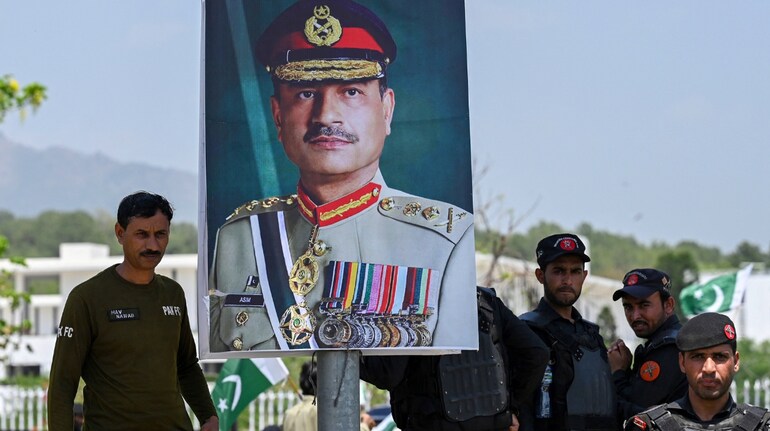
Pakistan prime minister Shehbaz Sharif last week put to rest rumours that Army chief General Asim Munir plans to overthrow President Asif Ali Zardari and assume the presidency himself.
“Field Marshal Asim Munir has never expressed any desire to become the president, nor is there any such plan in the offing,” Sharif said during a recent interview with The News.
Earlier, Pakistan's interior minister Mohsin Naqvi had rejected the speculation as a “malicious campaign” against the country’s civilian and military leadership.
Interestingly, Sharif's careful choice of words while dismissing the ongoing rumours underpinned the civilian government's subjugation to the all-powerful military, which has staged multiple coups and ruled the country for nearly half of its independent history.
Sharif, whose government elevated Munir to the Field Marshal rank after Operation Sindoor, said that the army chief "never expressed any desire to become president". The statement itself leads to the obvious question: what if he does?
Ever since his elevation to Field Marshal—the highest rank in Pakistan’s military—General Munir has drawn comparisons to General Ayub Khan, the country’s former army chief and its only other Field Marshal.
Both men are products of an establishment that thrives on anti-India rhetoric, sees civilian democracy as dispensable and consider peace as an existential threat to their military-industrial relevance.
Moreover, Ayub Khan staged the first ever military coup in Pakistan in 1958, seizing the presidency for himself.
While Munir may or may not "express desire" to become the Pakistani president, the fact that the only thing that stands in his way is his "own desire" is an unsettling truth that Islamabad often brushes under the carpet.
Munir is already the most powerful Pakistani of his time, the man who represented his country before US President Donald Trump following Operation Sindoor even as the civilian leadership was busy countering India's diplomatic outreach.
Pakistan PM Sharif himself sang praises for Munir and his leadership during Operation Sindoor, even as he overlooked the men who actually fought on the frontlines. Contrast this with Prime Minister Narendra Modi, who hailed the entire armed forces for the success of Operation Sindoor and met the brave airmen who gave a befitting reply to the neighbour.
History of coups haunts Pakistan
Since its creation in 1947, Pakistan has spent a significant portion of its history under direct military rule. Out of its nearly 78 years of existence, the country has been governed by military dictators for about 34 years.
The first military regime began in 1958 when Khan seized power, ruling until 1969. He was succeeded by another military officer, General Yahya Khan, who ruled until 1971.
After a brief democratic phase, General Zia-ul-Haq took power in a 1977 coup and stayed in control until his death in 1988. A decade later, in 1999, General Pervez Musharraf overthrew Nawaz Sharif’s government and ruled until 2008.
While Musharraf was the last military ruler of Pakistan, the country's all-powerful army still calls the shots when it comes to electing prime ministers.
For Munir, the hype and domestic fanfare after Operation Sindoor has effectively established himself as the de facto ruler of Pakistan. Coup or not, Munir's recent representation of Pakistan has made it clear that he does not need to replace Zardari to run the country.
Discover the latest Business News, Sensex, and Nifty updates. Obtain Personal Finance insights, tax queries, and expert opinions on Moneycontrol or download the Moneycontrol App to stay updated!
Find the best of Al News in one place, specially curated for you every weekend.
Stay on top of the latest tech trends and biggest startup news.









