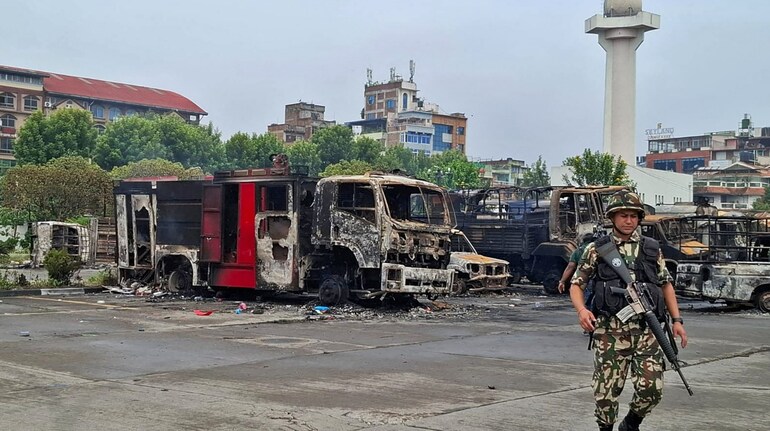
For years after abolishing its monarchy in 2008, Nepal has lurched from one government to another without ever achieving real stability. More than ten prime ministers later, corruption scandals, elite capture and joblessness have left a generation disillusioned. In early September 2025 that frustration boiled over. A sweeping social media ban, selective exemptions and the symbolism of China’s TikTok remaining online ignited protests on a scale unseen since the civil war. The uprising quickly toppled Prime Minister KP Sharma Oli and left Nepalis debating whether they had witnessed a spontaneous revolt or a scripted regime change.
From ‘nepo kids’ to the streets
Well before the first marches, Nepali social media had been seething with anger. Hashtags like #NepoKid, #NepoBabies and #PoliticiansNepoBabyNepal dominated TikTok and Reddit, contrasting the lifestyles of politicians’ children with the bleak realities of ordinary citizens. Viral clips showed “nepo babies” partying abroad while youth unemployment at home forced hundreds of thousands to migrate. Over 740,000 Nepalis left the country for foreign employment in the past year alone. As one protester put it, “We want our country back.”
Scandals deepened the resentment. The $71m Pokhara airport embezzlement and the fake refugee scam, in which politicians allegedly took money to disguise job-seekers as Bhutanese refugees, reinforced a perception of impunity. For young Nepalis, corruption meant unaffordable health and education, fertiliser shortages and rising prices in Kathmandu. “It added fuel to the fire,” one activist later said of the government’s next move.
Social media ban as a catalyst
In late August 2025, the government ordered 26 major platforms to register locally within seven days or face blocking. When the deadline passed, Nepal went dark online at midnight on September 4. Facebook, Instagram, WhatsApp, YouTube, X and Reddit were suddenly inaccessible. Only TikTok, owned by China’s ByteDance, and a few smaller services like Viber and WeTalk remained. Officials said the move was needed to curb “misuse” of online platforms for hate speech, fake news and cybercrime. For many young Nepalis the selective ban looked like censorship and an alignment with Beijing.
About 90 percent of the country’s 30 million people use the internet, and the abrupt cut to daily digital lifelines enraged a generation raised online. Calls for protests spread through VPNs and the still-functioning TikTok. An Instagram page called Gen.Z Nepal circulated instructions that stressed non-partisanship. Protesters were told: no party flags, no political leaders, no monarchist infiltration. Organisers even disavowed pro-royalist figures like Durga Prasai and members of the former royal family who tried to attach themselves to the movement.
On the morning of September 8, thousands of students and twenty-somethings, many still in school uniforms, flooded Maitighar Mandala in Kathmandu. They carried slogans such as “Shut down corruption – not social media”, “Unban social media” and “No More Nepo Babies.” The march initially had a festive energy but the demands were serious: end the ban, punish corruption and secure a future for Nepal’s youth.
Bloody Monday and the fallout
As marchers neared Parliament at New Baneshwar, heavy lines of police and paramilitary forces blocked their path. When a section of protesters pushed past barricades, security forces responded with tear gas, water cannons, rubber bullets and then live ammunition. By evening nineteen people were dead and hundreds injured. Witnesses described indiscriminate firing. Sareesha Shrestha, Miss Nepal Earth 2022, posted a tearful video: “Students, even minors, were shot.” TikToker Dristhi Adhikari accused the government of answering peaceful marches with live gunfire, calling it a violation of international human rights. Hashtags like #HatyaraSarkar (“Murderer Government”) and #ResignKPOli trended across VPN connections.
That same night Prime Minister Oli lifted the social media ban, hoping to calm the streets. It was too late. The next day fresh rallies erupted, more defiant and more violent. Mobs torched or attacked the homes of top leaders across party lines and portions of the Parliament building were burned. Kathmandu airport was shut down. Home Minister Ramesh Lekhak resigned first, taking “moral responsibility” for the killings. Two other ministers followed. By September 9 Oli himself stepped down, ending his fourth term. His exit was cheered as a victory for people power. Analysts noted that he had presided over a shaky coalition tilting toward Beijing and had been photographed in Shanghai days before the protests.
Western governments condemned the violence and called for restraint while China kept its public reaction muted. Some speculated that the registration drive mirrored Chinese influence but the rapid collapse of the ban suggested it was internal anger, not Beijing or Washington, that dictated events.
Organic uprising or regime change?
On the ground the evidence pointed to a decentralised youth revolt rooted in corruption and joblessness. Yet conspiracy theories flourished online about CIA-backed “colour revolutions” and Western attempts to destabilise China-friendly governments. Others noted how TikTok survived the ban while Western platforms were blocked. What is clear is that Nepal’s Gen Z, connected by VPNs and hashtags, managed to topple a government within days. What remains unclear is whether this was purely an organic eruption or part of a larger geopolitical chessboard.
Forsyth’s Icon imagined a Russia where a monarchist restoration was plotted to counter the rise of a hard-edged Communist. Nepal’s trajectory has been almost an inverted satire of that script: from monarchy to Maoist-led republicanism, once rebels in the hills now sitting in the palaces they once vowed to torch. In 1971 Gil Scott-Heron warned that “the revolution will not be televised.” In Nepal, 54 years later, the revolution did not need to be. It was on social media, streamed, hashtagged and VPN-routed. And when the government tried to ban the feed, Gen Z showed that revolt finds its own broadcast, with or without permission.
Discover the latest Business News, Sensex, and Nifty updates. Obtain Personal Finance insights, tax queries, and expert opinions on Moneycontrol or download the Moneycontrol App to stay updated!
Find the best of Al News in one place, specially curated for you every weekend.
Stay on top of the latest tech trends and biggest startup news.