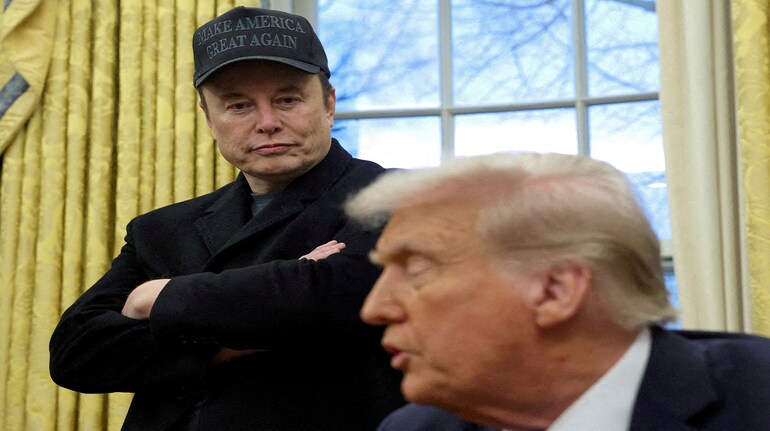
Elon Musk’s brief threat to cut off NASA’s use of SpaceX’s Dragon spacecraft highlighted just how dependent the US space agency has become on his company to access the International Space Station, underscoring the broader national security risks as Musk’s feud with President Donald Trump escalates, the Washington Post reported.
The threat, which Musk posted and then later walked back on X, came after Trump said he would terminate federal contracts with Musk’s companies in a move he described as a way to save “Billions and Billions of Dollars.” SpaceX, which launches astronauts for NASA, sensitive military payloads for the Pentagon and intelligence agencies, and provides satellite communications via Starlink, has become an essential federal contractor.
NASA did not say how it would continue flying astronauts to the $100 billion orbiting laboratory if it lost access to Dragon, which is currently the only American vehicle capable of ferrying crews to the ISS. “NASA will continue to execute upon the President’s vision for the fulfilment of space,” said press secretary Bethany Stevens in a statement.
A critical national asset
SpaceX first began flying NASA astronauts to the ISS in 2020 under a 2014 contract won alongside Boeing. But while Boeing’s Starliner spacecraft has faced repeated delays and technical problems, Dragon has become the workhorse of NASA’s human spaceflight programme. When Starliner’s first crewed flight went awry last year, NASA opted to bring the astronauts home on SpaceX’s Dragon.
It remains unclear whether Musk would have been contractually allowed to halt Dragon missions suddenly, but the public threat alone exposed how little redundancy exists in the programme. NASA occasionally buys seats on Russia’s Soyuz, but that option remains limited amid geopolitical tensions.
SpaceX’s importance goes beyond Dragon. NASA is investing $4 billion in SpaceX’s Starship rocket as part of its Artemis programme to return astronauts to the moon. Meanwhile, the Space Force recently awarded SpaceX $6 billion in launch contracts. SpaceX’s Falcon 9 rocket has become the most frequently launched orbital rocket in history, leaving the government heavily reliant on Musk’s company after competitors, such as Jeff Bezos’s Blue Origin, failed to keep pace.
Political fallout intensifies
The rift between Trump and Musk has already begun affecting national policy. Trump over the weekend pulled the nomination of Jared Isaacman— a private astronaut and Musk ally— to head NASA. Isaacman recently suggested that his ties to Musk played a role in the withdrawal of his nomination.
Separately, significant changes to NASA’s budget now look likely to be approved after Trump’s fight with Musk shifted political momentum. The White House had originally sought to cancel the costly Space Launch System and Orion capsule in favour of more commercial approaches. But with the Senate Commerce Committee moving to restore funding— including $4.1 billion for SLS— and relations with Musk strained, the White House is expected to accept the changes.
The risks of over-reliance
Space industry officials have long warned that NASA and the government needed to cultivate a more diverse base of providers to avoid over-reliance on SpaceX. While SpaceX has outperformed rivals, its dominance now poses strategic risks— as Musk’s momentary threat demonstrated.
Trump’s remark on Truth Social that cutting Musk’s federal contracts would be the “easiest way to save money” prompted Musk’s immediate response that SpaceX would start decommissioning Dragon. A few hours later, Musk reversed course: “Ok, we won’t decommission Dragon,” he posted.
Still, the incident left many officials rattled. “We have allowed ourselves to become too dependent on a single company,” one space policy adviser told The Washington Post. “That’s a vulnerability we need to address— quickly.”
Discover the latest Business News, Sensex, and Nifty updates. Obtain Personal Finance insights, tax queries, and expert opinions on Moneycontrol or download the Moneycontrol App to stay updated!
Find the best of Al News in one place, specially curated for you every weekend.
Stay on top of the latest tech trends and biggest startup news.