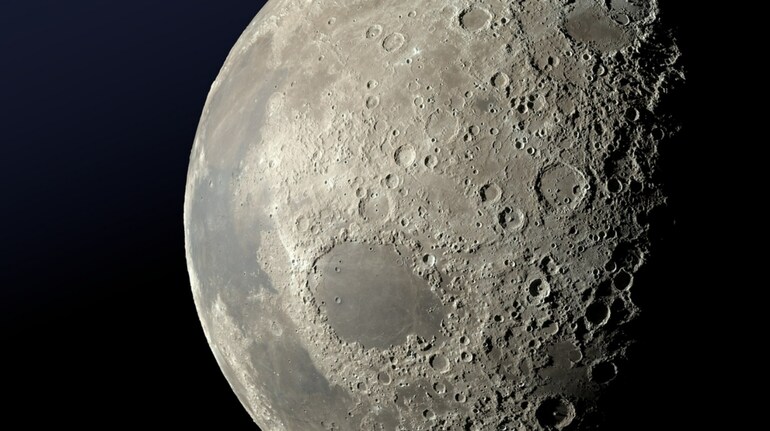
A lunar crater nearly 25 miles (40 kilometers) wide on the far side of the moon has recently played a significant role in the search for alien life within our solar system.
This crater, once known as "Pasteur T," is likely the most widely recognized lunar crater due to its appearance in one of the most iconic photographs ever taken of the moon.
It is prominently featured in the foreground of the famous "Earthrise" image captured by astronaut William Anders on December 24, 1968, during the Apollo 8 mission.
The striking photo, showing a half-lit Earth rising above the lunar horizon, became so well-known that the crater was renamed "Anders' Earthrise" in 2018.
JUICE's Lunar instrument test
The Jupiter Icy Moons Explorer (JUICE) spacecraft launched from Earth in April 2023 and is expected to arrive in Jupiter’s orbit in 2031. About a year ago, JUICE flew close to the moon, using the chance to test its 10 scientific instruments. These instruments will later help search for signs of life on Jupiter’s moons.
This flyby was the first time JUICE tested its tools on a solid surface in space, according to the European Space Agency (ESA). One important instrument, called RIME (Radar for Icy Moon Exploration), uses radio waves to measure the height of features on rocky surfaces.
RIME’s job at Jupiter will be to look beneath the icy shells of moons like Europa, Ganymede, and Callisto to map the hidden rocky layers underneath.
Because RIME needs very quiet conditions to accurately detect changes in radio waves, ESA scientists turned off all other instruments while JUICE passed over the famous Anders’ Earthrise crater. This allowed RIME to observe the crater for eight minutes without any interference.
RIME’s radar scanned the moon’s surface near the crater, and researchers compared these readings with earlier data from other spacecraft like NASA’s Lunar Orbiter Laser Altimeter (LOLA). They discovered that electronic interference from JUICE was affecting RIME’s accuracy, leading to a months-long effort to fix the problem using a new software update.
Discover the latest Business News, Sensex, and Nifty updates. Obtain Personal Finance insights, tax queries, and expert opinions on Moneycontrol or download the Moneycontrol App to stay updated!
Find the best of Al News in one place, specially curated for you every weekend.
Stay on top of the latest tech trends and biggest startup news.