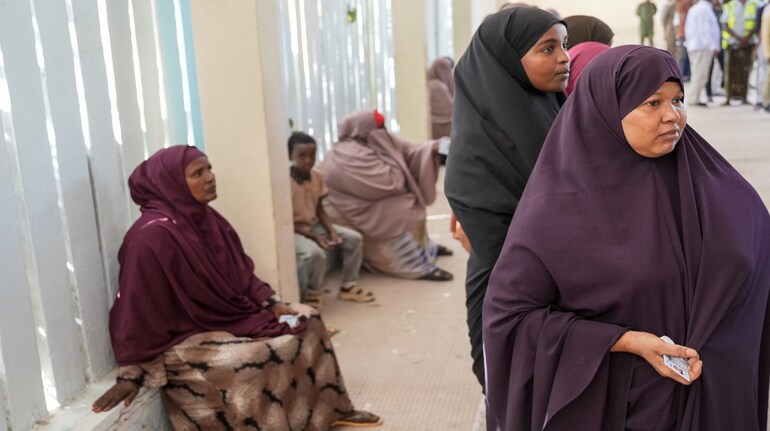
Somali authorities enforced tight security on Thursday for the first direct elections in the Mogadishu region in nearly six decades, though opposition leaders largely boycotted the vote.
Around 10,000 security personnel were deployed, and the city airport was closed as voters turned out for an election seen as a key test ahead of next year’s presidential ballot. Somalia continues to grapple with decades of conflict, an Islamist insurgency, and recurring natural disasters.
AFP correspondents reported long queues at polling stations in the morning, which thinned significantly by early afternoon. Election commission chief Abdikarin Ahmed Hassan said all stations had closed without incident at 1500 GMT, adding that the counting process would begin “soon” but did not specify when results would be announced.
“This is a great day,” said 37-year-old Guhad Ali, showing the ink on his finger as proof of voting. Ali Salad, 51, added that he had queued for hours to cast his ballot.
Universal suffrage was abolished after Siad Barre came to power in 1969. Since the collapse of his authoritarian regime in 1991, Somalia’s political system has operated under a clan-based framework.
Authorities have battled Al-Shabaab fighters linked to Al-Qaeda since 2006. Security has improved in Mogadishu, though violent incidents persist just 60 kilometres (40 miles) outside the capital, including attacks on the president’s convoy, missile fire near the international airport, and an assault on a detention centre over the past year.
More than 1,600 candidates are contesting 390 local council seats in the southeastern Banadir region, where Mogadishu is located. President Hassan Sheikh Mohamud hailed the election as “the future of the Somali people.”
However, the Somali Future coalition and several federal states have criticised the vote, claiming it is a power grab by the central government. Former Prime Minister Hassan Ali Kheire, a coalition member, said the government “orchestrated the election to extend the president’s mandate,” warning that “this is not going to be accepted.”
Although direct elections were abolished nearly 60 years ago, Somaliland in the north and Puntland previously conducted similar polls. Puntland held direct local elections in 2023 but returned to indirect voting in January 2025. This year’s vote had already been postponed three times.
The political strain heightens concerns ahead of the 2026 national elections, when parliament’s mandate ends in April and the president’s term concludes in May. The International Crisis Group warned in September that efforts to replace clan-based voting with direct elections “could plunge the country back into turmoil if leaders fail to compromise.”
Opposition groups have also threatened to organise a rival presidential vote if the federal government proceeds with direct elections next year.
Discover the latest Business News, Sensex, and Nifty updates. Obtain Personal Finance insights, tax queries, and expert opinions on Moneycontrol or download the Moneycontrol App to stay updated!
Find the best of Al News in one place, specially curated for you every weekend.
Stay on top of the latest tech trends and biggest startup news.