Mauritius is emerging as one of the world’s fastest-growing wealth markets, with its millionaire population projected to double by 2033. Now, the island nation is working to harness the boom — and shed its reputation as a tax haven.
The new government, in office since November, is courting family offices, wealth managers and fintech firms as it looks to diversify the $14.6 billion economy beyond tourism and real estate.
“You may call us a low-tax jurisdiction or an efficient-tax jurisdiction,” said Jyoti Jeetun, the minister of financial services and economic planning. “But we are not a tax haven.”
Still, the perception persists. About 2.3% of global tax haven flows pass through Mauritius, according to the Tax Justice Network. And the country remains one of the most competitive tax jurisdictions in the world: A top personal income tax rate of just 20%, no capital gains or inheritance taxes, and a flat 15% corporate tax rate for most companies — with exemptions of up to 95% available to some.
Mauritius also offers a golden visa program granting residency to foreigners who purchase property worth at least $375,000 in designated developments, invest a minimum of $50,000 in a business, or — if retired — transfer at least $18,000 annually into a local bank account.
Over the past decade, around 1,500 wealthy expatriates have relocated to the country, primarily from South Africa, France, China and the European Union. And the growth is poised to continue. The country’s millionaire population, currently estimated at 5,100, is projected to grow 95% by 2033, according to data from Henley & Partners and New World Wealth.
Still, Mauritius faces skepticism tied to its status as an offshore financial center, said Shamima Mallam-Hassam, managing director of Trident Trust Co. and chair of Mauritius Finance, an industry lobbying group. High-net-worth individuals, she added, are becoming “increasingly cautious about the reputational risks associated with their investment locations.”
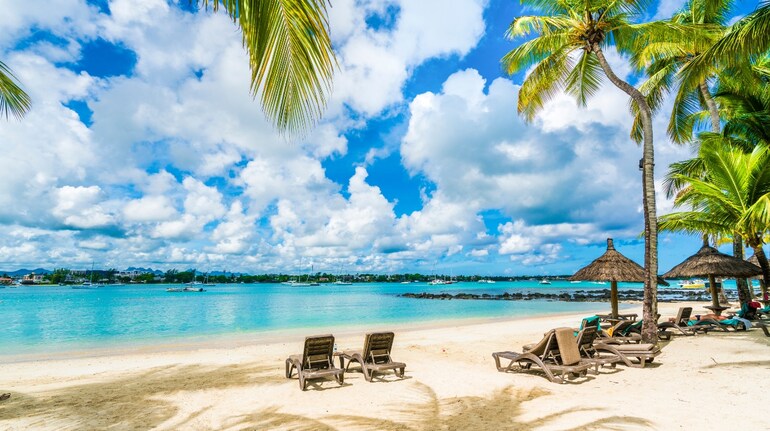
Even so, the steady influx of wealth has begun to reshape the tiny island nation — long known for its crystal-clear waters, white-sand beaches, and luxury resorts — into a playground for the ultra-rich.
Luxury residential developments are rising from Le Morne in the south to Grand Baie in the north — Africa’s richest seaside town — where prime apartments now sell for an average of $5,000 per square meter. Property accounted for 73% of total foreign direct investment last year, up from 52% during the 2021 to 2023 period, according to the central bank.
“We’re seeing greater demand from foreigners looking to relocate to Mauritius, as well as for long-term rentals,” said David Martial, chief executive officer of Alteo Ltd.’s property cluster. The company, which developed Anahita Mauritius — a luxury estate with two five-star hotels, a private beach and two championship golf courses — plans to invest 14 billion rupees ($303 million) in an adjacent lifestyle estate with a beach club, boat club and private school.
A growing number of resorts are now offering branded residences with concierge services and hotel-style amenities, according to Jonathan Tagg, the director of Pam Golding Properties Mauritius. Last year, the agency sold a six-bedroom beachfront villa for a record $13.6 million to a European family. The property was part of a private estate developed by One&Only Le Saint Géran and backed by Kerzner International, the firm behind Dubai’s Atlantis The Palm.
Amid the boom, the Economic Development Board Mauritius, which vets foreign property purchases, says it has stepped up due diligence. “The property market is very secure, and up to now, we have not had a single transaction where someone involved in illicit activity has passed the test,” said Deputy CEO Sachin Mohabeer. “It may happen that the individual was clean, but later on they had issues.”
The surge in luxury spending extends beyond real estate.
Yacht Management, a dealer of high-end Bénéteau boats, has been selling vessels between 9 and 12 meters (29.6 to 39.4 feet) in length for over 20 years. Clients are now requesting larger, custom yachts costing over $1 million, said Managing Director Bertrand Hardy.
Meanwhile, ENL Ltd.’s Axess unit has seen Land Rover sales more than double in the seven years through 2024, according to General Manager Stephane Chasteau de Balyon. Buyers, he said, are willing to wait months for bespoke configurations.
Beyond the lifestyle upgrades, the growing presence of high-net-worth individuals is expected to boost the financial services sector, which already accounts for about 14% of GDP.
Individuals and companies are already drawn to the country’s international financial center, which benefits from a hybrid English-French legal system, said Mathieu Leheilleix, who oversees Investec Wealth & Investment Mauritius Ltd.
But others are more skeptical. “It will be tough for Mauritius to convince wealth managers to move to the country,” said Pritish Behuria, a lecturer at the University of Manchester, pointing to structural challenges such as a limited local talent pool.
Mauritius will also face competition from more established wealth hubs. According to Savills, Dubai and Abu Dhabi have emerged as top destinations for the world’s wealthiest individuals seeking to relocate — followed by Singapore, Zurich and Auckland. Dubai’s financial hub alone is home to family offices managing over $1 trillion in assets.
Social Costs
The push for a more dynamic finance sector follows an audit that revealed miscalculations in the previous government’s fiscal framework. Prime Minister Navinchandra Ramgoolam, who also serves as finance minister, is expected to outline a new budget and economic strategy in June.
Still, a widening budget deficit and mounting fiscal pressures could limit the scope of incentives designed to attract wealthy expats.
Even as foreign wealth flows in, the economic gains have not been evenly distributed. In many parts of the country, infrastructure remains underdeveloped, with single-lane roads winding through fishing villages and sugarcane plantations. A brain drain continues as local graduates move abroad for work, and housing inflation is fueling inequality.
“These developments have come with noticeable social costs,” said Manisha Dookhony, chairperson of Mindex Ltd., citing the rise of gated communities and widening economic divides. She advocates for a wealth contribution fund that would compel wealthy newcomers to help support social initiatives.
Mauritius is also broadening its focus beyond traditional partnerships. Nearly four decades after signing a tax treaty with India — an agreement that helped establish its financial services sector and contributed to its reputation as a tax haven — the former Dutch, French and British colony is now working to deepen ties across Africa.
With several of the world’s fastest-growing economies, the continent presents a major opportunity. As one of the few African nations “whitelisted” by the Financial Action Task Force, Mauritius has positioned itself as a conduit for capital moving into and out of the continent. Still, it “lacks the scale and connectivity to serve as a full-spectrum gateway,” said Ronak Gopaldas, a director at Signal Risk, which advises companies on Africa.
The government hopes to change that. It’s aiming to attract financial conglomerates from across Africa to set up operations — including regional headquarters — to serve the wider continent, said Junior Finance Minister Dhaneshwar Damry. “Mauritius’ financial services sector will have a very important role to play as an enabler and catalyst for Africa.”
Discover the latest Business News, Sensex, and Nifty updates. Obtain Personal Finance insights, tax queries, and expert opinions on Moneycontrol or download the Moneycontrol App to stay updated!
Find the best of Al News in one place, specially curated for you every weekend.
Stay on top of the latest tech trends and biggest startup news.