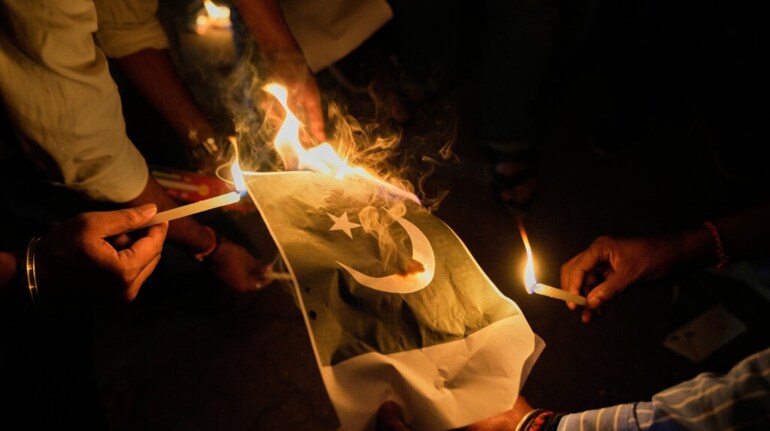
The terror attack in Jammu and Kashmir’s Pahalgam, which claimed 26 civilian lives, mostly tourists, was not just a brutal act of cross-border terrorism – it was a disturbing signal of Pakistan’s spiralling internal crisis now spilling into Indian territory. A deeper scrutiny of the attack reveals a chilling pattern that connects the dots between Pakistan’s domestic political chaos, the eroding credibility of its military, and a renewed reliance on asymmetric warfare through state-sponsored terror.
The region has seen its fair share of violence, but the Pahalgam attack stands out for its timing and execution. Just as Pakistan grapples with an economic freefall, a bitter civil-military rift and unprecedented anger on the ground against the establishment, it has once again resorted to its old playbook -- destabilize India to consolidate internal control. This is not an isolated attack —- it is a calculated diversionary tactic.
The assault comes at a time when Pakistan’s institutions are buckling under pressure. The military, long the puppet master of national politics, is now facing rare public dissent. The civilian government is shaky, saddled with IMF pressure and public distrust. In such a volatile backdrop, exporting crisis becomes a political necessity. And historically, whenever Islamabad faces an internal meltdown, India becomes the scapegoat.
This is not conjecture—it is a well-documented pattern. From Kargil in 1999 to the Uri and Pulwama attacks in recent years, Pakistan’s deep state has repeatedly used cross-border terrorism to deflect attention, provoke retaliation, and stir nationalist fervor at home. The Pahalgam attack fits right into that mold — with sophisticated tactics, Chinese-encrypted communications, and unmistakable fingerprints of Pakistani handlers.
So far, India has responded diplomatically and economically — turning the screws where it hurts Pakistan the most. And while Islamabad continues its denials, the world is watching the unfolding crisis with increasing suspicion. Pahalgam is not just a terror strike — it is a symptom of a deeper geopolitical malaise rooted in Pakistan’s own implosion.
A Familiar Blueprint
This isn't the first time that terror attacks in India have coincided with periods of intense political instability in Pakistan. From Kargil during Nawaz Sharif’s face-off with the Army to the Mumbai attacks amid civilian-military power tussles, the pattern is disturbingly familiar. With Imran Khan behind bars, Shehbaz Sharif heading a shaky coalition, and the military facing rare public backlash, Pakistan today is a pressure cooker. And history has shown that when Pakistan is on the verge of implosion, it often attempts to export instability.
Pahalgam fits squarely into this pattern—another “diversionary” operation, likely greenlit by elements in the ISI, with support from its longstanding terror proxies like Lashkar-e-Taiba operating under newer avatars like The Resistance Front (TRF).
“Pakistan’s internal crisis has eventually led to stronger control of the military. This has given military more leverage to conduct the external dynamics of the country catering to its strategic interests,” Dr Shalini Chawla, Distinguished Fellow at Centre For Air Power Studies (CAPS), told Moneycontrol.
Pakistan’s Domestic Powder Keg: Why Now?
Pakistan is a pressure cooker, a house on fire. Its economy is in tatters, inflation is sky-high, and public trust in institutions, particularly the military, is plummeting. Imran Khan’s arrest has triggered massive protests. Even traditionally quiet regions like Balochistan and Khyber Pakhtunkhwa are erupting in defiance. In such a scenario, the military’s playbook is simple—manufacture an external threat.
“What I feel is Pakistan, for quite some time, has been trying very hard to revive its strategic relevance. After US withdrew from Afghanistan, it has somewhere lost its strategic relevance, which it has cherished for many decades. I feel this move is a desperate attempt to revive its strategic relevance, bring Kashmir again in the international limelight and very importantly to challenge the narrative of normalcy in J&K,” Dr Shalini Chawla told Moneycontrol.
The idea is to stir nationalist fervour, shift public anger away from Rawalpindi and the civilian government, and present India as the common enemy. The timing of the Pahalgam attack, just weeks after mass protests in Lahore and Rawalpindi, is no accident.
Plausible Deniability
Pakistan Prime Minister Shehbaz Sharif and Foreign Minister Ishaq Dar have denied any involvement in the attack. Meanwhile, Pakistan-based journalists and social media proxies have pushed misinformation campaigns blaming “Indian false flag operations” and “Kashmiri freedom fighters.”
It’s the same old story: export terrorism, deny involvement, and flood the internet with conspiracy theories. But the world—and especially India—is no longer buying it.
Pakistan’s attempt to “externalize” its domestic woes through terror is a high-stakes gamble. In trying to stoke unrest in Kashmir, it has invited a multi-pronged retaliation that is squeezing its fragile state machinery even harder. With Indian diplomacy isolating Pakistan, and internal dissent growing, the coming days could mark a turning point.
Discover the latest Business News, Sensex, and Nifty updates. Obtain Personal Finance insights, tax queries, and expert opinions on Moneycontrol or download the Moneycontrol App to stay updated!
Find the best of Al News in one place, specially curated for you every weekend.
Stay on top of the latest tech trends and biggest startup news.