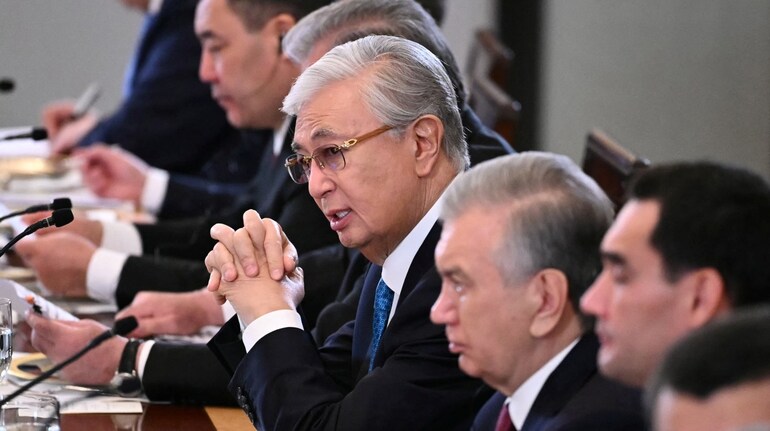
Kazakhstan has officially joined the Abraham Accords, becoming the first country to do so under US President Donald Trump’s second term. Trump announced the development on Thursday, calling it a “major step forward in building bridges across the world” and saying that “more nations are lining up to embrace peace and prosperity through my Abraham Accords.”
The move brings renewed life to the landmark initiative that reshaped Israel’s ties with the Arab world during Trump’s first presidency. Although Kazakhstan has maintained diplomatic and economic relations with Israel for more than three decades, its inclusion adds new strategic weight to the accords amid shifting power dynamics in Central and West Asia.
What are the Abraham Accords?
The Abraham Accords are US-brokered agreements that formalised relations between Israel and several Arab nations. Signed in 2020 during Trump’s first term, the initial accords brought together the United Arab Emirates and Bahrain, followed later by Morocco and Sudan.
Named after the patriarch Abraham -- revered in Judaism, Christianity, and Islam -- the accords symbolised a shared heritage and a new spirit of reconciliation across religious and political divides.
The initiative marked the first time in 25 years that Arab states recognised Israel. It was driven largely by Trump’s son-in-law and senior adviser Jared Kushner, who promoted it as a path toward regional peace and economic integration. For participating nations, it represented a pragmatic shift from conditioning normalisation on Palestinian statehood to prioritising trade, security, and technology cooperation with Israel.
Countries that joined before Kazakhstan
Four countries joined the Abraham Accords between 2020 and 2021: the United Arab Emirates, Bahrain, Morocco, and Sudan. Each of them established full diplomatic relations with Israel, opening embassies, starting direct flights, and signing agreements in sectors such as defence, technology, and tourism.
The UAE’s participation was widely seen as a breakthrough because of its economic influence and its position as a regional power. Morocco’s entry was tied to increased economic and diplomatic cooperation, while Sudan’s participation came after Washington removed it from the list of state sponsors of terrorism.
Kazakhstan’s decision now makes it the first new member of the accords since 2020 and the first addition under Trump’s second administration.
How the announcement was made
Trump revealed the development on his Truth Social platform, writing that he had “a great call between Prime Minister Benjamin Netanyahu, of Israel, and President Kassym-Jomart Tokayev, of Kazakhstan.” He added, “Kazakhstan is the first Country of my Second Term to join the Abraham Accords, the first of many.”
Calling the move “a major step forward in building bridges across the World,” Trump said a signing ceremony would take place soon to formalise the agreement.
He later told reporters that “more countries are trying to join this club of strength,” describing the expansion as “real progress, real results.” Trump concluded, “So much more to come in uniting countries for stability and growth. Blessed are the peacemakers.”
The announcement came during President Tokayev’s visit to Washington for a meeting between Trump and the leaders of the five Central Asian republics -- Kazakhstan, Kyrgyzstan, Tajikistan, Turkmenistan, and Uzbekistan.
Why Kazakhstan’s entry matters
While largely symbolic, Kazakhstan’s decision carries strategic significance. The Central Asian nation established diplomatic relations with Israel in 1992, shortly after its independence from the Soviet Union. Joining the accords reinforces that longstanding relationship while signalling support for dialogue at a time when Israel faces global criticism over the Gaza conflict.
The move is expected to expand cooperation in defence, cybersecurity, agriculture, and energy. For the United States, Kazakhstan’s inclusion revives momentum for the accords and reaffirms Washington’s role in shaping alignments across the Muslim world.
For Kazakhstan, it fits within its traditional “multi-vector” foreign policy of maintaining balanced ties with Russia, China, the United States, and regional partners. By joining, Kazakhstan positions itself as a diplomatic bridge across regions and strengthens its ties with both Washington and Jerusalem.
Part of Trump’s broader strategy
The addition of Kazakhstan also fits neatly into Trump’s foreign policy narrative. The Abraham Accords were one of his key diplomatic successes during his first term. Their expansion under his second administration allows him to claim that the initiative continues to yield results.
The Trump administration has made clear that bringing more countries into the accords remains a top priority. CNN quoted a source familiar with the discussions as saying that the administration views Kazakhstan’s entry as “just the tip of the iceberg.”
Trump has also hinted that Saudi Arabia could soon join the framework. He told Time magazine last month, “Saudi Arabia will lead the way toward the Abraham Accords,” and when asked whether it could happen by the end of the year, he replied, “Yes, I do. I do.”
What Kazakhstan gains
For Kazakhstan, the move offers political and economic dividends. It strengthens its visibility on the global stage, brings renewed attention from Washington, and opens opportunities for broader trade and technological cooperation with Israel and other signatories.
The decision also reinforces its reputation as a pragmatic, balanced actor in global diplomacy.
In practical terms, Kazakhstan’s entry does not create new relations with Israel but reaffirms existing ones. Yet the symbolism carries weight. In a region where diplomatic gestures often signal deeper realignments, the move underscores both Kazakhstan’s careful diplomacy and Washington’s determination to sustain the accords amid evolving geopolitical realities.
Discover the latest Business News, Sensex, and Nifty updates. Obtain Personal Finance insights, tax queries, and expert opinions on Moneycontrol or download the Moneycontrol App to stay updated!
Find the best of Al News in one place, specially curated for you every weekend.
Stay on top of the latest tech trends and biggest startup news.