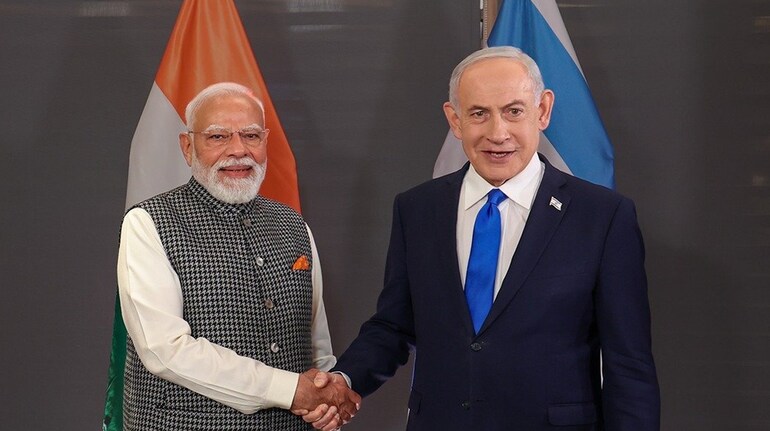
Prime Minister Narendra Modi’s visit to Israel signals deeper strategic alignment beyond diplomatic symbolism, underscoring growing cooperation across technology, defence and innovation. The visit comes amid expanding bilateral engagement and a broader recalibration of India’s West Asia ties.
In an interview with Moneycontrol, former diplomat Deepak Vohra described it as the consolidation of a long-maturing partnership rooted in trust and what he called a “meeting of hearts”, while rejecting suggestions that India is drifting away from its traditional support for Palestine and arguing instead that New Delhi’s policy has “matured”.
From cautious distance to strategic embrace
Vohra was unequivocal in his assessment of the India–Israel relationship. “Of the many countries that profess friendship with India, there is one that has never abandoned us, that has never hurt our vital interests. And that country is Israel,” he said.
For decades after recognising Israel in 1948, India avoided full diplomatic engagement. That changed in 1992 under Prime Minister P.V. Narasimha Rao, when formal diplomatic relations were established. According to Vohra, once those channels opened, cooperation expanded rapidly.
“Once we opened our mission, the floodgates opened. Israel said, we were waiting for you.”
The visit, he argued, signals to the international community that India and Israel now view each other as solid, reliable partners in critical sectors, defence, space technology, cyber security, agriculture and medicine.
On technology transfers, Vohra was particularly emphatic, “Of the many countries that give us equipment and technology, Israel is the most willing to transfer technology in its entirety… Israel gives us everything we need.”
He also highlighted the symbolism of Prime Minister Narendra Modi using the Hebrew phrase “Am Yisrael Chai” in Israel’s parliament, meaning “the people of Israel live”.
“Prime Minister used this phrase. And they absolutely loved it,” Vohra noted, describing the warmth extended by Prime Minister Benjamin Netanyahu and Israeli leaders as a public affirmation of strategic alignment.
In Vohra’s framing, Israel is signalling that India belongs to the small group of major powers shaping the future global order — and that it considers New Delhi a dependable partner in that future.
No drift on Palestine: A ‘matured’ policy
Addressing concerns that India may be abandoning Palestine, Vohra dismissed the suggestion outright.
“Have we abandoned our support for Palestine? Have we said the Palestinians can jump in the Mediterranean Sea or in the Jordan River? No.”
He recalled that before establishing full diplomatic ties with Israel in the early 1990s, India consulted Palestine Liberation Organization leader Yasser Arafat.
“We asked Yasser Arafat… Do you have a problem?… He said, none whatsoever. Go right ahead.”
According to Vohra, Arafat even suggested India could serve as a constructive intermediary.
“If you establish full-fledged diplomatic relations, you can be our advocate with Israel. You can tell the Israelis that, look, go easy on the Palestinians. Let’s find a solution.”
For Vohra, this undercuts the narrative of a policy reversal. Instead, he describes a transition from ideological positioning to pragmatic engagement.
“Therefore, there is no change in our position. If anything, we have matured.”
He contextualised this shift within India’s 1991 economic crisis, when New Delhi reassessed its external partnerships. At the time, he argued, Arab states offered limited tangible support, prompting India to rebalance political solidarity with national interest.
Today, he suggested, India approaches the region with greater confidence.
“The time that we were scared, we were reticent. This is not India anymore. This is Bharat. And Bharat does what it thinks is in its best interest.”
A strategic signal to the region
Taken together, Vohra’s remarks frame the visit as a declaration of strategic confidence. India is publicly deepening ties with Israel while maintaining support for a negotiated Palestinian solution.
Rather than a geopolitical pivot, the former diplomat portrays the moment as the articulation of a more self-assured West Asia doctrine: partnership without dependency, advocacy without confrontation, and engagement driven squarely by India’s national interest.
Discover the latest Business News, Sensex, and Nifty updates. Obtain Personal Finance insights, tax queries, and expert opinions on Moneycontrol or download the Moneycontrol App to stay updated!
Find the best of Al News in one place, specially curated for you every weekend.
Stay on top of the latest tech trends and biggest startup news.