






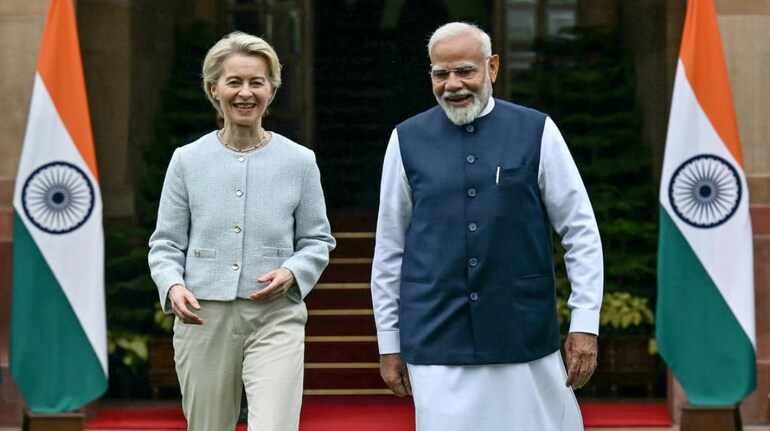

India and the European Union are set to officially announce the conclusion of negotiations on a comprehensive Free Trade Agreement (FTA) at a high-level summit in New Delhi today. This marks a breakthrough after talks that began in 2007 and were revived in 2022 following years of stagnation.
European Commission President Ursula von der Leyen, who was the chief guest at India’s 77th Republic Day celebrations on Monday, will attend the summit alongside European Council President Antonio Costa. Prime Minister Narendra Modi will host the leaders at the event, which is also expected to finalise a strategic defence partnership and a mobility framework.
Commerce Secretary Rajesh Agrawal confirmed that negotiations for the long-pending trade deal have been successfully concluded. “Negotiations have been successfully concluded. The deal has been finalised,” he said, describing it as balanced and forward-looking from India’s perspective. He added that the agreement would integrate India more closely with the European economy.
Von der Leyen highlighted the strategic significance of the pact, tweeting, “A successful India makes the world more stable, prosperous, and secure, and we all benefit.” Commerce and Industry Minister Piyush Goyal has previously described the FTA as “the mother of all deals,” underlining its scale and long-term importance.
Key features of the India-EU FTA
The agreement is expected to cover a broad range of goods and services, offering duty-free or preferential access for Indian exports in labour-intensive sectors such as textiles, garments, leather, gems and jewellery, engineering goods, and processed foods.
Currently, the EU’s average tariff on Indian goods is 3.8%, but duties on labour-heavy products can reach 10%. India’s weighted average tariff on EU imports stands at 9.3%, with high duties on automobiles, plastics, chemicals, and pharmaceuticals.
One of the most notable aspects is the proposed reduction of tariffs on EU cars. Presently, import duties on fully built cars range from 70% to 110%. Under the new deal, duties on select EU-made cars priced above €15,000 could immediately drop to 40%, with a gradual reduction to 10% over time. This move is expected to open India’s protected auto market to European manufacturers such as Volkswagen, Mercedes-Benz, and BMW.
Strategic and economic significance
Officials say the deal reflects a renewed political will to strengthen India–EU ties, especially amid global trade disruptions and elevated US tariffs. By diversifying trade partnerships and reducing reliance on China, both sides aim to enhance long-term economic stability.
India’s goods trade with the EU reached $136.53 billion in 2024-25, with exports totaling $75.85 billion and imports $60.68 billion. Services trade amounted to $83.10 billion, with a trade surplus of $15.17 billion. The EU accounts for roughly 17% of India’s total exports, while India contributes about 9% to the EU’s global shipments.
The FTA is expected to reduce or eliminate tariffs on over 90% of traded goods and ease barriers in services, including telecommunications, transport, and professional services.
Summit schedule and next steps
The programme will begin at 11:10 am with a wreath-laying ceremony at Raj Ghat, followed by a meeting between Prime Minister Modi, von der Leyen, and Costa at Hyderabad House.
Joint press statements are scheduled at 1:15 pm. Von der Leyen will later attend a business event at Bharat Mandapam, meet the Vice President at 4:30 pm, and then meet the President at Rashtrapati Bhavan at 6 pm. She will depart Delhi at 9:30 pm, while Costa leaves the city on Wednesday.
Impact on India’s automobile sector
The reduction of import duties on European cars is expected to allow automakers to offer vehicles at lower prices and expand their presence in India before considering local manufacturing.
Mohit Gulati, CIO and managing partner of ITI Growth Opportunities Fund, told Livemint that the move could be sentimentally negative for domestic auto players, shifting the advantage toward brands like Volkswagen, Mercedes-Benz, BMW, and Audi.
India ranks as the world’s third-largest car market, following the US and China. The sector has historically been highly protected, but the FTA’s provisions are expected to provide European manufacturers with a wider market with reduced barriers.
What is kept out?
Although the pact covers a wide range of sectors, some exceptions have been made. Key agricultural and dairy products have been excluded to safeguard the interests of India’s millions of small farmers.
Certain sensitive industrial segments have also been treated carefully to prevent abrupt disruptions for domestic producers.
Discover the latest Business News, Sensex, and Nifty updates. Obtain Personal Finance insights, tax queries, and expert opinions on Moneycontrol or download the Moneycontrol App to stay updated!
Find the best of Al News in one place, specially curated for you every weekend.
Stay on top of the latest tech trends and biggest startup news.










