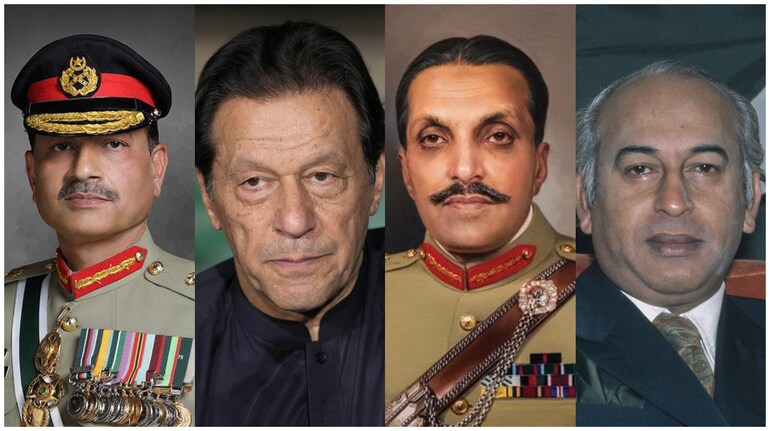
In most democratic countries, former premiers are treated with a sense of reverence – despite the prevailing political climate. In Pakistan, most are jailed, exiled, or even killed.
Thus, rumours of ousted Pakistan prime minister Imran Khan's death in jail came hardly as a shock to anyone. Though the jail authorities and Imran's own sister have denied the claims, those familiar with Pakistan’s political history cannot entirely discount the possibility of the cricket-turned-politician being eliminated behind bars.
Imran Khan himself has prophesied his possible death in jail, his own warning that “if anything happens to him", army chief Asim Munir "must be held responsible". Imran's warning, and the repeated rumours about his death, have revived memories of one of Pakistan’s bleakest political chapters: the Bhutto–Zia era.
A familiar playbook: coup, prison and public fear
In 1977, Zulfikar Ali Bhutto was toppled in a military coup by General Zia-ul-Haq. What followed is now political lore: Bhutto was jailed, tried on contentious charges, and eventually executed inside prison. His 1979 hanging is still described by many observers as a “judicial murder”, a politically driven elimination of a popular civilian leader.
Today, Imran Khan sits in a prison cell in Pakistan’s Adiala jail under a military-dominated power structure where Field Marshal Asim Munir is the most powerful figure in the state.
Reports of harsh jail conditions, allegations of rights being denied, and a steady drip of rumours about Khan’s health have stirred a sense of déjà vu. His explicit message to PTI leaders, that Munir should be held accountable for his death, has amplified fears that Pakistan may be sleepwalking into a repeat of its past.
Power beyond the ballot
The tension then and now stems from the same source: the struggle between civilian legitimacy and military control. Under Zia, the army subsumed civilian authority. Political parties were dismantled, dissent silenced, and institutional checks eroded. Bhutto’s fate became a warning of how fragile democratic mandates could be in the face of a military ruler’s will.
Khan’s supporters see a familiar pattern today. They allege that institutions meant to safeguard liberties have been bent under military pressure, with opposition leaders facing legal blowback while the ruling establishment closes ranks around the army chief. The anxiety that a democratically elected leader could face an extrajudicial end reflects an unease deeply rooted in Pakistan’s history.
The Bhutto–Zia template
Bhutto’s story remains the starkest precedent. On July 5, 1977, General Zia-ul-Haq deposed Prime Minister Zulfikar Ali Bhutto and suspended the constitution.
Bhutto was subsequently convicted in a murder-conspiracy case that many criticised as deeply biased. On April 4, 1979, he was hanged, a verdict the Pakistani Supreme Court later called “unfair”. Zia himself met a mysterious end in 1988, when the plane he was travelling in exploded mid-air, a crash that spawned conspiracy theories and remains unresolved to this day.
A new era of constitutionalised power
Against this backdrop, Pakistan’s freshly enacted 27th Constitutional Amendment adds a new dimension. Passed on November 14, 2025, it grants lifetime immunity to Field Marshal Asim Munir, while reshaping the judiciary into an executive-controlled structure. Two Supreme Court judges resigned in protest; the opposition walked out of Parliament.
The amendment reads like a political biography of three people: a jailed ex-cricketer, his spiritual-leaning wife, and a general-turned-field marshal whose power is now fully codified.
“He probably has as much power as Musharraf,” military analyst Shuja Nawaz told AFP. “Like Musharraf, he has a subservient prime minister and the authority to reshape the army’s structure.”
And unlike Musharraf, Munir carries no stain of a coup. His authority is not extra-constitutional—it is protected by the constitution itself.
“Field marshals don't retire. They may leave a post, but they remain field marshal for life,” Nawaz said.
Discover the latest Business News, Sensex, and Nifty updates. Obtain Personal Finance insights, tax queries, and expert opinions on Moneycontrol or download the Moneycontrol App to stay updated!





Find the best of Al News in one place, specially curated for you every weekend.
Stay on top of the latest tech trends and biggest startup news.