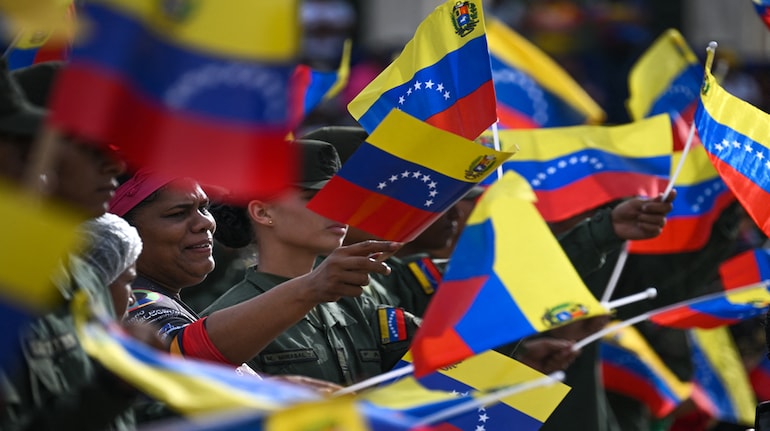
Venezuela has become a major staging ground for huge volumes of cocaine heading across the Atlantic. Corrupt military officers and powerful drug gangs move shipments by light aircraft, fishing boats, semi-submersible vessels and freighters, exploiting the country’s long coastline and weak security institutions. International law-enforcement officials say these consignments increasingly travel not toward the United States, but to West Africa, from where they are pushed north into Europe, the Wall Street Journal reported.
This shift is driven by unprecedented levels of cocaine production in Colombia in recent years, which have overwhelmed traditional routes through Central America and the Caribbean. Traffickers have turned to Venezuela’s geography and governance gaps to find new corridors. United Nations drug researchers note that cocaine consumption is now rising in regions that were not historically major markets, including Eastern Europe and Australia.
A new alignment with jihadist groups in West Africa
Once the cocaine leaves Venezuela and arrives in West Africa, it enters a second network involving jihadist-linked groups and local traffickers. Current and former rebel leaders in northern Mali describe how al Qaeda-affiliated factions escort convoys across the Sahel, levy “taxes” on drug loads and offer protection in return for payment.
This convergence of narcotraffickers, jihadists and corrupt officials is part of a wider pattern that worries Western security agencies: an emerging alignment between criminal gangs, militant movements and rogue or fragile governments. Officials caution that this nexus threatens democratic norms, fuels violence and weakens already strained states across Africa and beyond.
Pressure on Maduro and the limits of U.S. strikes
The Trump administration has used Venezuela’s role in the trade to justify military pressure on President Nicolás Maduro, whom U.S. officials accuse of being deeply implicated in narcotics smuggling. Maduro denies the allegations. Washington has ordered strikes on boats it says are carrying drugs toward the United States from Venezuela and Colombia.
But experts note that far larger quantities are believed to be headed east, not north. They argue that Europe, not the U.S., is now the primary destination for cocaine leaving Venezuelan shores, mostly via West Africa and nearby islands. Even so, Secretary of State Marco Rubio has cited Venezuela’s role as a transit hub to defend U.S. actions and suggested that European governments should be grateful rather than critical of the strikes.
Record seizures expose the scale of trans-Atlantic flows
Recent seizures illustrate the magnitude of the new corridor. In September last year, two Gulfstream private jets loaded with cocaine took off from a makeshift airstrip in Apure, a Venezuelan state on the Colombian border. One was intercepted in Guinea-Bissau with 2.6 tons on board, the largest seizure in the country’s history. The other reached Burkina Faso, another state struggling with Islamist insurgency.
Traffickers are believed to be flying at least one such cargo a week from Venezuela to West Africa. Smugglers regularly switch off aircraft transponders and, according to investigators, bribe air-traffic controllers to disable radar tracking as planes pass overhead. At sea, Spanish authorities recently seized 3.3 tons of cocaine on a Venezuelan fishing vessel near the Canary Islands, while Ireland’s largest ever haul, 2.2 tons aboard the MV Matthew in 2023, was traced to loading in waters near Venezuela. Portuguese police this month detained a semi-submersible crewed by Venezuelans and carrying 1.7 tons of cocaine across the mid-Atlantic.
From Sahel routes to European ports
Once cocaine reaches West Africa, much of it is routed through Mali and neighboring states, where jihadist groups exert control in remote areas. After al Qaeda-linked fighters seized swathes of northern Mali in 2012, veteran Algerian militant Mokhtar Belmokhtar fought local Tuareg factions to dominate smuggling corridors, including those used for cocaine. European investigations and security officials say local traffickers have since learned to work with jihadist leaders to keep their routes open.
From Mali, drugs move across the Sahara into Algeria, Morocco and Libya. A 2024 United Nations report found that a Russia-backed Libyan faction is charging fees on cocaine transiting from Niger toward Egypt. From North Africa, shipments cross the Mediterranean to southern Europe, landing in ports in Spain, Portugal, Italy and beyond. Venezuelan groups also exploit corruption at ports and along their own coastline to send vessels directly toward Europe, where Spanish, Portuguese and Irish cases have highlighted their presence.
Instability and corruption widen the pipeline
Law-enforcement agencies in Europe have increased cooperation with partners in Africa, but officials admit they are struggling to keep pace with the volume. Coups and political instability in Sahel countries have disrupted joint operations and intelligence sharing, making lawless areas even more attractive to traffickers.
Analysts say this combination of Venezuelan launch sites, jihadist-controlled corridors in West Africa and high European demand has created a resilient, multi-layered trafficking system. With cocaine seizures in Europe now exceeding those in North America, authorities warn that without stronger institutions and sustained cooperation, the flow is likely to grow rather than shrink.
Discover the latest Business News, Sensex, and Nifty updates. Obtain Personal Finance insights, tax queries, and expert opinions on Moneycontrol or download the Moneycontrol App to stay updated!
Find the best of Al News in one place, specially curated for you every weekend.
Stay on top of the latest tech trends and biggest startup news.