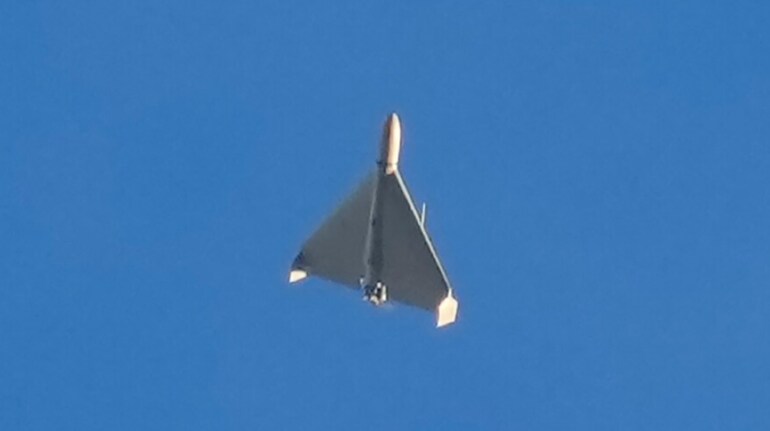

The United States Army has sent 10,000 interceptor drones developed in Ukraine to the Middle East to counter Iranian drone attacks without relying heavily on costly missile defence systems, news agency Bloomberg reported.
Dan Driscoll, secretary of the US Army, said in an interview that the AI-enabled Merops drones were deployed within five days of the start of the US-Israeli military operation against Iran on February 28.
The drones were developed by Project Eagle, a defence venture backed by former Google chief executive Eric Schmidt, and were first sent to Ukraine in 2024, according to Bloomberg.
Merops interceptor drones currently cost between $14,000 and $15,000 each, though Driscoll said large-scale orders could bring the price down to between $3,000 and $5,000 per unit. By comparison, Iran’s Shahed-136 drone costs at least $20,000 and has been widely used against US forces and their allies.
“We’re actually on the better end of the cost curve there,” Driscoll said. “So each time Iran launches one that we are able to take down, they are losing a meaningful amount of money.”
The deployment of technology tested during Russia–Ukraine War comes even as Donald Trump dismissed the need for assistance from Ukraine in countering Iranian drones.
Ukrainian President Volodymyr Zelenskyy had offered support to help intercept drones in the region. However, Trump said in an interview on Fox News Radio with Brian Kilmeade, “No, we don’t need their help on drone defense. We know more about drones than anybody. We have the best drones in the world, actually.”
US and Israeli forces have previously relied on systems such as the Patriot missile system and THAAD missile defense system, whose interceptor missiles can cost more than $4 million each, to destroy incoming drones and ballistic missiles.
Alongside Merops, the US has also deployed other counter-drone systems, including Coyote interceptor drone made by RTX Corporation.
The army has also introduced Bumblebee interceptor drone, a quadcopter armed with explosives designed to hunt and collide with enemy drones. The system, developed by Perennial Autonomy, was previously tested in Ukraine as an attack drone.
The US Army purchased Bumblebee systems under a $5.2 million contract in January 2026 through the Joint Interagency Task Force 401, a Pentagon unit set up to develop and rapidly deploy counter-drone technologies.
The Merops system gained global attention during its use by Ukrainian forces to counter drone swarm tactics used by Russia. Unlike traditional air defence systems that rely on explosive projectiles, Merops is designed as a physical interceptor that uses artificial intelligence to identify, track and neutralise incoming threats.
Operating in contested airspaces across the Persian Gulf and the Levant, the drones can intercept targets by ramming them or deploying nets to disable propellers. Because Shahed drones are relatively slow-moving, the Merops drones — designed for higher speed and manoeuvrability — can intercept them before they reach intended targets.
The system also relies on onboard computer vision and edge artificial intelligence, allowing it to function even in heavily jammed electronic environments without continuous human control. This enables a single operator to oversee hundreds of units simultaneously, forming a distributed counter-drone shield across the region.
*With Agency InputsDiscover the latest Business News, Sensex, and Nifty updates. Obtain Personal Finance insights, tax queries, and expert opinions on Moneycontrol or download the Moneycontrol App to stay updated!
Find the best of Al News in one place, specially curated for you every weekend.
Stay on top of the latest tech trends and biggest startup news.