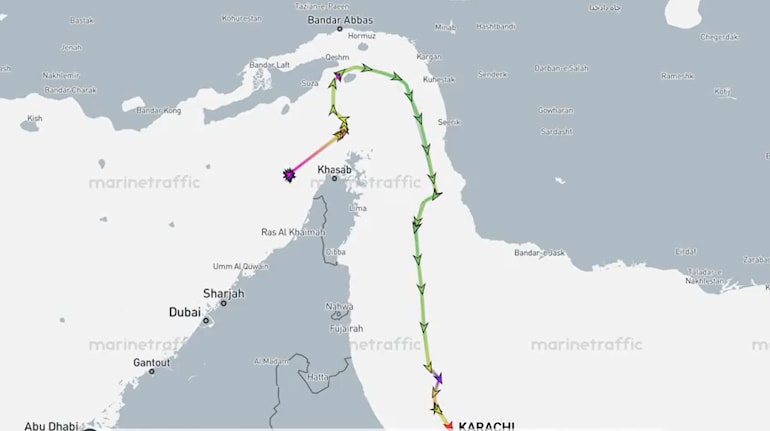

A Pakistani-flagged oil tanker has managed to pass through the tense Strait of Hormuz even as Iran has restricted access to the crucial energy corridor for ships linked to the United States and its allies.
The passage of the vessel is drawing attention from maritime analysts, who say it could indicate a pattern in how Tehran is selectively allowing certain ships to transit the strait.
The Pakistani tanker’s route
A Pakistani-flagged Aframax tanker named Karachi sailed through the strait on Sunday while broadcasting its location, becoming the first non-Iranian vessel to do so since the latest tensions escalated, according to ship-tracking data from MarineTraffic.
The midsize tanker, carrying Abu Dhabi crude, departed from Das Island, about 100 miles northwest of the United Arab Emirates mainland.
Maritime analysts believe the vessel may have received approval from Iranian authorities before entering the strait.
First non-Iranian cargo transits Strait of Hormuz with AIS onThe Aframax tanker Karachi, carrying Abu Dhabi’s Das crude, has become the first non-Iranian cargo to transit the chokepoint while broadcasting its AIS signal, suggesting that select shipments may be receiving… pic.twitter.com/Q6j6W3Cxz3 — MarineTraffic (@MarineTraffic) March 16, 2026
Just a day before the tanker was allowed to pass, Iran's FM Abbas Araghchi thanked Pakistan for condemning US‑Israeli attacks in a post on X. Today, the Pakistani‑owned tanker safely crossed the Strait of Hormuz, still closed to US, Israeli, and allied ships.
“It transited along Iranian waters rather than in international waters, signalling that it could have received approval to transit from the Iranian regime. This is a pattern to look out for going forward,” Jemima Shelley told The Wall Street Journal.
Shelley said that most ships passing through the strait so far belong to Iran’s so-called “dark fleet”, but Tehran now appears to be allowing a limited number of other tankers to pass as well.
However, it remains unclear which vessels may receive such approvals in the future.
Indian-bound tankers also pass
In a separate development, two India-bound tankers -- Shivalik and Nanda Devi -- carrying around 3 million barrels of crude oil transited the Strait of Hormuz between March 5 and 10.
According to ship-tracking data from Kpler shared with Moneycontrol, both vessels travelled with their transponders switched off.
One tanker was loaded at the Al-Basra Oil Terminal in southern Iraq, while the other departed from Saudi Arabia’s eastern coast.
The transit followed intense diplomatic outreach between India and Iran. Since the crisis began in late February, India’s External Affairs Minister S Jaishankar has held four rounds of talks with Iranian Foreign Minister Seyed Abbas Araghchi.
Prime Minister Narendra Modi also spoke with Iranian President Masoud Pezeshkian to ensure safe passage for Indian vessels.
The tanker Shivalik reached Mundra Port on Monday, while Nanda Devi arrived at the Gujarat port on Tuesday.
Ship traffic still far below normal
Despite these limited movements, traffic through the Strait of Hormuz remains far below pre-conflict levels.
Data from Kpler shows that 17 oil tankers sailed through the strait between the second day of the conflict and Sunday. Seven of them flew the Iranian flag, suggesting they were transporting Tehran’s crude, much of which is believed to be headed to China.
Just one of the tankers, managed by a Hong Kong-based shipping firm, was reportedly sailing toward Europe.
According to S&P Global Market Intelligence, more than two dozen attacks on commercial vessels have been reported in the Middle East Gulf this month, most targeting oil tankers.
As a result, many ships are avoiding the waterway due to safety concerns.
Stephen Gordon, head of research at shipbroker Clarksons, told WSJ that around 1,100 ships — including about 250 petroleum tankers — are currently stuck in the Gulf.
Before the conflict, roughly 125 ships passed through the Strait of Hormuz daily. Last week, the average fell to just five per day.
Discover the latest Business News, Sensex, and Nifty updates. Obtain Personal Finance insights, tax queries, and expert opinions on Moneycontrol or download the Moneycontrol App to stay updated!





Find the best of Al News in one place, specially curated for you every weekend.
Stay on top of the latest tech trends and biggest startup news.