






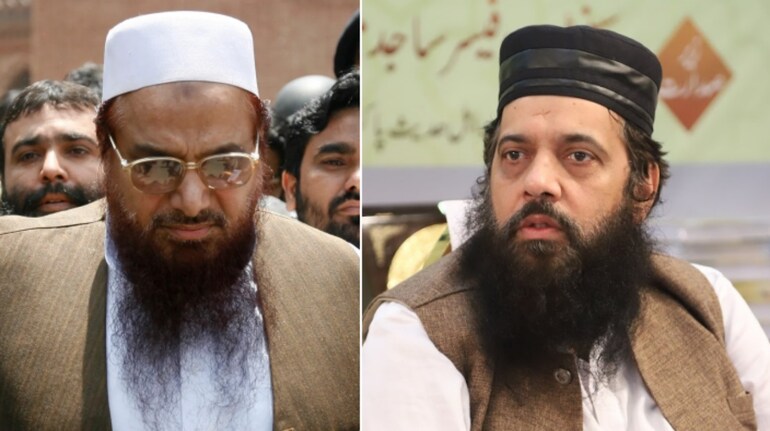
A fresh security alarm has been triggered in India’s east after a close associate of Lashkar-e-Taiba (LeT) founder Hafiz Saeed was spotted operating freely in Bangladesh. Ibtisam Elahi Zaheer, General Secretary of Pakistan’s Markazi Jamiat Ahl-e-Hadith and a long-time ally of the UN-designated terrorist, has been touring districts near the India-Bangladesh border since October 25. His public sermons and meetings with local radicals are raising concerns that Pakistan’s jihadist networks are once again attempting to use Bangladeshi soil as a launchpad to destabilise the region. The silence of the interim government in Dhaka under Muhammad Yunus has only deepened suspicion that extremist actors enjoy political protection.
Saeed’s associate touring sensitive border districts
Zaheer landed at Shah Makhdum Airport in Rajshahi on the evening of October 25, where he was received by Abdur Rahim bin Abdur Razzaq, a member of Al Jamia As-Salifa, an Islamic research institute tied to Bangladesh’s Ahl-e-Hadith movement.
Since then, Zaheer has embarked on a tour of frontier areas. Over the weekend, he visited Rajshahi and Chapainawabganj, two districts located along the India-Bangladesh border, before setting out for Rangpur this week. He is also expected to travel through Lalmonirhat, Nilphamari, Joypurhat, and Nagaon in the coming days.
This is his second visit since the Yunus regime took power in August 2024. His earlier trip, in February 2025, lasted more than a week.
Zaheer’s schedule includes participation in a major Salafi conference in Rajshahi on November 6 and 7, where he is expected to deliver a keynote address before returning to Pakistan on November 8.
Provocative sermons and calls for Islamist unity
A video accessed by India Today shows Zaheer addressing a gathering in Chapainawabganj, where he openly incited religious extremism. “You must be ready to sacrifice yourself for the cause of Islam... ready to sacrifice your children as well. We must stand prepared to confront secular and liberal forces,” Zaheer said.
He went on to proclaim that “from Pakistan to Bangladesh, all Muslims will unite against the seculars.”
Zaheer’s remarks also targeted India. “The Kashmiris are being deprived of their freedom. It is Pakistan’s responsibility to raise a strong voice against the anti-Islamic laws and the oppressive acts in Indian Kashmir. By the grace of Allah, the day will come when Kashmir will become part of Pakistan,” he said.
Security experts believe such statements point to coordinated ideological campaigns intended to radicalise border communities in northern Bangladesh and create fresh threats for India’s Northeast.
Dhaka’s silence raises questions
Zaheer’s visit has gone unacknowledged by the Bangladesh government, which has refused to comment publicly on his activities. The silence has sparked concern among Indian security agencies, given the broader pattern of extremist resurgence in post-Hasina Bangladesh.
Since the ouster of Sheikh Hasina’s government in August 2024, Dhaka has seen a resurgence of Islamist movements long suppressed under her rule. Analysts believe the interim administration led by Muhammad Yunus has created political space for Pakistan-linked radicals to re-enter Bangladesh under the guise of religious outreach.
Zaheer’s meetings reportedly include interactions with Asadullah Al Ghalib, president of the Ahl-e-Hadith Movement Bangladesh, an organisation that has historically maintained links with foreign Salafi clerics.
He also attended an event at Nibras International School in Dhaka, which sources say was organised by local Salafi circles sympathetic to his ideology.
Deep links to global jihadist figures
Ibtisam Elahi Zaheer is not an ordinary cleric. His connections span some of the most dangerous terrorist networks in South Asia. He has been closely associated with Hafiz Saeed for over 24 years and has ties to Saeed’s brother-in-law, the late LeT commander Abdul Rahman Makki, as well as LeT co-founder Amir Hamza.
Zaheer’s ideological base in Pakistan’s Ahl-e-Hadith network has long served as a soft recruitment ground for jihadist groups like Lashkar-e-Taiba. Through religious outreach and madrasa networks, Zaheer has helped propagate Salafi extremism across South Asia, giving it a veneer of clerical legitimacy.
His reach also extends to Indian fugitive Zakir Naik. The two reportedly met in Pakistan in October 2024, and their alliance, observers warn, could facilitate a dangerous convergence of radical voices operating between Pakistan, Malaysia, and Bangladesh.
A growing Pakistan-Bangladesh nexus
Zaheer’s free movement within Bangladesh and the apparent state indifference to his activities point to an evolving partnership between Pakistani radical elements and sympathetic actors in Dhaka. His tour, coinciding with upcoming Salafi events and visits by other Islamist preachers, suggests an orchestrated effort to entrench Pakistan’s ideological and operational influence in the region.
Security officials fear this deepening nexus could destabilise India’s eastern frontier by providing a logistical corridor for extremist networks to spread propaganda and recruitment.
The fact that a known associate of Hafiz Saeed is operating openly in Bangladesh should be a wake-up call for Dhaka. Instead, the interim government’s silence and continued tolerance of such elements risk turning the country into a new hub for cross-border radicalisation.
Why India needs to watch closely
For India, Zaheer’s presence in Bangladesh is not an isolated concern but part of a larger strategic challenge. His activities along the sensitive border regions of Rajshahi, Rangpur, and Chapainawabganj place him within striking distance of India’s vulnerable northeastern corridor, including West Bengal and Assam.
Indian security agencies are already wary of Pakistan’s long-standing strategy of exploiting Bangladesh-based sleeper cells to infiltrate the Northeast. The appearance of a figure like Zaheer, who maintains ideological and operational links with Hafiz Saeed and Zakir Naik, raises the possibility of a renewed attempt to radicalise sections of the population and revive cross-border terror logistics.
India also needs to monitor the growing cooperation between Pakistan’s Ahl-e-Hadith movement and Bangladesh’s Salafi networks, which could serve as conduits for funding, recruitment, and propaganda targeting Indian Muslims.
If Zaheer’s movements go unchecked, the region could see a revival of Pakistan’s proxy tactics reminiscent of the early 2000s. India’s intelligence and diplomatic apparatus will need to stay alert, not only to prevent infiltration but also to ensure that the Yunus regime in Dhaka is held accountable for allowing known extremists to operate so close to Indian territory.
Discover the latest Business News, Sensex, and Nifty updates. Obtain Personal Finance insights, tax queries, and expert opinions on Moneycontrol or download the Moneycontrol App to stay updated!
Find the best of Al News in one place, specially curated for you every weekend.
Stay on top of the latest tech trends and biggest startup news.









