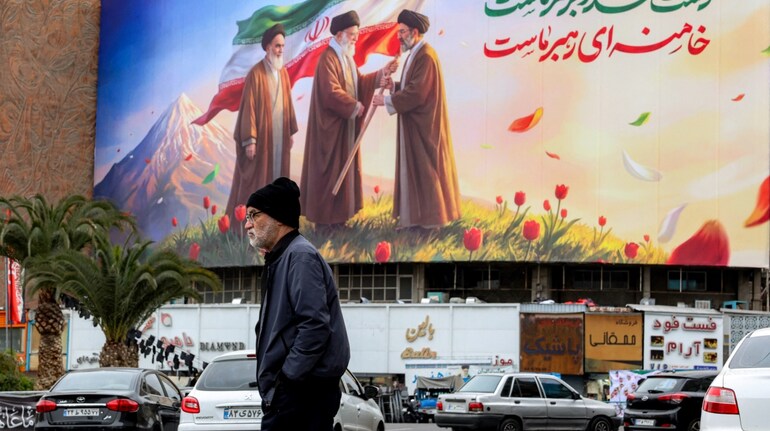

The ongoing US-Israel war on Iran has not just targeted military infrastructure. It has systematically dismantled the country’s leadership. From Supreme Leader Ayatollah Ali Khamenei to senior military commanders and key security officials, a significant portion of Iran’s top decision-making structure has been wiped out in a matter of weeks.
The result is an unprecedented leadership vacuum at the heart of the Islamic Republic, raising a critical question. Who is actually in charge of Iran right now?
A leadership decapitation strategy
The conflict began with a high-impact strike that killed Iran’s Supreme Leader Ayatollah Ali Khamenei on February 28.
As the country’s top authority, Khamenei had ultimate control over national security, the armed forces and strategic decision-making. His death alone would have created instability. But the strikes did not stop there.
Earlier today, Israel claimed responsibility for killing Ali Larijani, secretary of Iran’s Supreme National Security Council, and Gholamreza Soleimani, commander of the Basij paramilitary force.
Other key figures believed to have been killed include defence strategist Ali Shamkhani, IRGC chief Mohammad Pakpour, defence minister Aziz Nasirzadeh, military bureau head Mohammad Shirazi, and senior intelligence officials.
Together, these figures formed the backbone of Iran’s political, military and intelligence architecture.
Their elimination has left multiple power centres weakened at the same time.
Why these losses matter
Each of the leaders killed held a specific and critical role. Khamenei was the ultimate authority.
Larijani was widely seen as a central political operator and strategist, often tasked with sensitive diplomatic and security responsibilities.
Soleimani oversaw the Basij, a key force used to maintain internal control and suppress dissent.
Shamkhani and Pakpour were deeply embedded in Iran’s military planning and coordination.
Shirazi served as a vital link between the Supreme Leader and the armed forces.
Taken together, their removal represents not just individual losses but a collapse of institutional continuity.
This is not a normal wartime loss of personnel. It is a targeted dismantling of the command structure.
Fragmented command and rising uncertainty
With so many senior figures gone, Iran’s chain of command appears increasingly fragmented.
There is no clear indication of who is coordinating military responses, managing internal security, or handling diplomatic engagement.
Even external observers are struggling to identify a central authority.
US President Donald Trump highlighted this uncertainty in his remarks.
“We don’t know... if he’s dead or not,” Trump said, referring to Iran’s new Supreme Leader Mojtaba Khamenei.
“A lot of people are saying that he’s badly disfigured. They’re saying that he lost his leg -- one leg -- and he’s, you know, been hurt very badly. Other people are saying he’s dead. Nobody’s saying he’s 100 percent healthy. You know he hasn’t spoken.”
Trump added, “We don’t know who we’re dealing with. We don’t know who their leader is.”
These comments underscore a growing perception that Iran’s leadership structure is not just weakened but opaque.
Mojtaba Khamenei: Leader on paper, missing in action?
Reported injury, no public appearance: Mojtaba Khamenei, the son of the late Supreme Leader, was declared Iran’s new leader after his father’s death. However, his current status remains deeply uncertain.
According to reports, Mojtaba is believed to be alive but severely injured following the initial strikes. His communication is said to be restricted, and he has not made any public appearance since assuming leadership.
This absence has fuelled speculation about his ability to govern or even survive.
Trump’s remarks have further amplified these doubts.
“We don’t know... if he’s dead or not,” he said.
Despite being named Supreme Leader, Mojtaba has not addressed the nation directly. His only known message was delivered through state media, raising further questions about his condition and control.
Power vacuum or silent transition?
In the absence of visible leadership, multiple scenarios are possible.
One possibility is that Iran’s remaining institutions, including the Islamic Revolutionary Guard Corps, are operating collectively without a single dominant leader.
Another is that a shadow leadership structure is in place, with decisions being made behind closed doors to avoid exposing remaining figures to targeted strikes.
There is also the possibility of internal power struggles, as different factions attempt to assert control in a rapidly changing environment.
A country without a clear command centre
What makes the current situation unusual is the scale and simultaneity of leadership losses.
Rarely has a country lost its top political leader, senior military commanders, intelligence chiefs and key strategists in such a short span.
This creates not just a vacuum but a crisis of coordination.
Military operations, internal security, and diplomatic outreach all depend on clear lines of authority. Without them, decision-making slows, responses become inconsistent, and vulnerabilities increase.
Iran’s ‘mosaic defence’: The strategy keeping it in the fight
Despite the loss of its top leadership, Iran’s ability to sustain military operations is rooted in its “mosaic defence” doctrine, a decentralised war strategy built precisely for such scenarios. Instead of relying on a single command chain, Iran has divided its military structure into semi-autonomous units across regions, allowing local commanders to continue operations even if senior leadership is eliminated.
This system enables the Islamic Revolutionary Guard Corps, the regular army, and the Basij to function independently while still coordinating loosely. The aim is endurance rather than quick victory, forcing adversaries into a prolonged and costly conflict.
Crucially, the doctrine also supports asymmetric warfare. Iran leverages drones, missile strikes, and regional proxies to stretch the battlefield and impose pressure beyond its borders.
The result is a system designed to survive “decapitation strikes,” ensuring that even without visible leadership, the war effort continues largely uninterrupted.
Conclusion: A war beyond the battlefield
The war in Iran is no longer just about territory or military targets. It has evolved into a battle over leadership itself.
By targeting the top tier of Iran’s command structure, the US and Israel have fundamentally altered how the country functions internally. But the outcome remains uncertain.
Whether Iran consolidates power under a new leadership, operates through a fragmented system, or descends into deeper instability will shape not just the conflict, but the region’s future.
For now, one thing is clear. Iran’s leadership has been hit hard, and the question of who is truly in control remains unanswered.
Discover the latest Business News, Sensex, and Nifty updates. Obtain Personal Finance insights, tax queries, and expert opinions on Moneycontrol or download the Moneycontrol App to stay updated!
Find the best of Al News in one place, specially curated for you every weekend.
Stay on top of the latest tech trends and biggest startup news.