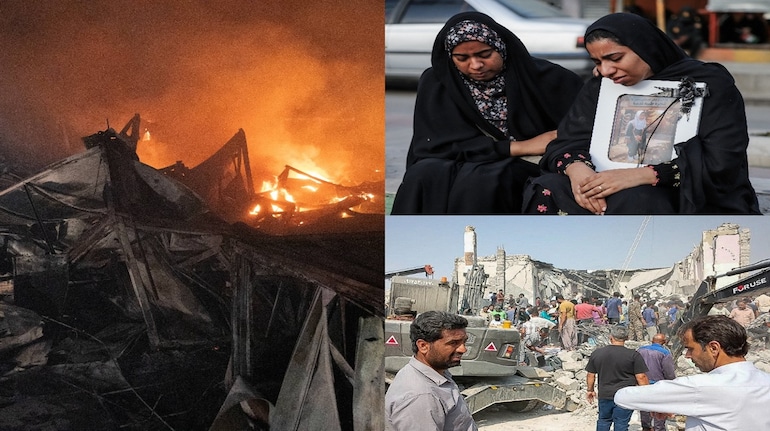

In two tragic incidents this month, civilians have borne the full brunt of regional conflicts, exposing severe breaches of international humanitarian law and raising urgent questions about accountability in modern warfare.
The first incident occurred on March 1, when the Shajare Tayyebeh girls’ elementary school in Minab, southern Iran, was struck. Iranian authorities reported at least 165 dead, mostly children, with the Iranian Red Crescent initially confirming 108 casualties.
Videos showed the school building severely damaged, colorful murals defaced, and distraught civilians gathering around the site. While neither the U.S. nor Israel has officially claimed responsibility, investigative reports suggest that U.S. forces targeting nearby IRGC naval facilities were likely behind the attack.
The strike, which occurred during school hours, immediately drew international condemnation. The UN has urged the need for a prompt, transparent investigation and called for accountability, highlighting that schools are civilian institutions that should never be targeted in conflict.
Under international humanitarian law, civilian objects, especially schools, are protected unless they are being used for military purposes. Even then, proportionality and precautionary measures must be applied to minimise civilian harm.
Barely two weeks later, on March 16, Pakistan conducted airstrikes on a drug rehabilitation centre in Kabul, Afghanistan, during the evening after residents had broken their Ramadan fast. The centre housed roughly 3,000 patients, all civilians, and the Italian NGO Emergency confirmed dozens of casualties among patients and staff.
Pakistan claimed the strike targeted “military installations and terrorist support infrastructure.” However, all evidence indicates the facility was a purely civilian medical institution, and all victims were non-combatants. Unlike the Minab school, there were no nearby military targets, meaning the attack cannot be justified as collateral damage.
The strike directly violated the core principles of international humanitarian law, which guarantee protection for medical facilities, humanitarian workers, and the wounded regardless of affiliation.
International law is clear on the protection of civilian and medical infrastructure. Article 18 of the Geneva Convention IV and Article 19 of the Geneva Convention I forbid attacks on hospitals and medical units. Additional Protocol I, Article 52, explicitly protects civilian objects, including schools, unless they are being used for military purposes. Striking civilians or protected facilities constitutes a war crime under Article 85.
While the Minab school strike is under investigation and occurred near military targets, Pakistan’s attack on the Kabul rehab centre represents a more flagrant breach of IHL. The centre’s sole function was humanitarian, providing care to the sick and vulnerable, making its deliberate targeting particularly egregious. Hundreds of civilians, unable to defend themselves, suffered death or injury, showing a higher degree of culpability under international law.
Both incidents starkly illustrate the human cost of modern conflicts.
The Minab school strike claimed over 150 lives, while the Kabul rehab centre strike killed nearly 400. The disparity in civilian protection is clear -- one strike occurred near military targets and remains under investigation; the other struck a purely humanitarian facility, violating the most fundamental norms of warfare.
These attacks call for the immediate need for global enforcement of the Geneva Conventions and stronger accountability mechanisms. Schools, hospitals, and vulnerable civilians must never be treated as collateral damage.
The world’s response, or lack thereof, sets the precedent for the protection of civilian lives in conflicts stretching across West Asia and South Asia.

Discover the latest Business News, Sensex, and Nifty updates. Obtain Personal Finance insights, tax queries, and expert opinions on Moneycontrol or download the Moneycontrol App to stay updated!
Find the best of Al News in one place, specially curated for you every weekend.
Stay on top of the latest tech trends and biggest startup news.